


ALLTHATSINTERESTING.COM
We Want To Undo The Myth: Study Reveals True Toll Of 1789 Smallpox Epidemic Inflicted Upon Aboriginal Australians By British Colonists
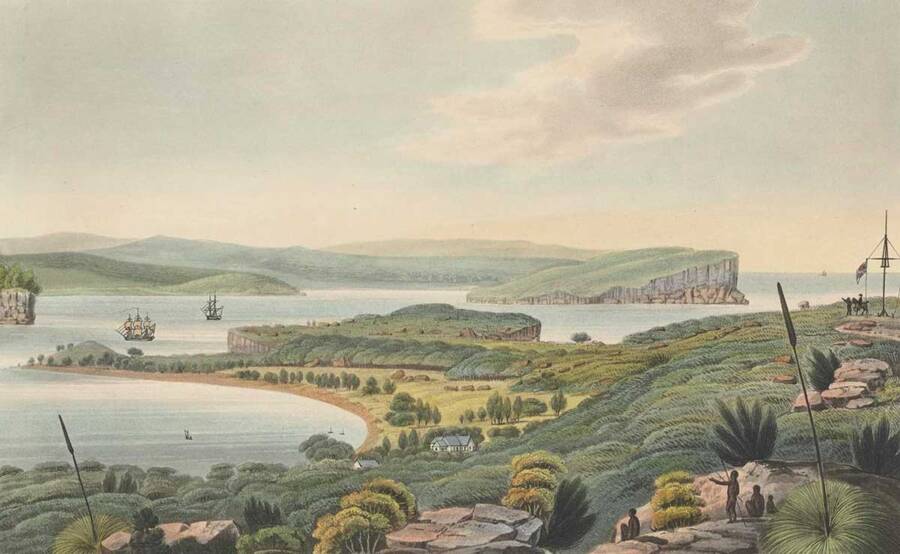
Art Gallery of NSWA depiction of the entrance to Sydney Harbour, Australia by Joseph Lycett circa 1822.Soon after Royal Navy officer and explorer James Cook first surveyed Australia, Britain sent 11 ships to settle the continent in 1788. Once the ships reached shore and the Union Jack was raised, a wave of terror began to devastate the continents Indigenous people.Smallpox tore through the Aboriginal population, especially in and around Sydney, causing untold thousands of torturous deaths. Historians have long remained uncertain about the source of the outbreak. Now, researchers believe theyve proven that the 1789 smallpox epidemic began, beyond a shadow of a doubt, with the First Fleet of British colonists and that the death toll was far worse than previously thought.The British First Fleet That Likely Caused Australias 1789 Smallpox OutbreakDue to the fact that there were no documented cases of smallpox on the First Fleet of British colonists, historians had long argued that the outbreak could not have been triggered by those ships. Instead, it was said that the disease must have come to the continent from the northern coast, through contact with Makassan fishermen from Indonesia.Mitchell Library, State Library of New South WalesA 1786 portrait of Captain Arthur Phillip, the commander of the First Fleet.However, as described in a recent study published in Nature Human Behavior, researchers tested this earlier hypothesis using computer models that incorporate death rates, travel routes based on water availability, Aboriginal language group data, and population density comparisons between Sydney and Australias northern coast.Ultimately, the modeling revealed that if a smallpox epidemic did originate in the northern coast of the continent, it would have dwindled before reaching Sydney Harbor.No matter how bad we assume the disease to be, it couldnt have made it from the north to Sydney at the right time, Flinders University ecologist Corey Bradshaw, a co-author of the paper, said to Science.Pictorial Press Ltd/AlamyResearchers believe that the British First Fleet brought vials of smallpox scabs with them to Australia.Alan Williams, another study co-author and archaeologist, told Live Science that, although there were no recorded smallpox cases on the First Fleet, the source of the outbreak was likely vials of dried smallpox scabs that medics kept for inoculations (a kind of pre-vaccine).Furthermore, Williams said that the scabs were probably replenished at various stops along the way from Portsmouth, England to Botany Bay, Australia to keep the virus alive.There is very strong evidence that it was the First Fleet, study co-author Matthew Cody Nitschke told Live Science, regarding the source of the 1789 outbreak.How This Study Debunks Earlier Ideas About The Devastation Of Australias Indigenous PopulationResearchers estimated that 220,000 Aboriginal people died from the 1789 smallpox outbreak, which was under-documented by early 20th century Australian authorities. The study also refers to a related preprint paper that further shows how smallpox and other repercussions of colonization took a greater toll on the Aboriginal people than previously believed.Previous researchers had estimated that precolonial Australia was home to somewhere between 200,000 and 800,000 Indigenous people, based on reports collected in the late 1800s.Theres been an assumption that Aboriginal populations were quite low and their activities were ephemeral and transient, Williams told Science.National Gallery of Australia, CanberraResearchers estimated that about 220,000 people died from the 1789 smallpox outbreak.In the preprint paper, however, the same research team used radiocarbon dating at archaeological sites in Australia, population growth modeling, and modern genetic analysis of people of Aboriginal descent to suggest that the population of pre-colonial Australia was much higher at the time of the First Fleets arrival likely about 2.3 million.This finding debunks a common narrative that, when the First Fleet landed on the shore of Australia, the land was not densely populated, and that the few inhabitants that were there vanished quickly after the first colonists came.The smallpox story was a way that the British could say that there were no more of us in those early times, that everybody was wiped out. We want to undo the myth, Shane Ingrey, a co-author of both papers whose Indigenous ancestors lived around Sydney Harbor, said to Science.Wikimedia CommonsThis study seeks to upend the idea that there were only very few Aboriginal Australians present when the British first arrived.Neither study addresses the question of whether these early British colonists knew that they were exposing the Aboriginal people to smallpox. That would only make this an even darker episode in the decades-long genocide of Australias Indigenous people.Although there is no record of an intentional plan to infect the Indigenous people with the disease, this unfortunately was likely the case when British colonists brought smallpox to the New World, which caused catastrophe among the Indigenous populations there.It would be devastating to find out it was intentional, Australian National University historian Ann McGrath, who was not part of the research team, told Science. But the whole colonial project was intentional and damaging enough without proving smallpox was intentionally spread.After reading about how early British colonists likely caused the smallpox outbreak that devastated Australias Indigenous population, discover research that shows people lived in Australia 120,000 years ago, 55,000 years earlier than previously thought. Then, learn about Pemulwuy, the Aboriginal resistance fighter who led attacks against early British colonists.The post We Want To Undo The Myth: Study Reveals True Toll Of 1789 Smallpox Epidemic Inflicted Upon Aboriginal Australians By British Colonists appeared first on All That's Interesting.
0 Σχόλια
0 Μοιράστηκε
22 Views

 English
 Arabic
 French
 Spanish
 Portuguese
 Deutsch
 Turkish
 Dutch
Dutch
 Italiano
 Russian
 Romaian
 Portuguese (Brazil)