


ALLTHATSINTERESTING.COM
The Incredible Adventures Of John Colter, The Mountain Man Who Explored The American West
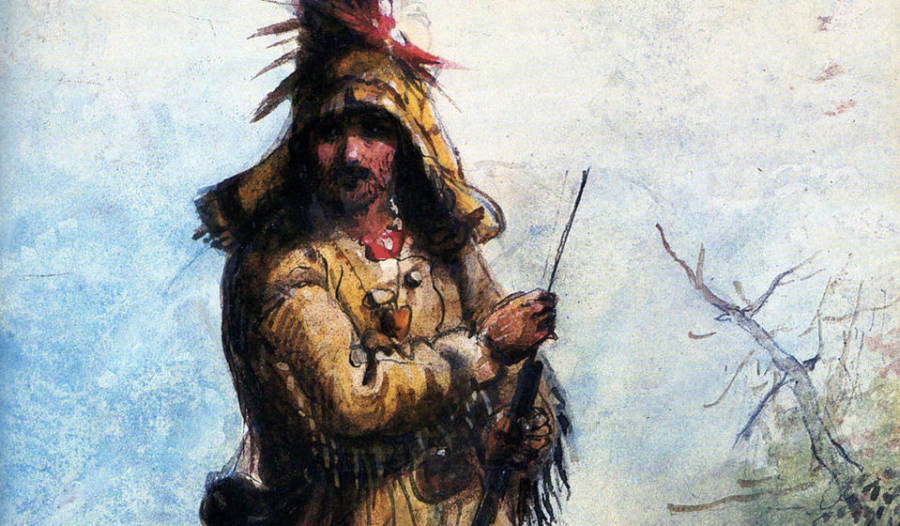
Wikimedia CommonsAn illustration of a 19th-century mountain man.At the dawn of the 19th century, John Colter marched into the West and never looked back. He supported the Lewis and Clark Expedition as a hunter and scout, spent years as a trapper and a guide, and developed a reputation as one of the nations first mountain men.Along the way, he became one of the first white men to step foot in Yellowstone, and had a number of near misses with Native Americans. During a famous encounter known as Colters Run, he was forced to run naked from a band of Blackfeet warriors, and narrowly escaped with his life.Though his story is little-known today, John Colter was an important figure in the American West, a mountain man who embodied the regions rugged individualism and survived thanks to his skill as a trapper, hunter, and guide. John Colter And The Lewis And Clark ExpeditionLittle is known about John Colters childhood. He was born around 1775 in Virginia, but didnt enter the historical record until 1803. Then, Colter joined Meriwether Lewis and William Clark in their expedition to explore the American West. They were looking for good hunters, stout, healthy, unmarried men, accustomed to the woods and capable of bearing bodily fatigue in a pretty considerable degree, and Colter fit the bill. He officially joined the Lewis and Clark Expedition on Oct. 15, 1803. The expedition, commissioned by President Thomas Jefferson, sought to explore territory that the United States had acquired from the Louisiana Purchase. The deal had effectively doubled the size of the country, and Lewis and Clark were tasked with finding out what exactly the U.S. had just bought.Wikimedia CommonsNative American guide Sacagawea directs Meriwether Lewis and William Clark during their journey.Initially, Colter made a bad impression. As Discover Lewis and Clark notes, he got in trouble for getting drunk with other expedition members at Camp Dubois in Illinois and he may have even threatened to shoot another man.But Colter quickly proved his worth. His ability as a navigator, scout, and hunter proved invaluable to the expedition, and the National Park Service notes that Colter was mentioned more than 200 times in the Lewis and Clark journals because of his hunting abilities. Colter was also adept at making connections with Native Americans who the expedition encountered.As the expedition made its way back toward civilization, however, a chance encounter convinced John Colter to stay in the West. He and the party met a pair of fur trappers named Forrest Hancock and Joseph Dickson, and in the summer of 1806, Colter decided to follow them toward Yellowstone.Public DomainA map of the Lewis and Clark expedition.Lewis and Clark allowed him to leave the expedition early, writing that they wished Colter every Suckcess.Exploring The West With A Group Of Fur TrappersIn August 1806, John Colter set out with Hancock and Dickson. Their partnership was ultimately short-lived by the spring of 1807, Colter was paddling along the Missouri River alone. He soon crossed paths with Manuel Lisa, a fur trader who had created the Missouri Fur Company. Colter guided Lisa and his men into present-day Montana, and Lisa and the others constructed Fort Raymond near the mouth of the Bighorn River. This was among the first trading posts in the region, and Lisa sent Colter and several others to alert Native Americans. Traveling light, Colter wandered hundreds of miles. He is believed to be the first white man to cross the region that became Yellowstone National Park, and Colters report of the steaming mineral springs he encountered led his fellow trappers to dub it Colters Hell. Jeff the quiet/Wikimedia CommonsColters Hell today.However, John Colter is perhaps best known for an encounter he had with Blackfeet warriors in 1809, known today as Colters Run.The Harrowing Story Of Colters RunBy that year, Colter had teamed up with John Potts, a comrade from the Lewis and Clark expedition. They were working along the Missouri River, trapping beavers, when one day they were confronted by Blackfeet warriors.Public DomainA depiction of a Blackfeet warrior.[T]hey suddenly heard a great noise, resembling the trampling of animals; but they could not ascertain the fact, as the high perpendicular banks on each side of the river impeded their view. Colter immediately pronounced it to be occasioned by Indians, and advised an instant retreat; but was accused of cowardice by Potts, who insisted that the noise was caused by buffaloes, and they proceeded on, John Bradbury, a British naturalist who heard the story from Colter in 1811, later recounted. But Colter was right sure enough, a group of Blackfeet warriors soon appeared. Colter steered their canoe to shore and got out, but Potts pushed the canoe away from the shore and was shot with an arrow. He responded by killing one of the Native Americans with his rifle and was immediately shot with arrows. According to Colter, he was made a riddle of. The Blackfeet then stripped Colter of his clothes. Thanks to his travels, he understood some basics of the Blackfeet language, so he listened as the Blackfeet argued about what to do with him. At first, someone suggested tying him up and using him as target practice. But one of the elder warriors had a better idea. They would hunt him. Colter was then told to run. With hundreds of warriors in pursuit, John Colter raced across the prairie. He was fast, but he knew he couldnt keep up the pace for ever. Once he had gained ground to a considerable distance he looked behind him and saw that just one warrior remained. So Colter suddenly stopped and turned around. As Bradbury later wrote:Denver Public Library Western History CollectionsA depiction of Colters Run. The Indian, surprised by the suddenness of the action, and perhaps at the bloody appearance of Colter, also attempted to stop; but exhausted with running, he fell whilst endeavouring to throw his spear, which stuck in the ground, and broke in his hand. Colter instantly snatched up the pointed part, with which he pinned him to the earth, and then continued his flight.John Colter had survived, but barely. He walked 200 miles back to Fort Raymond a grueling journey which took a week and a half and arrived on the brink of death. John Colter Becomes A LegendJohn Colter stayed in the West a bit longer following Colters Run. But after several of his companions were killed by the Blackfeet, he decided to returned to civilization. In the spring of 1810, he arrived in St. Louis. Paul Hermans/Wikimedia CommonsA memorial to John Colter in Cody, Wyoming.Though he had spent seven years in rugged American frontier, routinely escaping danger and death, Colter seemed at peace to those who knew him. One man remarked that Colter wore an open, ingenious, and pleasing countenance of the Daniel Boone stamp. Nature had formed him, like Boone, for hardy endurance of fatigue, privation, and perils.However, John Colter wouldnt live in civilization for long. After getting married around 1811, he enlisted to fight in the War of 1812, then died of jaundice (either in May 1812 or November 1813). His story is little-known today, but John Colter remains one of the legendary figures of the early American West. Because of his rugged individualism, ability to survive deep in nature, and his many adventures, hes also considered one of the nations first mountain men. Its a fitting description for someone who seemed happiest in the wild, and who spent many of his days wandering the unfurling American frontier. After reading about the many adventures of John Colter, one of the nations first mountain men, look through these astounding survival stories from around the world. Or, learn the true story of Grizzly Adams, the California mountain man who trained grizzly bears.The post The Incredible Adventures Of John Colter, The Mountain Man Who Explored The American West appeared first on All That's Interesting.
0 Kommentare
0 Geteilt
15 Ansichten

 English
 Arabic
 French
 Spanish
 Portuguese
 Turkish
 Dutch
Dutch
 Italiano
 Russian
 Romaian
 Portuguese (Brazil)
 Greek
Greek