WWW.THEHISTORYBLOG.COM
Miraculous Florentine fresco restored
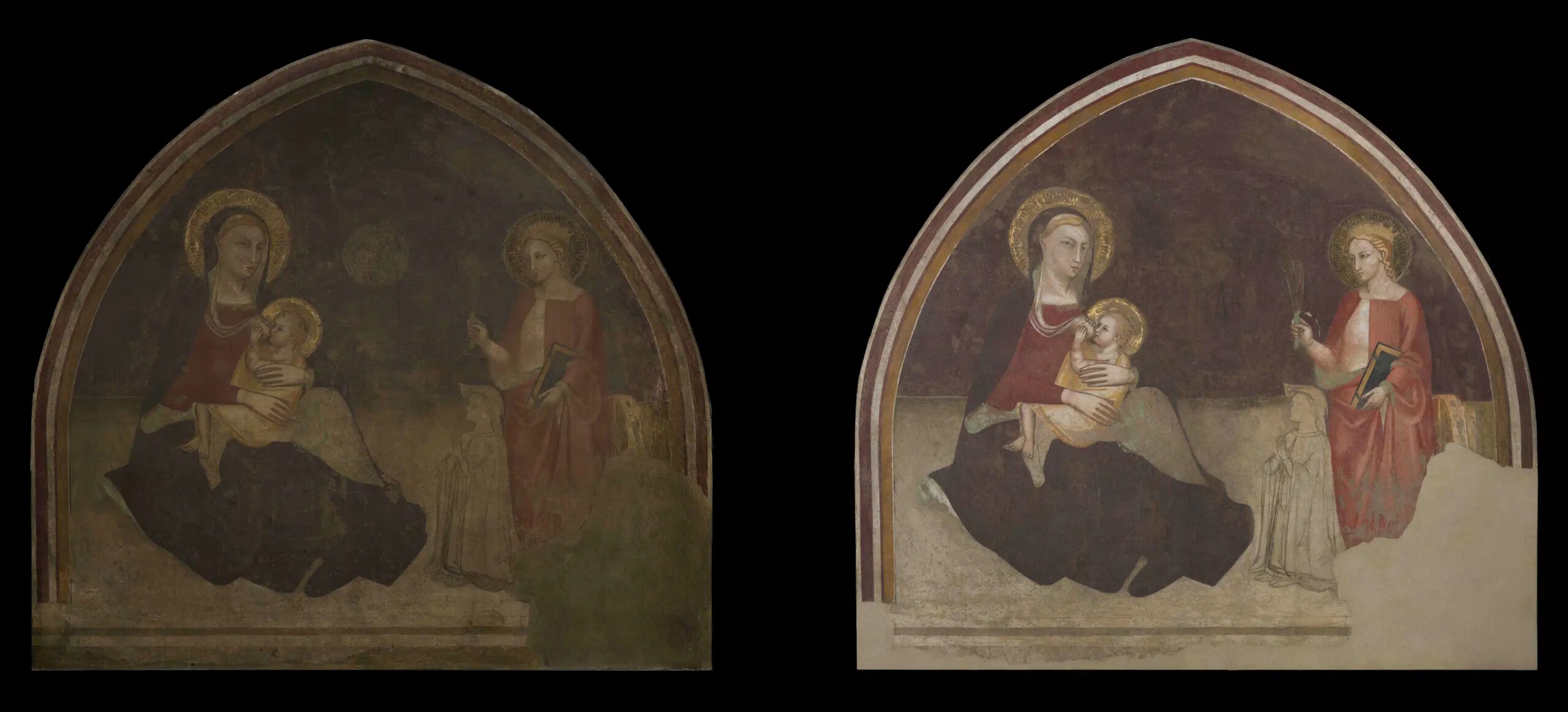
The late medieval fresco of the Madonna della Pura in Florences Basilica of Santa Maria Novella, venerated for hundreds of years as miraculous, has been restored.The fresco depicts the Virgin Mary nursing the Christ child with Saint Catherine of Alexandria on the side next to a smaller en grisaille portrait of the patron who commissioned the work. According to tradition, it was originally placed in the Della Luna familys burial vault in the cemetery on the eastern wall of the basilica, the fresco became an object of devotion when the Virgin Mary appeared before children playing the cemetery and asked them to clean the dust and spiderwebs off the painting.The importance attributed to the event is evidenced by the speed with which the cult developed. In fact, within a year of the alleged miracle, a first altar was built in front of the image. A devotion to the so-called children of purityso named in reference to the purity evoked by the Marian figuretook such firm hold that it convinced the Dominicans to grant the Ricasoli family permission to build a chapel designed to house and showcase the fresco. The new chapel was completed in 1476 and represented a significant architectural and artistic achievement. The image was incorporated into an elegant aedicule designed by Giovanni di Bertino, conceived according to a sophisticated perspective and characterized by references to classical architecture. From that moment on, the Madonna della Pura became one of the most significant objects of Marian devotion at Santa Maria Novella, maintaining a central role in the spirituality of the Dominican complex over the centuries.Previous attempted conservations were highly invasive, most significantly in the 1950s when the fresco was detached from its original wall and remounted on a new backing. There was also extensive repainting of the flesh tones using pigments that over time have become discolored. The three-layer Masonite backing is still in good condition and structurally stable, but the painted surface had deteriorated over time. Dust and particulate matter from smoke and other materials were stuck to the surface and left scratches. Areas of loss that had been covered with stucco in previous restorations were overly large and marred the readability of the image.Restorers began by dry cleaning the surface with soft brushes and low-power vacuuming to remove loose particle deposits. Next they wet cleaned the surface with natural sponges moistened with demineralized water. This simple treatment greatly improved the palette, restoring the original lightness of the piece. For the retouched, discolored flesh tones, conservators applied Japanese paper soaked in a solution of ammonium carbonate to soften and rehydrated the pigments. They were then removed with cotton swabs soaked in demineralized water.The stucco patches were handled by paring down the mismatched edges with scalpels and micro-chisels. Any gaps exposed were filled with a modern material: aged lime putted and silica sand. This time the fill was applied meticulously only inside the gaps instead of having overlapping edges like the stucco repair had.Loss areas were then lightly filled with watercolors. This makes the places where the original paint is gone look much less obvious, but at the same time it is still clear what is original and what has been added. Modern conservation principles dont attempt to hide any changes that were made. The idea is to show your work, as subtly as possible, of course, and ensure whatever adaptations you make can be reversed.The results of the restoration have restored a more authentic perception of the fresco. The removal of the 20th-century overpainting made it possible to restore the proper chromatic balance of the flesh tones and to bring to light pictorial details that had been obscured by alterations and deposits accumulated over time. The cleaning process has also highlighted the quality of the works execution, allowing for a clearer understanding of the artists technical and stylistic choices. At the same time, the restoration has reinforced the images devotional function, restoring to the faithful and visitors a work that once again expresses its spiritual significance more effectively.
0 Compartilhamentos
30 Visualizações




 English
 Arabic
 French
 Spanish
 Deutsch
 Turkish
 Dutch
Dutch
 Italiano
 Russian
 Romaian
 Portuguese (Brazil)
 Greek
Greek