Name of 8th c. Maya astronomer deciphered
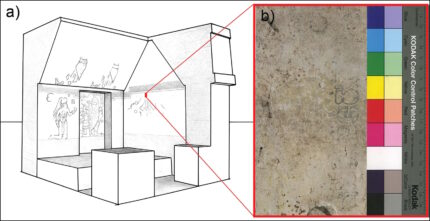
A text of Maya glyphs painted on a Classic period (250900 A.D.) building at the ancient site of Xultun, Guatemala, has been discovered to record an astronomical formula that concludes with the name of its author: so says Sak Tahn Waax (meaning White-Chested Fox). He is the first mathematician and astronomer in the Americas known by name.Mathematics and astronomy were highly regarded subjects of scholarship in Maya society, studied by scribes and religious figures and used to predict astronomical phenomena and guide human calendars and activities to move in concert with heavenly cycles. Complex mathematical and astronomical calculations played an important role in Maya culture during the Classic period, and are referred to in official inscriptions on murals, stelae and ritual offerings.As an astronomer and mathematician, White-Chested Fox would have observed natural cycles and made calculations the political and religious elite then used to make major decisions, like when to crown a king or build major public monuments on the Maya 260-day ritual calendar.The inscription was first discovered in 2010 when archaeologists found a looters tunnel that exposed part of a mural. They excavated the hole and uncovered a large chamber with murals on the wall. On the inner east wall, a layer of plaster was applied and microtext glyphs written on it. The paint was heavily faded, so the team scanned, drew and photographed the microtexts so they could be digitally enhanced for legibility. In total, they were able to identify 52 mathematical and astronomical texts on that one wall.Massachusetts Institute of Technology archaeologist Franco D. Rossi and lead author of the research paper published in the journal Antiquity, found the key clue to decipher the inscription. He recognized it as a celestial chronology and together with the research team was then able to figure out that the glyphs recorded the time it took for plants to return to a given position after a turn around the sun. White-Chested Fox took these individual observations and combined them into one mathematical formula, then signed his work.Significantly, these inscriptions appear to be rough draft calculations for the content of codices produced by the Maya within the residential complex. The researchers liken this discovery to finding a sketch of a great work of art. The team also unearthed papermaking tools in and near the chamber, suggesting that it may have been a place where people were trained in calendrical calculationsbased on the titles of scribes shown in the wall paintings. []Rossi notes that, for the moment, only a handful of the chambers often highly eroded texts have been fully analysed and deciphered. This makes the continued analysis of all the microtexts a focus for future research. The team also hopes to identify the different scribal hands at work in the painted chamberit is possible that Sak Tahn Waax wrote other texts there, tooand they plan to continue their archaeological survey and documentation across the city of Xultun, of which 900 hectares of urban zone remain covered by forest.




 English
 French
 Spanish
 Portuguese
 Deutsch
 Turkish
 Dutch
Dutch
 Italiano
 Russian
 Romaian
 Portuguese (Brazil)
 Greek
Greek