


ALLTHATSINTERESTING.COM
The Body Of Green Boots Has Served As A Macabre Guidepost For Mount Everest Climbers For 30 Years. Now, His Identity Was Just Unveiled
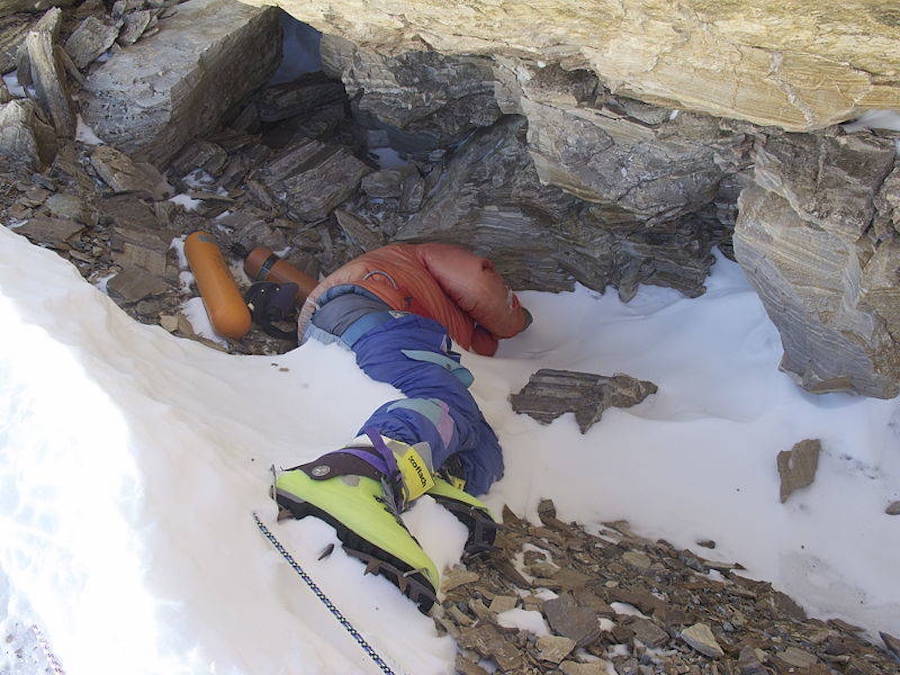
Wikimedia CommonsNow identified as Dorje Morup, Green Boots long served as a macabre landmark for climbers attempting to summit Everest.Reaching the peak of Mount Everest ranks among the most difficult treks in the world. And for many climbers whove achieved this feat in recent decades, one macabre landmark has signaled that they had finally almost reached the top: the frozen body of a fallen fellow climber.Huddled in a small cave near the trail on the North Face at 27,900 feet was the body of a long-dead climber known only as Green Boots. Until 2014, when a Chinese expedition reportedly moved his body to a less conspicuous location, climbers would walk right by Green Boots on their way to the top.Perhaps the most infamous of the more than 200 corpses that sit on Mount Everest to this day, Green Boots was long believed to have been Tsewang Paljor, one of three Indo-Tibetan Border Police officers who perished in a 1996 blizzard that led to the deaths of eight climbers.But after recent DNA testing, the Indian government identified Green Boots as Dorje Morup, one of the other officers that attempted to reach the top alongside Paljor on that fateful day in 1996.This is the haunting story of Dorje Morup and the mystery surrounding Green Boots.Mount Everests Green Boots Corpse Is Identified As Dorje MorupIndo-Tibetan Border PoliceGreen Boots has been identified as Dorje Morup, who perished in the 1996 Mount Everest blizzard.Recently-issued Indian government documents detail its plan to finally bring Green Boots down the mountain, 30 years after his death. In the documents, the government identifies the body as belonging to Dorje Morup and not Tsewang Paljor, which was concluded after DNA testing using evidence retrieved during a prior expedition.Now, the governments plan is to recover the body of Dorje Morup and deliver him to Delhi by October 2026. The government is putting together a highly specialized team to complete the mission, with at least six Sherpas who have successfully summited Mount Everest several times before.Dozens of bodies have been left on Mount Everest due to the great cost of retrieving them, which could be upwards of $75,000. Theres also great difficulty in pulling a body down from the Death Zone, which is anything above 26,200 feet near Everests peak. Up there, oxygen levels are dangerously low and temperatures are dangerously frigid.The Chinese side of Mount Everest, where Dorje Morup perished, is especially hard to navigate due to logistics with the Chinese government as well as particularly difficult terrain.Wikimedia CommonsThe North Face of Everest where Green Boots is located has more difficult terrain than the South Face.Historically, the bodies have stayed up there, especially if theyre above Camp IV, like Green Boots. Its really technical on the ridge up there. You cant just drag a body; they have to be carried, Everest guide Willie Benegas told Outside.The mission will also be dangerous because the extraction window by October 2026 lies within Everests monsoon season. During this time, almost all commercial expeditions pause their climbs due to the blinding storms that sweep the mountain. In fact, this very kind of destabilizing wind and snowfall is precisely what led to the death of Dorje Morup 30 years ago.How Dorje Morup And Tsewang Paljor Died During The 1996 Mount Everest DisasterWikimedia CommonsThe position of Dorje Morup, a.k.a. Green Boots, near the summit of Mount Everest, marked here by 1st.A calamity that left eight climbers dead, the Mount Everest disaster of May 1996 was one of the deadliest events in the mountains history.On May 10, 1996, Dorje Morup, alongside fellow officers Tsewang Paljor and Tsewang Smanla, set out to become the first Indian expedition to summit the mountain from the North Face.The team had gotten a late start on their climb, but they were determined to reach the summit before dark. This decision has since been criticized, as it is standard practice to turn around if it is impossible to reach the top before 2 p.m.In fact, the men had radioed their commander, Mohinder Singh, at around 3 p.m. to say they were almost at the peak. When Singh ordered them to turn around, they refused. The three continued on to the summit, and at around 5:30 p.m., they had supposedly reached it, and then began their descent.Find a GraveLong misidentified as Green Boots, Tsewang Paljor likely froze to death or perished from lack of oxygen.At this point, a blizzard struck the mountain, and in the ensuing darkness, visibility was almost at zero. The three officers were never heard from again.Five other people also died on Everest between May 10 and 11, 1996, including Rob Hall and Scott Fischer. Meanwhile, their fellow climber Beck Weathers walked away from the disaster with one of the most incredible survival stories of all time.When the storms calmed and skies cleared, Green Boots was found in a cave at 27,900 feet, wearing those bright green boots for which the body became infamous. After the disaster, and for the last 30 years, it was commonly reported that Green Boots was Tsewang Paljor, but this was never confirmed. But we now know that Green Boots was in fact Dorje Morup.The mystery of the identity of Green Boots has been solved. The next mission is bringing Dorje Morup home.After reading about the confirmed identity of the Mount Everest corpse Green Boots, discover the story of George Everest, the mountains namesake. Then, learn about George Mallory, whose body was discovered on Mount Everest more than 70 years after his disappearance there in 1924.The post The Body Of Green Boots Has Served As A Macabre Guidepost For Mount Everest Climbers For 30 Years. Now, His Identity Was Just Unveiled appeared first on All That's Interesting.
0 Comments
0 Shares
24 Views

 Arabic
 French
 Spanish
 Portuguese
 Deutsch
 Turkish
 Dutch
Dutch
 Italiano
 Russian
 Romaian
 Portuguese (Brazil)
 Greek
Greek