


WWW.THECOLLECTOR.COM
The Self-Taught Genius of George Boole Who Changed Mathematics
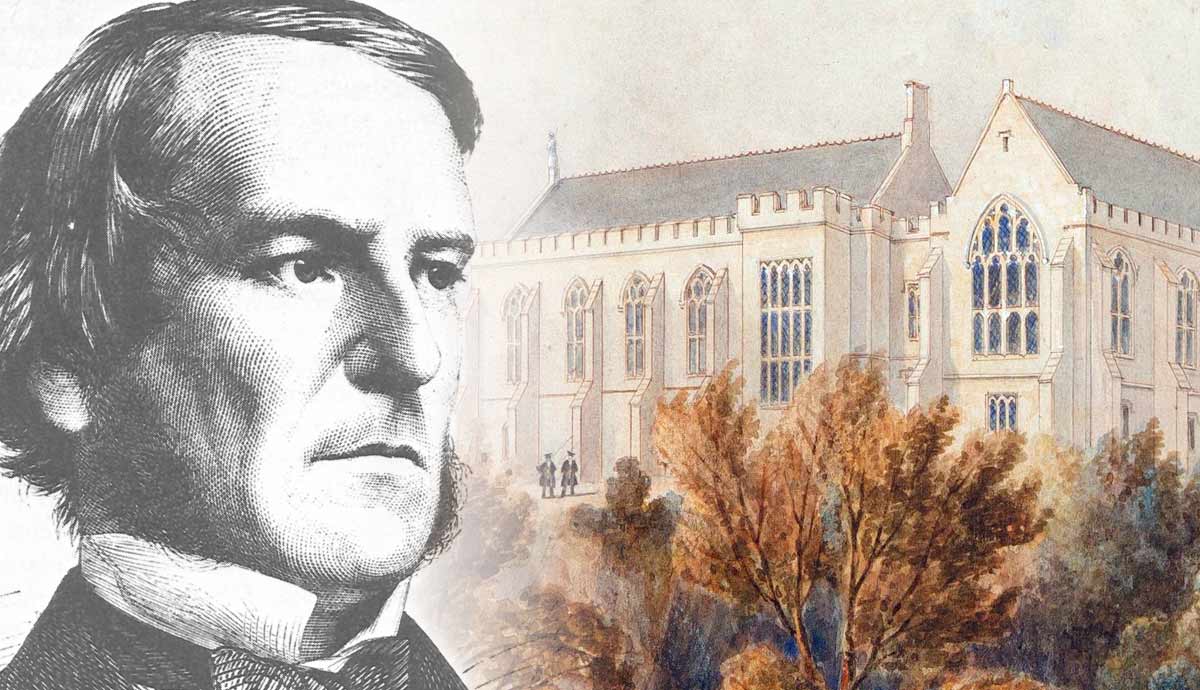
George Boole is an unknown name for many people, especially those unfamiliar with the history of science and mathematics.But despite his relative obscurity, this ingenious mathematician holds a significant place in the history books. His humble beginnings did not hold him back from achieving great things, for Boole was capable of learning complex mathematics without a mentor.With his pioneering ideas, Boole advanced the fields of logic and algebra, laying the foundation for modern computer technology.George Booles Early Life in the City ofLincolnLincoln Cathedral from the North-West by Frederick Mackenzie, 1850. Source: Victoria and Albert MuseumThough Boole came to prominence in the Victorian era, his childhood took place in the final chapters of the Georgian era during the reigns of King George III and King George IV.George Boole was born in the English city of Lincoln on November 2, 1815, and was baptized a day later in Swithins Church. He was the first of four children and had a relatively poor upbringing as the son of a cobbler (shoemaker), John Boole.Alongside his work as a cobbler, John had a passion for mathematics and science. He passed on this passion to his oldest son, who soon established himself as an intellectual youngster. A minister who worked at Swithins Church also played a part in Georges mathematical journey by lending him a book on Calculus. The young Boole had a knack for languages, too, for he studied German, Greek, and Latin as a teenager.At just sixteen years old, George started working as a teaching assistant at a school in Doncaster, Lincolnshire. He also briefly took up a teaching post in Liverpool. He was the primary breadwinner for the family during this time, supporting his parents and his three younger siblings, Charles, William, and Mary.Contrary to what one might expect, the young mathematician never attended university, at least not as a student. British universities were very exclusive at the time. Instead, Boole decided to set up his own schools instead. One of the schools was located close to Lincoln Cathedral, while another was established on Free School Lane.Published Work and Wider RecognitionPhotograph of Augustus De Morgan by Maull & Polyblank, c. 1860s. Source: National Portrait GalleryIn 1833, a technical institute was founded in Lincoln, and Boole obtained access to the reading room. Here, he used the available references to study higher mathematics. He accomplished this without any assistance, learning complex branches of study all by himself. This ability to understand advanced topics independently remains one of the most remarkable aspects of the great mathematician.Booles first published work appeared in the Cambridge Mathematical Journal in February 1840, just a few years into the reign of Queen Victoria. The paper was called Researches in the Theory of Analytical Transformations, with a Special Application to the Reduction of the General Equation of the Second Order.This led to a close friendship with the Scottish mathematician Duncan Gregory, the editor of Cambridge Mathematical Journal. Gregory himself was an important mind in the mathematical community, having studied at Cambridge University and published many of his own papers on operational Calculus. Boole and Gregory remained friends until the latters untimely death in 1844.Portrait of George Boole by an unknown illustrator, c. 1865. Source: Wellcome Collection / Linda Hall LibraryThe same year, Boole published another paper entitled On a Method of Analysis. The paper helped pave the way for operation theory and led to the first gold prize for mathematics from the Royal Society. While this was all very impressive, Boole was only just getting started with his pioneering ideas.In 1847, he published his first book, The Mathematical Analysis of Logic. Frequently cited as the origins of modern symbolic logic, Booles book showed how it was a branch of mathematics and introduced the revolutionary idea that symbols could represent objects, not just quantities.The Mathematical Analysis of Logic also developed a method for expressing algebraic rules of syllogistic reasoning. Other mathematicians from history, including the great Gottfried Wilhelm Leibniz, had failed to do this.Augustus De Morgan is another prominent name in Booles life. De Morgan first corresponded with Boole in 1842. He was an impressive mathematician in his own right and helped Boole proofread and prepare his papers for publication.Professor of Mathematics inIrelandQueens College Cork by Robert Lowe Stopford, c. 1850. Source: University College CorkWith the publication of Mathematical Analysis of Logic, Booles reputation grew considerably in the mathematical community. This enhanced reputation helped him become the Professor of Mathematics at Queens College, Cork, in Ireland. He took up this position in 1849, the year the college was formed.Ireland, having come through the worst of the Great Famine, was in a better place than it had been for several years. While Cork was not a major intellectual center, Booles new position was much more suitable for his reputation than his previous job as a schoolmaster. Whats more, having recently lost his father and found suitable provisions for his mother, Boole was free from his role as the family provider and could finally focus on his own life, both professionally and personally.Booles annual salary of 250 was supplemented by a 2 tuition fee every term from each of the students he taught. He graded all of the homework assignments himself, for he had no assistant to help him.Alongside his work at the university, Boole found time to write another book: An Investigation of the Laws of Thought (1854). Considered the mathematicians seminal masterpiece, the book was a key milestone in the history of computer science. Within its pages, Boole reduced logic to an algebra of true and false variables. This influenced many of his mathematical contemporaries, including Charles Babbage, John Venn (the inventor of the Venn diagram), and Augustus De Morgan.A few years after the publication of An Investigation of the Laws of Thought, an economist and logician called William Jevons built a logic piano for doing calculations. Limited to just four propositions, it wasnt a particularly useful device, but it was the first mechanization of what we now call Boolean logic.A Young Wife and a TalentedFamilyPhotograph of George Boole by an unknown photographer, c. 1840s. Source: University College CorkIn 1855, Boole married Mary Everest, the daughter of a clergyman and the niece of Lieutenant-Colonel Sir George Everest, the British surveyor whose name was given to the great Himalayan mountain.She was also the niece of Booles colleague John Ryall, who was Vice President and Professor of Greek at Cork. It was this mutual connection that had led to the relationship in the first place.The couple had a happy marriage and produced five children, all of whom were daughters. Like their father, many of the girls were incredibly clever individuals with a knack for originality.The middle sibling, Alicia, possessed an amazing ability to visualize geometric objects in four dimensions and contributed her thoughts to A New Era of Thought (1888), a book written by the mathematician Charles Howard Hinton. In 1900, Alicia published a paper in which she described three-dimensional sections of four-dimensional regular polytopes.Lucy, meanwhile, was a chemist and a pharmacist who wrote a paper for the Royal Society with the help of fellow chemist Wyndham Dunstan. Lucy also earned a place in the history books by becoming the first female professor at the London School of Medicine for Women.Ethel, the youngest daughter, went down a more creative pathway. She grew up to be a prolific novelist, with her most famous work being The Gadfly (1897). Set in the 1840s, the story takes place during the Italian Risorgimento, also known as the Unification of Italy.Some of Booles grandchildren also did well. Geoffrey Ingram Taylor followed in his grandfathers footsteps by becoming a mathematician and a member of the Royal Society. Leonard Stott, meanwhile, was a medical pioneer who invented a portable X-ray machine and a pneumothorax apparatus.Tragically, Boole didnt witness any of these achievements due to his untimely death.George Booles Death andLegacyPhotograph of Alan Turing by Elliott & Fry, 1951. Source: National Portrait GalleryBoole died at the age of forty-nine on December 8, 1864, in Cork.Toward the end of the previous month, the great mathematician had walked three miles from his home to the university. The weather conditions were poor, causing Boole to develop bronchitis after lecturing in wet clothes. The disease developed into pneumonia, and Boole died soon afterward. He was buried at Saint Michaels Church in Cork.Boole is an underrated figure in the vast catalog of influential inventors and scientists. Most people are familiar, at least to a certain extent, with the work of Isaac Newton, Thomas Edison, or Albert Einstein, but few have even heard of Boole. His greatest achievement was combining the branches of logic and mathematics. This was crucial for the development of computers. Booles symbolic logic was precisely what engineers required to design circuits for the digital age.Indeed, theres a direct connection between Booles work in the 19th century and the development of modern computers in the twentieth. Pioneers like Alan Turing (the English mathematician who cracked the German Enigma Machine during the Second World War) would not have achieved what they did had it not been for Boole. While Boole is more well-known in Lincoln and Cork, very few are aware of his place in the history of science and mathematics.
0 Commenti
0 condivisioni
2 Views

 English
 Arabic
 French
 Spanish
 Portuguese
 Deutsch
 Turkish
 Dutch
Dutch
 Russian
 Romaian
 Portuguese (Brazil)
 Greek
Greek