


WWW.THECOLLECTOR.COM
1993 Russian Constitutional Crisis: Yeltsins Showdown With Parliament
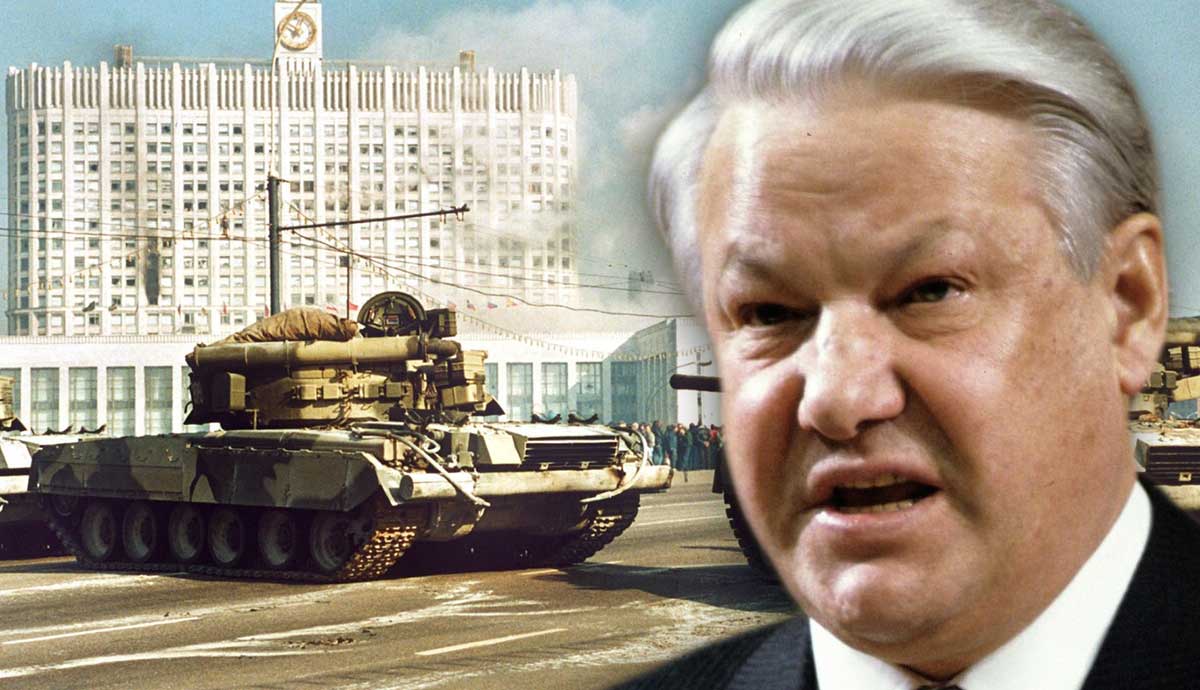
In the chaotic years that followed the collapse of the Soviet Union, the newly created Russian state was consumed by political turmoil. The culmination of this period was the 1993 Russian constitutional crisis. It was a showdown that claimed the lives of 147 people and was eventually brought to an end with military force. The confrontation showed how fragile Russias new democracy had become and set the course for the trajectory of the country over the next decade.Historical Context: The Collapse of the Soviet UnionBoris Yeltsin Waves the Russian Flag During the 1991 August Coup, 1991. Source: Wikimedia CommonsMany historians believe that the constitutional crisis of 1993, particularly its violent nature, was predicted by the August coup in 1991. The coup exposed the serious flaws in Soviet leadership, which Yeltsin used to gain support among the Russian people and portrayed himself as a hero of the Independence movement. Yeltsins famous speech outside the Russian Parliament Building in defiance of the hard-line communist coup made him a hero in the eyes of many people. After the coup failed, Yeltsin acted quickly as prime minister of Russia to dissolve the Communist Party and officially begin the process of dissolving the Soviet Union itself.The euphoria of Russian independence soon was replaced by chaos and uncertainty as the leaders of Russia were now faced with filling a power vacuum that had been left by 70 years of autocratic and centralized government. A political conflict was almost inevitable because of the improvised and contradictory nature of the political institutions that were set up in the wake of the collapse of the Soviet Union. One of the key sources of conflict was the Soviet Constitution of 1978, which was adopted by Russia but unfit to govern a nation in the post-Soviet world. The constitution caused a number of disputes over the separation of powers between the legislative and executive branches of government, which set the stage for the constitutional crisis of 1993.A Nation on the BrinkYeltsin Near a Polling Station During a Referendum of the Future of the Soviet Union, 1991. Source: Vladimir Vyatkin / Smart HistoriesDuring the early 1990s, Russia was constantly on the verge of political and economic collapse as it attempted to navigate the hardships left in the wake of the Soviet Union. The nations political structure, still stuck in the Soviet past, was pulled from either side by the two forces of the executive and legislative branches of government. Each branch claimed they had the constitutional power to set the countrys agenda, and the stage was set for a showdown.Boris Yeltsin was a passionate supporter of swift modernization and rapid change, which he saw as the only way to help Russia emerge from the post-Soviet period. However, his aggressive economic measures, which were characterized by his policy of shock therapy, brought about quick but painful changes in the market, which triggered runaway inflation that made the lives of everyday Russians miserable. In opposition to Yeltsins reformist approach was the Russian Parliament, which was dominated by officials from the Soviet era. These old Soviets grew wary of Yeltsin and began to demand that the executive powers of the presidency be checked by the Russian Constitution.The Road to Crisis: Causes and Build-upVice President of Russia Alexander Rutskoy, 1993. Source: KommersantOne of the key motivations behind the 1993 constitutional crisis was a fundamental disagreement between parliament and representatives over the direction, nature, and pace at which Yeltsin pursued constitutional reform to achieve his aims. Yeltsin argued that the newly independent Russian nation required a strong leader to navigate the challenging tides of transition; therefore, he advocated that the president be given more power to impose swift and decisive reforms. In contrast, the Russian parliament, which was made up mostly of conservative and nationalist officials, aimed to hold on to a significant amount of legislation or authority in order to check the growing power of the president.Between 1992 and 1993, the relationship between parliament and the presidency became increasingly hostile. A legislative impasse resulted in parliament preventing Yeltsin from carrying out several of his most important decrees. Russian Vice President Alexander Rutskoy became a key figure in support of parliament and became the de facto leader of the opposition against Yeltsin.The Constitution Controversy: Power StrugglesBoris Yeltsin in 1993. Source: RIA NovostiTo settle the dispute between parliament and the presidency, Yeltsin sought to dismiss the 1978 Soviet-era constitution in favor of a new document that would create a presidential republic. This new constitution would give the president broad executive authority, allowing Yeltsin to carry out his reform program without the permission of parliament.However, the Russian Parliament fiercely opposed Yeltins planned constitution as they believed such a document would give the executive overwhelming power to overrule the democratic checks and balances that the 1978 Soviet-era constitution had created. They saw Yeltsins proposal as a prelude to an authoritarian government that would stifle Russian democracy before it had a chance to flourish.In response to Yeltsins proposal, the Russian Parliament refused to pass any of the presidents proposed laws and reforms. To circumvent this, Yeltsin used a number of presidential decrees to get his laws passed. In retaliation, the Russian Parliament attempted to limit Yeltsins authority by passing laws that restricted his reforms and even approved the budget without his approval. As more members of the Russian parliament opposed Yeltsins orders, a string of legal and political disputes ensued, leaving the government in disarray and the country in chaos.The Confrontation: Decrees and Counter-DecreesCongress of Peoples Deputies of Russia, 1990. Source: DiletantThe Constitutional Crisis effectively began on September 21, 1993, when Yeltsin issued a presidential decree that dissolved parliament and triggered an election. This sparked the beginning of an open confrontation between the Russian president and the Russian Parliament. To justify his decree, Yeltsin claimed that the legislative branch was blocking important reforms that went against the best interests of the country. His actions were framed as a necessary step to prevent a national emergency and bring back order. However, there was widespread opposition to Yeltsins move, and many accused him of behaving unconstitutionally.In response to his decree, the parliament began the process of impeaching Yeltsin and declared his declaration invalid and unconstitutional. The crisis reached a dangerous stage when parliament declared Vice President Alexander Rutskoy the acting president of Russia. The leaders of the legislative group, Rutskoy and Chairman Ruslan Khasbulatov, further inflamed the conflict by calling on the military to back them in their opposition to Yeltsin.Constitutional instability deepened over the next few days as both sides issued a series of decrees and counter-decrees. The support of senior military officers, regional governors, the United States, and other Western countries emboldened President Yeltsin, and no compromise was made. As the situation worsened, the Russian Parliament Building, known as the White House, was turned into the center of resistance against Yeltsin, and the Russian Parliament sealed itself within the building in preparation for a siege.The Siege of the White HouseTanks Shelling The Russian Parliament Building, 1993. Source: Rabkor MagazineThe Constitutional Crisis reached a violent peak on October 3 when pro-parliament demonstrators arrived in Moscow, blockaded streets, and attempted to take control of the Ostankino television center. Yeltsin was forced to declare a state of emergency to regain control over the capital and demonstrate his authority. During the storming of the Ostankino TV tower, Russian military forces defended the building from huge crowds of protesters with deadly force. In total, 46 people were killed during violent clashes at the TV station.One day later, Yeltsin ordered the Russian armed forces to invade the Russian Parliament building and bring the crisis to an end. The White House was surrounded by tanks, and the parliament was attacked by heavy artillery. The resulting resistance within the building was quickly put to an end as the White House was consumed by flames.The leaders of the parliamentary faction, notably Rutskoy and Khasbulatov, quickly surrendered themselves to the military and were later taken into custody. The use of force to end the standoff highlighted how serious the constitutional crisis was and how far Yeltsin was prepared to go in order to maintain control. More than a hundred people died during the siege, which was one of the bloodiest days in post-Soviet Russian history and represented the ruthless end to parliamentary resistance to executive power.Aftermath: Victory and FalloutDemocratic Russia Activists Campaigned For The Pro-Yeltsin Slogan Yes-Yes-No-Yes Throughout The Country, 1993. Source: TASSAfter the Russian Constitutional crisis came to an end, the political and social culture of the nation experienced a profound change. Yeltsin quickly began consolidating his power and acted quickly to bring into force a new constitution that would give him broad authority. This new constitution dramatically changed how the Russian Federation was governed, giving the executive considerably more power than was even possible under the Soviet Union.The new constitution was given public legitimacy in a national referendum in December 1993. While the new constitution aimed to improve the stability of the government and free the executive branch from the obstructions of the legislature when implementing essential reforms, it also created a precedent for future executive overreach that would have serious consequences.The 1993 Russian Constitutional Crisis and how it was resolved had a significant impact on the trajectory of Russian democracy. Yeltsins strategy of dealing with the crisis by using violence and force set a precedent that would characterize the later years of his presidency and that of his successor Vladimir Putin. Moreover, the crisis contributed to a disillusionment with democracy and the peaceful political process.Legacy: Reflections on the CrisisCombat Squads Of Supporters Of The Russian Parliament During A Rally Near The Ostankino Television Center, 1993. Source: TASSThe political future of Russia was permanently changed by the Constitutional Crisis of 1993. Although Yeltsins victory brought short-term stability to the country, it also weakened legislative oversight and greatly increased presidential authority, planting the seeds for a slide toward autocracy and the end of democracy itself.The long-term effects are seen in the ongoing consolidation of power by the executive. The new constitution was used by Vladimir Putin to further solidify his hold on power, frequently at the expense of democratic institutions and civil rights. What happened in 1993 showed that parliamentary opposition could be overcome by strong executive action, which helped to foster a political climate in which stability and power were frequently valued above democratic procedures.
0 Comentários
0 Compartilhamentos
20 Visualizações

 English
 Arabic
 French
 Spanish
 Portuguese
 Deutsch
 Turkish
 Dutch
Dutch
 Italiano
 Russian
 Romaian
 Greek
Greek