How Hollywood Gets Medieval Cavalry Charges Wrong
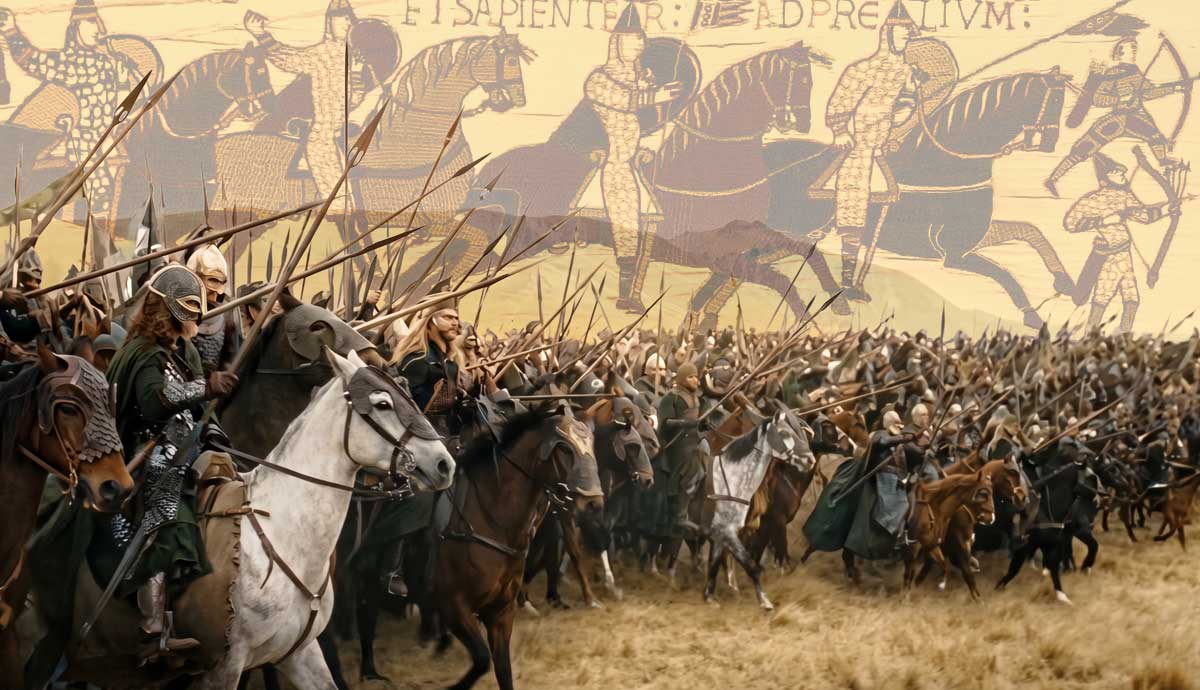
Hollywood never fails to entertain with a powerful display of knights on horseback, crashing into a line of terrified infantry. The images and sounds are visceral, with men screaming and the clash of steel upon steel as hundreds of horses charge headlong into the enemy at high speed, carving a deep wedge into the enemy formation. This powerful visual seems effective on screen, but it is full of poetic license that wouldnt work well on a real battlefield.In reality, the use of cavalry in medieval combat was far more nuanced. It relied on careful planning, immense discipline, and a large degree of psychology to be effective. And when it was effective, it was utterly devastating. The Myth of the Suicidal Horse CollisionVintage illustration of knights charging an infantry line at the Battle of Hastings in 1066. Source: iStockHorses are naturally skittish animals. Even well-trained warhorses are prone to instinctive responses in dangerous situations that humans can be trained to override. Historian Sir John Keegan noted that cavalry charges against disciplined, well-prepared infantry often failed because horses refused to gallop into a dense mass of enemies. When a mass of soldiers is wielding sharp objects, the prospect becomes even less appealing.The Ride of the Rohirrim from The Return of the King (2003). Source: Wingnut Films / New Line Cinema.While pikes were perfect for holding back cavalry, they were not the only option. Even before the age of the pike, infantry with spears and other polearms were easily able to resist cavalry charges. A perfect example of this is the Battle of Hastings in 1066, where the Anglo-Saxon shield wall stood firm against many attempts by the Norman cavalry to break through.Here, and in many battles before and since, the horses simply refused to impale themselves on spears. Which is quite reasonable from the horses perspective. In the age of the pike, the spears became ever longer and deadlier, putting a lot more distance between the charging cavalry and the defending infantry.So, with the refusal of horses to throw themselves onto a wall, bristling with spikes, how did the cavalry charge actually succeed? Much of the answer lies with psychology. Shock Tactics and Psychological Warfare on the BattlefieldDetail of the Battle of Orsha by Hans Krell, ca 1524-1530. Source: National Museum in Warsaw / Wikimedia CommonsFrom ancient to modern times, mass charges used shock tactics, relying heavily on breaking enemy morale and forcing soldiers to rethink the wisdom of standing in the path of 1000 lbs of equine fury. Throughout history, holding the line against mounted riders has always been a terrifying proposition. In the face of a wall of horses and mounted knights, all it takes is for a few infantrymen to break, for a gap to be exposed, which cavalry can then exploit.As such, cavalry had to break the enemy formation, not by force, but by psychology. A feigned charge could cause men to scatter, and a feigned retreat could cause infantry formations to break in pursuit, at which point the cavalry wheeled round and took advantage of the lack of infantry cohesion.Ultimately, it was a game of chicken in which the resolve of the infantry and the cavalry was tested until one side broke or miscalculated the others intentions.Norman knights depicted on the Bayeux Tapestry. Source: Wikimedia CommonsAlthough exceptions always exist, a solid line of cavalry seldom made contact with a solid line of unbroken infantry, and when it did, it was often catastrophic for the cavalry. Without a gap to exploit, cavalry would simply be impaled.In short, the general theme was that cavalry would charge at the infantry. If the infantry broke, the cavalry would press the attack. If the infantry stood firm, the cavalry would veer off at the last moment and reform to try again. Sometimes the cavalry would feign retreat to lure the enemy infantry out of formation, then turn and attack.Mass, Momentum, and Deadly PrecisionPolish Hussars at a re-enactment in Gniew, 2020. Source: iStockHollywoods full-pace cavalry charges are certainly spectacular, but full of creative interpretation, and often very far from reality. Approaching the enemy was far more disciplined and slower than on-screen depictions.The cavalry line was not haphazard. It was in the formation of cohesive, serried ranks of knights, slowly increasing speed, and breaking into a gallop at the last moment. Mass and momentum were key. Such discipline played into psychology, heightening the panic in the enemy. With lances presented, such a sight could easily cause individual soldiers to flinch, panic, and in some cases, run. If the infantry, even individuals, lost their nerve, gaps would open, and the cavalry would ride in, pushing soldiers aside and widening the wedge.If that happened, the infantry formation was doomed more often than not.




 English
 Arabic
 French
 Spanish
 Portuguese
 Deutsch
 Dutch
Dutch
 Italiano
 Russian
 Romaian
 Portuguese (Brazil)
 Greek
Greek