


WWW.THECOLLECTOR.COM
Why River Ironclads Were the Ultimate Secret Weapon of the Civil War
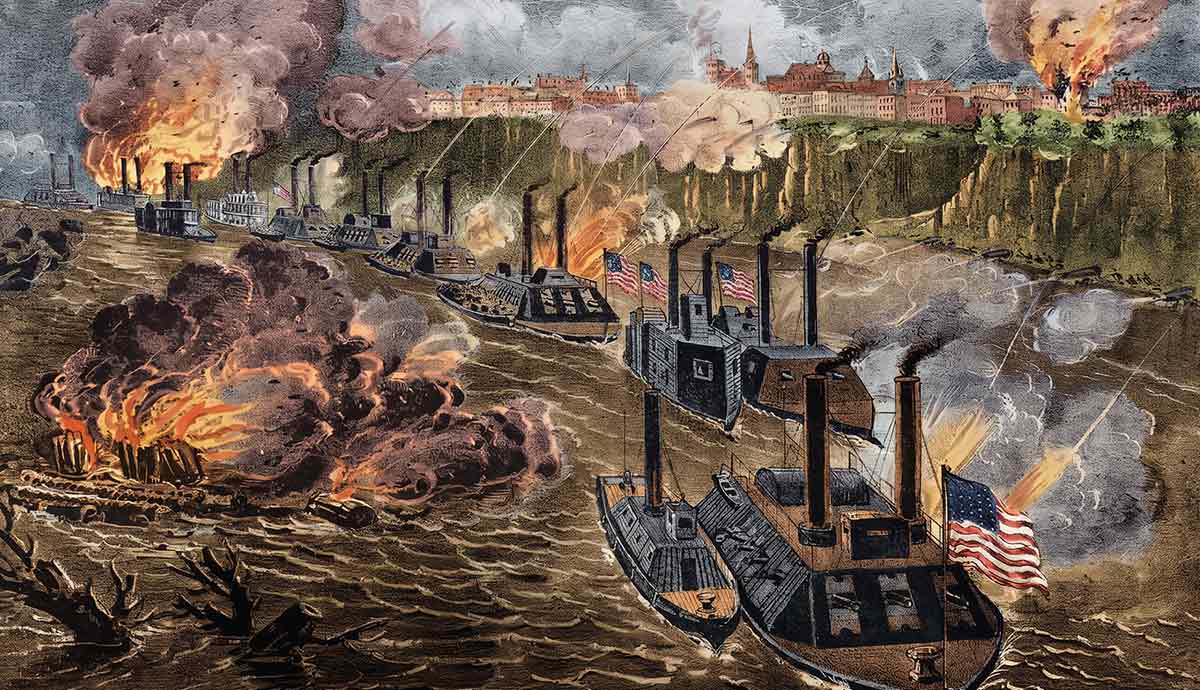
Picture a slab-sliding ironclad rounding a bend on the Cumberland River in 1863. Firing on the move and belching black smoke, these nearly invulnerable vessels suddenly made any Confederate river defense vulnerable. While their ocean-going cousins captured national headlines, river ironclads were busy splitting the Confederacy in half.As a central part of Winfield Scotts Anaconda Plan to control the Mississippi River, river ironclads were purposely built. With their slow speeds, shallow drafts, armor, and firepower, these ironclads were the real weapons that cracked open the Souths interior.The Brown Water NavyThe importance of the Mississippi River for Union naval operations. Source: Library of Congress / WikimediaWhile the ocean contingent of the Unions naval campaign was critical, the Mississippi River Squadron, also known as the Brown Water Navy, was no less important. Built to operate within the narrow, shallow confines of the different rivers like the Cumberland, Red River, and Mississippi, river ironclads became the campaigns workhorse. Army owned and commanded by Navy officers, they projected power inland, often helping to win crucial campaigns.At the start of the Civil War in 1861, the Union scrambled to obtain ships. Paddle wheelers, towboats, and steamboats were converted using timber and iron plating. These sufficed until intentionally designed ironclads and later river monitors arrived. These had similar characteristics, such as shallow drafts, armored hulls and turrets, large naval guns, and side or stern wheels for propulsion.Beginning in January 1862, ironclads began to appear. Soon, they and the Union Army started to break the Confederates Mississippi lifeline, which cut off Texas, Arkansas, and parts of Louisiana.Unique, Powerful, but Not ImperviousThree City-class ironclads off Cairo, Illinois, 1863. Source: National Museum of the US Navy / Wikimedia CommonsDuring the Civil War, the Union produced about 76 ironclads of different types by 1865: monitors, casemates, and armored river rams. Of these, the City-class ironclads stood out. Designed by Samuel Pook, their distinctive sloped casemate armor helped deflect shots, a wide beam for stability, and armored paddle wheels positioned inside the hull earned them the nickname Pook Turtles. These characteristics allowed survival against Confederate shore batteries.Their size enabled ironclads to deliver firepower in unexpected spots. Boats like the City-class brought heavy naval artillery, such as 42-pounder rifles, to bear. They simply blasted their way past earthen works or hurriedly built outposts manned with often inferior guns. Yet these behemoths had weaknesses too.Working in a heated, enclosed iron box meant temperatures spiked past 120 degrees. Crews frequently fainted in the intense heat or from fumes from massive boilers or furnaces. Even their armor had a weakness, typically from above. Plunging Confederate shellfire punched through thinner armored (or unarmored) spots. But these powerful ships still clobbered their way past defenses. They were great but imperfect weapons.Ironclads Versus FortificationsMonitors passing Confederate positions, April 1863. Source: Naval History & Heritage Command / Wikimedia CommonsThe Union river fleets ironclads, starting in 1862, completely upended the Confederate defense tactic of static river blockades. Under normal circumstances, their heavy guns would shred wooden hulls. Now, Union ironclads sailed up to the forts, shrugged off most hits, and pounded the emplacements to pieces. Whereas a normal siege might take weeks, the ironclads placed shells along the defenses, helping force a surrender in days. This did come with risks the City-class ironclad USS Cairo sank upon striking a mine during the run-up to the Vicksburg Campaign.This approach became clear to frustrated Confederate officials during the 1863 Battle of Vicksburg (May 18-July 4). Of the Mississippi River naval battles, this bruising fight is considered the most important. Union ironclads repeatedly traversed the river under Vicksburgs guns to bring supplies, men, and artillery, despite repeated hits. The city eventually fell on July 4, 1863, splitting the Confederacy.Confederate Rams as a ResponseConstruction of the CSS Arkansas. Source: British Library / Wikimedia CommonsThe Confederates quickly realized the Union ironclads menace to their cause. Unlike the industrialized North, the South had few rolling mills, few foundries capable of forging iron plates, and almost no engines. Workers scavenged railroad iron, scrounged machinery, and unseasoned lumber to build boats like the CSS Arkansas. Cobbled together, this underpowered Confederate warship was later scuttled following several important battles only due to engine failure (August 1862).The South also built cottonclads, or armed steamers loaded with tightly packed cotton bales. This unconventional but effective armor was built cheaply and quickly. These werent meant to clash with ironclads but were effective as an expendable defense.While improvisation was the rule, the Souths industrial weakness quickly hampered defense efforts. The Norths boatyards consistently rolled out City-class (or similar) ironclads. The Confederacy struggled to produce one, often due to material shortages or long delays. The Union wore down its opponents, but the inability to match the Norths production led to the loss of the Mississippi theater.The Civil War helped introduce the 19th century to ironclad technology. Union ironclads proved themselves as a winning factor on Americas rivers. They turned the Confederate river lifeline into a Union highway by 1865.
0 Комментарии
0 Поделились
37 Просмотры

 English
 Arabic
 French
 Spanish
 Portuguese
 Deutsch
 Turkish
 Dutch
Dutch
 Italiano
 Romaian
 Portuguese (Brazil)
 Greek
Greek