One In A Million: Scientists Stunned By 450-Million-Year-Old Sea Creature Fossil That Still Has Soft Tissue Intact
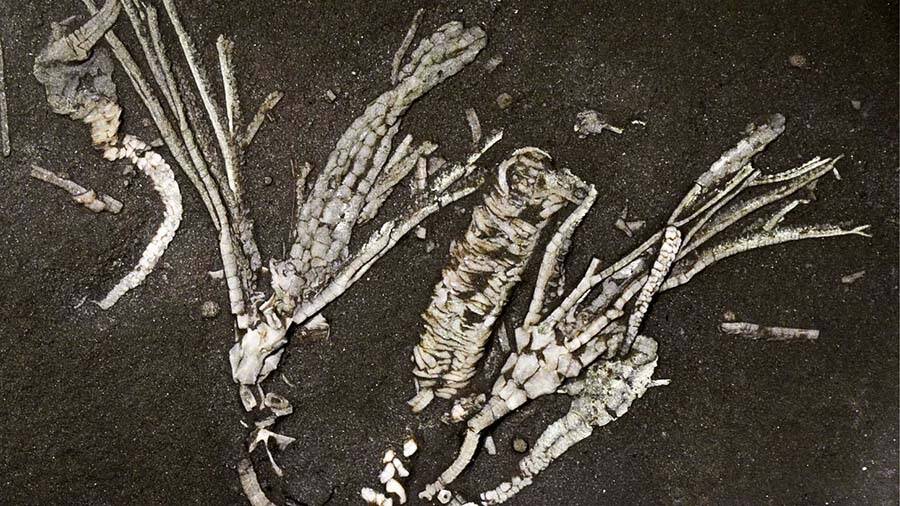
University of OklahomaPaleontologists discovered intact soft tissue from a crinoid that lived 450 million years ago.In the prehistoric animal kingdom, before dinosaurs walked the Earth, and even before any animals and plants occupied dry land, starfish-like creatures known as crinoids thrived in some of the planets earliest marine ecosystems.Scientists just discovered a 450-million-year-old fossilized crinoid that still has some of its soft tissue intact. This is extremely rare, as fossils almost always preserve only the animals bones, teeth, or hard shells. But this astonishing crinoids soft tissue will give researchers unprecedented insight into the evolution of life in Earths prehistoric oceans some 200 million years before the dinosaurs.The 450-Million-Year-Old Crinoid Found With Soft Tissue IntactPaleontologists at the University of Oklahoma made the discovery of the soft tissue while studying a fossil of a Dendrocrinus simcoensis being held at a small Montral museum called the Muse de palontologie et de lvolution. The museum simply hadnt been aware of the importance of this specimen that had long been sitting in their collection.Only one other crinoid fossil has ever been found with preserved soft tissue, and this discovery is older by a significant margin.Dr. Lena Cole, a paleontologist at the university, said in a statement that the discovery was truly one in a million, as millions of crinoid fossils have been found, but only two have ever had intact soft tissue.University of OklahomaFeather stars, found in todays oceans, are modern crinoids.Crinoids are echinoderms, sea animals with rough, spiny surfaces and radial symmetry. They are sometimes called sea lilies for their flower-like appearance, and appear in todays oceans as feather stars. The bodies of crinoids are mostly made up of chalky, calcium carbonate plates that allow them to fossilize well. But this merely aids in fossilizing the animals hard tissue, while the preservation of soft tissue requires highly specific and rare conditions.After an animal dies, soft tissues like skin, eyes, or internal organs are the first things to decay, said Dr. Cole. Most fossils are only made up of hard parts like bones, teeth, or shells. Soft tissues are only preserved when the environment acts almost like a natural refrigerator or vacuumsealer conditions that are incredibly rare.The researchers identified the soft tissue preserved in this fossil as the crinoids tube feet. Despite what the name might imply, tube feet do not allow crinoids to stand, but instead to eat.Wikimedia CommonsResearchers identified the soft tissue as tube feet, which crinoids use to eat.Crinoids use their tube feet, which line the edges of their fans, to capture plankton. As the crinoids move their feathery fans through the ocean, particles of plankton get trapped and stuck to the tube feet and are then moved down to their mouths from there.Tube feet are remarkably diverse in size and shape depending on how each crinoid has evolved based on its specific ecology.Since crinoid tube feet are used for feeding, you can think of them in a similar way to how we think about teeth in mammals, said Dr. David Wright, another University of Oklahoma paleontologist. Differences in their structure tell us about what kinds of environments a species lived in and how it fed.What This Crinoid Discovery Could Reveal About Planet Earths Prehistoric OceansAlthough paleontologists have been able to piece together prehistoric ecosystems with hard tissue fossils, the preserved soft tissue reveals much more about how crinoids biology worked and evolved.Comparisons with living crinoids show that the anatomy of this ancient species was very different, Dr. Cole said. This gives us new insight into how crinoids evolved and how their feeding strategies changed over hundreds of millions of years.Not only does the discovery deepen researchers knowledge of prehistoric crinoids, it also provides clues about entire ecosystems that flourished in Earths oceans hundreds of millions of years ago.Fossilized remains of longextinct species can show features well outside the range of variation we see in living species, Dr. Wright said. By comparing ecological ways of life for extinct and modern species, we can understand how patterns of adaptive evolution have changed through time and what factors shaped the modern biosphere.After reading about the discovery of a 450-million-year-old crinoid with soft tissue intact, learn about this terrifying 20-armed feather star found in the Antarctic Ocean. Then, discover these dinosaur fossils found with preserved skin.The post One In A Million: Scientists Stunned By 450-Million-Year-Old Sea Creature Fossil That Still Has Soft Tissue Intact appeared first on All That's Interesting.




 Arabic
 French
 Spanish
 Portuguese
 Deutsch
 Turkish
 Dutch
Dutch
 Italiano
 Russian
 Romaian
 Portuguese (Brazil)
 Greek
Greek