


WWW.THECOLLECTOR.COM
The Swords That Dominated the Renaissance
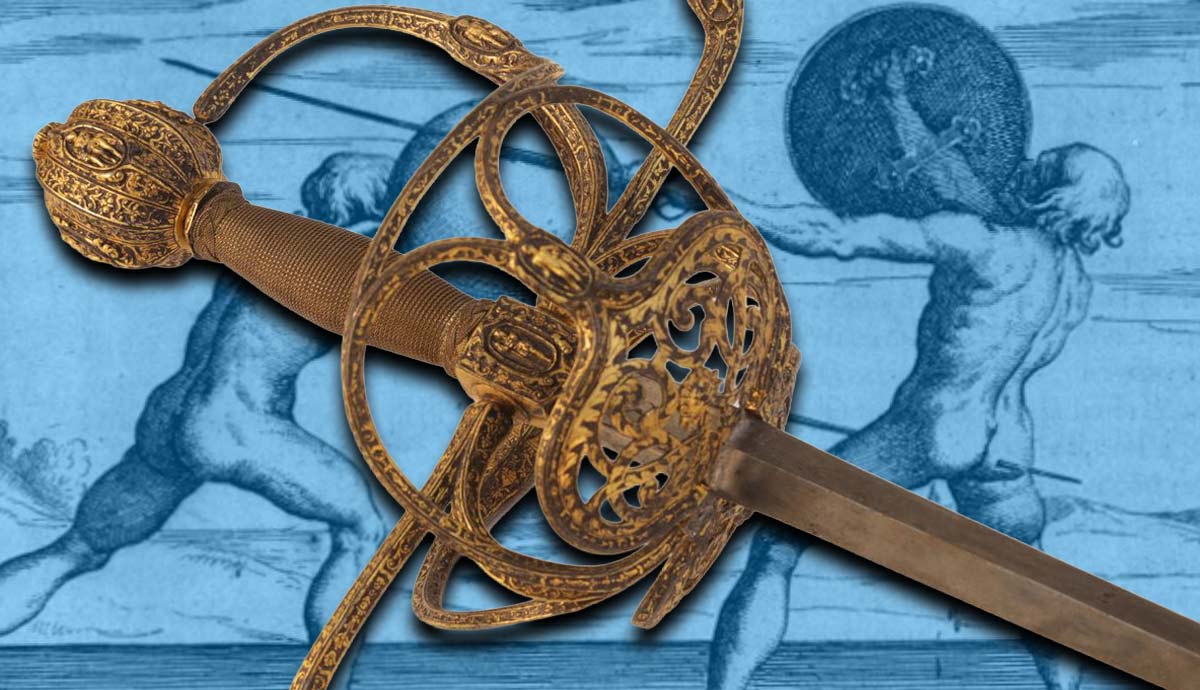
Three sword archetypes capture the public imagination more than any other: the knightly longsword or arming sword, the various swords of Japan, and the thrust-based swords wielded during the Renaissance and later, such as the rapier, estoc, and (much later) the smallsword.Every weapon design is a response to the needs of the people who would use it. This means they take into account the presence of armor, environmental considerations, any laws governing the wearing and/or use of weapons, and even fashion sense. During the Renaissance, there was a transition from the relatively broad cutting blades to lighter, nimbler weapons that focused on the thrust, broadly categorized and termed as the rapier.What were the factors that determined this change? What exactly is the rapier, and how did these swords influence the culture of the Renaissance?Broad Societal Changes in the RenaissanceThe Peasants Revolt, from Chronicles, by Jean Froissart, c. 1460-1480. Source: British LibraryMedieval life was largely defined by a strict class hierarchy: commoners who worked the land and performed other skilled trades, clergy who handled religious and academic matters, and nobility who collected taxes, made laws that governed whatever portion of land they had been given, and conducted military operations to protect the other classes.The feudal system ultimately collapsed due to several factors: the Black Death, increased food surplus, and the reopening of old trade routes. Cities began to flourish, and people who formerly lived in the countryside began moving to more urban environments, outside the protection of their former feudal lords. This migration influenced a mindset of civilian self-defense and influenced the kinds of weapons that people would use: cities tended to be tightly packed with a lot of narrow streets and alleyways that would prevent the use of cutting weapons in wide arcs. Therefore, the stab became a more important tactic in fencing for self-defense.This being said, in a sword fight, the cut was still used, but it was more of a diversion or to cause minor wounds than the primary means of ending an earnest fight. It is exceptionally easy for a sword blow to be lethal. A cutting blow can end a fight more quickly because it can cut through muscle or sever tendons.Hand-and-a-Half Sword, ca. 14001430. Source: The Met, New YorkConversely, a thrust is more likely to cause fatal damage because the point can penetrate deeper into flesh; if one were to strike the torso, it could easily penetrate the abdominal wall and into the viscera, leading to a more fatal wound if less immediately so. Another reason for the thrust is that the shortest distance between the tip of a sword and the enemy is a straight line. It is quicker than the arc of a cutting attack. However, it is relatively easy to displace a thrust and move offline to defend against it.Which Swords Were Used the Most?Rapier with Scabbard, c. 1600. Source: Wikimedia CommonsIn the early Renaissance, the classic single-handed, double-edged knightly arming sword gradually gave way to what we call the sidesword. In Spain, it was called espada ropera (dress sword); in Italy, it was called spada da lato (sword of/at the side). When discussing swords, know that period texts often just use the local word for sword.The sidesword was, as a rule, a lighter variant of the arming sword with a narrower profile, intended for nimble movement. Over time, the design of the sidesword gradually lengthened and thinned into what we recognize and label as the rapier. The Spanish term ropera is thought to be where we get the word rapier.There were some larger swords similar to older medieval designs, but these were used in specialized military contexts. For example, the Zweihander of Germany was used as a shock weapon to shatter pike block formations. The montante of Spain could be used similarly, but also as a space-clearing weapon.What Were the Properties of Popular Renaissance Swords?Rubens Sword, 16th century. Source: Wikimedia CommonsMost of the swords developed during the Renaissance used increasingly longer and thinner blades that shifted the point of balance close to the hilt. The wielder could have greater point control and thus more precise targeting. This was a gradual transition. In the Medieval Period, swords often had a basic cruciform handguard; this is why you often hear a longsword referred to as a cruciform sword. The designs of handguards gradually became more complex with additions like finger rings, which connected to the ricasso of the blade. It is commonly said that rapiers that were developed later had no edge; this is often incorrect.Earlier cut-and-thrust swords had a thin hexagonal or lenticular cross-section. Later, as the thrust became more prominent, the need for stiffer blades required triangular or diamond-shaped cross-sections, better suited for keeping the blade rigid.Handguards of swords became more complex because methods of hand protection (shields, gauntlets) that had been used in the Medieval Period were largely phased out in the new civilian context. Also, ornate furnishings indicated wealth and social status, which was paramount to the social perception of a man in this time period. Elaborate patterns and the use of precious metals were the order of the day.The styles of handguards varied: Spanish rapiers used fully enclosing handguards because their system led to increased hand vulnerability. Italian rapiers used longer quillons on their guards to allow better blade control at range.How Renaissance Swords Influenced Fashion and BehaviorRenaissance Doublet, 1620. Source: The Met, New YorkIn the Renaissance, the sword became a status symbol as well as a weapon of war, and fashion developed to accentuate it. For example, capes, cloaks, slashed fabric, and similar accessories abounded. Capes could be used as an off-hand accompaniment to ensnare an opponents weapon, blind them, or trip them.The wearing of a sword was seen as an indicator of high social status, masculinity, and personal/family honor. It then followed that dueling over perceived slights became commonplace. There were laws put in place against dueling. Still, just like today, they were often circumvented by the wealthy elite whose family connections made punishment politically riskyor who simply could afford to pay the fine. Punishments ranged from a fine to execution, with the latter being more common for those of lower social status.Dueling CultureCapo Ferro 42, men dueling with sword and rotella, 1610. Source: Wikimedia CommonsThe idea of dueling was hardly new to the Renaissance, but it is likely the earliest period in which it was a ubiquitous, documented cultural institution. In the Medieval Period, there was the concept of judicial dueling, also known as trial by combat, but the culture of personal gentlemanly honor brought it to an unprecedented level. If someone were issued a challenge, refusing it without a valid reason was seen as cowardly.There was an accepted procedure. It wasnt just a matter of two people drawing swords in a busy Florentine street. Often, challenges were negotiated with a set date, time, location, and weapons to be used, and win conditions (i.e., to satisfaction, first blood, or death). The terms had to be agreed upon by both parties for the duel to be considered valid.The two duelists would each appoint a second, or trusted party, to aid them during and prior to the duel. Immediately prior, the seconds would meet and try to negotiate a peaceful resolution.Duels were fought to satisfaction, which usually meant the offended person felt that his honor had been restored. This could range from a sincere apology from the other (allowed up until the point at which the duel actually started), first blood, or death. Although fatalities did occur, it was rare given the laws against murder. Also, defeating an opponent without killing them was seen as a mark of dominance and skill.Development of Rapier FencingTreatise on the Science of Arms, 38, by Camillo Agrippa, 16th century. Source: Association for Renaissance Martial ArtsOne of the most enduring tropes in fiction features Renaissance nobles dueling with rapiers. Many fencing treatises written during this period elaborate on the rapiers use. Keeping to the theme of looking at the world through a gradually more scientific lens, much of fencing theory treated swordsmanship as an expression of geometry. Swordsman Camillo Agrippas manuscript portrays, for example, meticulous diagrams of the different ranges given by adjusting ones posture.Rapiers became popular throughout most of Europe, with each country having developed its own fencing styles. The Spanish and Italian schools of thought became the most influential. The Italian style emphasized a lower stance, a broader range, and aggressive, linear movement. The Spanish style employed upright stances with circular footwork and precise, angled control of the blade from close quarters, similar to the idea of hard and soft styles in Eastern martial arts.Transition Into the Modern PeriodFrench smallsword with scabbard, 1762. Source: The Met, New YorkThe specialized rapier was eventually shortened into the smallsword, which became popular during the late 17th century and onward. Dueling and the use of the rapier declined in popularity. Firearm development meant more accurate, more reliable, and faster-loading rifles, which led to the sword being supplanted by the bayonet among infantry troops. Amongst cavalry officers, the sword of choice became the saber.Governments began to centralize their authority, resulting in more robust enforcement of public safety. Therefore, swords gradually fell out of fashion. Wearing one, unlike during the Renaissance, marked a person as vulgar or prone to starting fights. In fact, laws against the wearing of swords became commonplace in cities. This was also done to curb the prevalence of dueling.The rapier and its cousins evolved into the sport of modern Olympic fencing with the epee and the foil. Both of these swords contain sportified versions of French rapier fencing, which evolved from the Italian rapier.
0 Comments
0 Shares
26 Views

 Arabic
 French
 Spanish
 Portuguese
 Deutsch
 Turkish
 Dutch
Dutch
 Italiano
 Russian
 Romaian
 Portuguese (Brazil)
 Greek
Greek