


ALLTHATSINTERESTING.COM
Archaeologists In Bulgaria Just Unearthed An Ancient Roman Surgical Tool Thats Only Ever Been Found Once Before
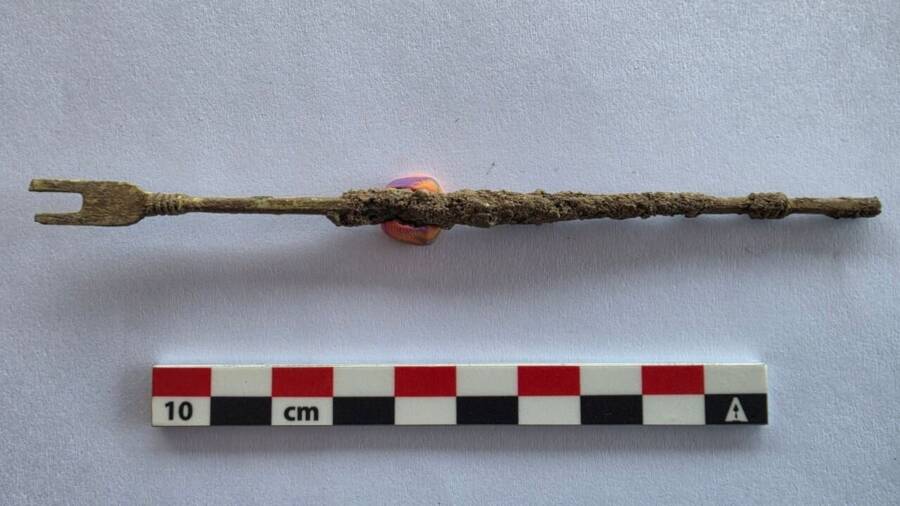
Archaeologia BulgaricaArchaeologists made a rare discovery of a specialized tool that physicians used to remove bladder stones during the Roman era.Archaeologists excavating the ancient ruins of Heraclea Sintica in southwestern Bulgarian just uncovered a rare surgical instrument that was used to remove bladder stones in the third century C.E.This find is exceptionally significant, the archaeologists said, because there has only been one other comparable discovery of a similar surgical instrument thats ever been made before.The Discovery Of A Roman-Era Surgical Tool That Removed Bladder StonesThe finding, announced on July 3, was published by excavation director Lyudmil Vagalinski in the journal Archaeologia Bulgarica.The team was excavating Heraclea Sinticas Temple of Hercules and found the tool in an adjoining room.Wikimedia CommonsThe excavation site of Heraclea Sintica, an ancient city that flourished in present-day Bulgaria in the third century C.E.This surgical instrument was known as a lithulkos and was a part of an advanced kit used by ancient surgeons to perform a lithotomy, the procedure to remove bladder stones. A surgeon would make an incision in the perineum the area just underneath the genitals and then remove the stones with a hooked tool, or sometimes even their fingers.This operation was performed mainly in ancient times, as less invasive methods were developed in the following centuries, ones that crushed bladder stones rather than removed them via surgery.The surgical tool found in Bulgaria once had its hooked tips on its working end, but these did not survive. However, the archaeologists did find the instruments bronze handle, adorned with several embossed rings, which remained well-preserved.Researchers hope that this rare discovery will shed more light on both medical advancements made during the early centuries C.E., as well as Heraclea Sinticas place in the ancient medical world.The instrument is an extremely rare find not only for Bulgaria, but also worldwide, Vagalinski said. From the available scientific literature, only one other similar discovery is known in Italy.The Scourge Of Bladder Stones In The Ancient WorldAccording to Vagalinski, ancient writers, like the Roman Pliny the Elder, described bladder stones as one of the ancient worlds most painful and dire medical conditions. Meanwhile, the Greek physician Ammonius of Alexandria, who lived in the third century B.C.E., was known for devising surgical procedures and instruments for operations that would remove bladder stones. His contributions to the field earned him the nickname Lithotomos or The Stone Cutter.Wikimedia CommonsThe Hippocratic Oath mentions bladder stone removal surgery, and urges the surgery to be left to physicians with proper training.While other, less specialized surgical tools have been found and identified by archaeologists such as scalpels, needles, curettes, and spoons researchers believe that tools like the lithulkos were rarer among ancient physicians.Bladder stone surgery is even mentioned in the Hippocratic Oath, written by Hippocrates circa the fourth or fifth century B.C.E. The ancient Greek text states: I will not cut for stone, even for the patients in whom the disease is manifest; I will leave this operation to be performed by practitioners.This indicates that lithotomy was seen in ancient times as a very advanced procedure, only to be done by the most well-trained medical professionals.What This Discovery Could Reveal About Ancient Life In Heraclea SinticaThis surely means, then, that some of these specialized medical professionals were living in Heraclea Sintica during the third century C.E., the period from which the newly-unearthed tool comes. During this century, the ancient city was also experiencing major economic growth as part of the Roman Empire.Wikimedia CommonsArcheologists believe that pilgrims may have gone to the Temple of Hercules in Heraclea Sintica for both divine and medical healing.In addition to the question of where Heraclea Sintica as a whole stood in the ancient medical world, the archaeologists are curious about the significance of the specific location where this new find was made.The tool was found in a room next to the Temple of Hercules, leading researchers to guess that those traveling to the temple for divine healing perhaps also went there for medical treatment or surgeries.The fact that we found it in a room next to the Temple of Hercules suggests that perhaps sick people seeking the help of the mythical hero were treated there, Vagalinski said.These, however, are just educated guesses, and more research is needed to make any definitive conclusions about the function of the temple.Excavations in Heraclea Sintica are ongoing as researchers are removing thick river sediment to uncover and document the citys ancient buildings.While more work needs to be done, the archaeologists are thrilled at the opportunity to open up a window into the medical practices of the ancient Roman era, and reveal more about life in Heraclea Sintica, one of Bulgarias richest archaeological sites.After reading about the rare Roman-era surgical tool found in Bulgaria, learn about the history of female hysteria, coined by Hippocrates. Then, discover the history of trepanation, the worlds oldest cranial surgery.The post Archaeologists In Bulgaria Just Unearthed An Ancient Roman Surgical Tool Thats Only Ever Been Found Once Before appeared first on All That's Interesting.
0 Commentaires
0 Parts
24 Vue

 English
 Arabic
 Spanish
 Portuguese
 Deutsch
 Turkish
 Dutch
Dutch
 Italiano
 Russian
 Romaian
 Portuguese (Brazil)
 Greek
Greek