Medieval jewelry hoard found in Saudi Arabia
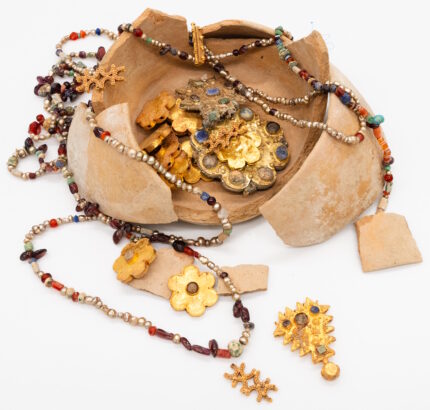
A jewelry hoard of more than 100 pieces made of gold, silver and precious gemstones has been discovered at the ancient pre-Islamic site of Dariyah. It was found in the same archaeological layer as the remains of structures from the 9th century A.D., so that it likely when the hoard was buried.The objects were buried inside a ceramic vessel. Pieces inside the pot include hand-hammered floral ornaments and triangular pendants inlaid with colored semi-precious gemstones, bead bracelets, gold spacers, fragments of oxidized copper and gold sheets. The largest object is a disc-shaped ornament decorated with inlaid stones of different colors.Located at the center of the Arabian Peninsula, Dariyah was an important stop on the Basran Hajj pilgrimage route between Iraq and Mecca during the Abbasid Caliphate (750-1258 A.D.).The same route used by pilgrims was a trade route as well. The high quality of the objects in the hoard, the raw materials, craftsmanship and goldsmithing, attest to the wealth of the people who and passed through Dariyah, be they pilgrims or merchants.The discovery of the stone foundations, mud brick walls with plastered interiors, hearths, glass in this seasons excavation are evidence that the site wasnt just for people passing through. There was a permanent settlement here in the 9th century, so the hoard may have been buried by someone who lived there, not just someone passing through.A stop along such a route could become a small but active center of exchange. The gold jewelry fits that picture. It suggests a settlement connected to movement, money, and cultural contact during the early Islamic centuries.[]That wider archaeological setting matters. Without it, the jewelry would be only a beautiful hoard. With it, the discovery becomes evidence for a lived settlement tied to Abbasid-period trade and pilgrimage. []The Dariyah gold collection now adds a vivid new chapter to the archaeology of early Islamic Arabia. It shows that the desert routes of the Abbasid world were not empty passages between cities. They were active corridors where faith, commerce, and luxury craftsmanship could meet.




 English
 Arabic
 French
 Portuguese
 Deutsch
 Turkish
 Dutch
Dutch
 Italiano
 Russian
 Romaian
 Portuguese (Brazil)
 Greek
Greek