


WWW.THECOLLECTOR.COM
When the President of Texas Declared His Own Navy to be Pirates
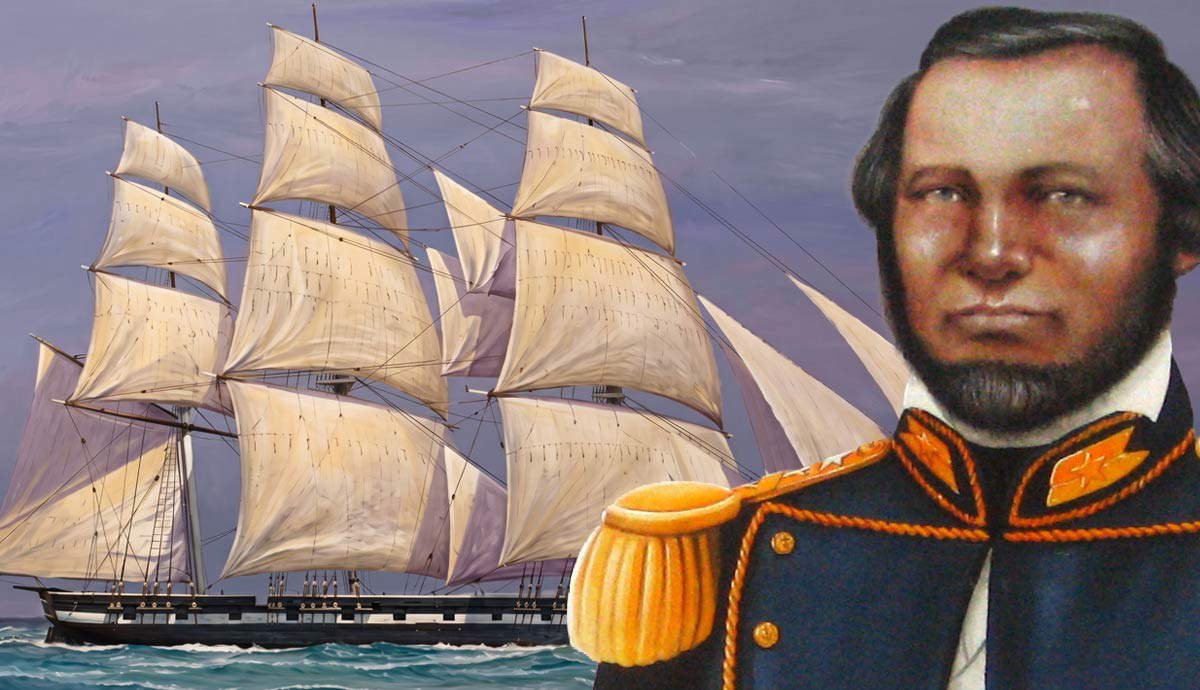
Imagine the ruckus if a modern US naval captain refused to bring his nuclear-powered warship back into port. How would the president react? It is unlikely he would encourage the navies of foreign nations to actively attempt to apprehend the wayward vessel, but such a scenario became the reality of President Sam Houston of Texas in the spring of 1843.The Disobedient Texan NavyUS Brig Niagara. Photograph by Lance Woodworth, 2009. Source: Wikimedia CommonsHouston was not a happy man in spring 1843. Three times in the past year Mexican armies had invaded Texas and twice occupied San Antonio. Though repulsed, a retaliatory expedition to the Rio Grande turned into a gross act of stupidity when some militiamen chose to disobey orders and carry the war into Mexico.This force was crushed, the survivors imprisoned, and forced to draw lots, witnessed the cruel slaughter of their comrades in the face of Mexican firing squads. On top of all this, however, Houston was facing yet another act of gross insubordination from the Republics navy. Its commander, the fiery Captain Edwin Moore, refused presidential orders to return to Galveston, and instead announced his intention to proceed to sea and under the flag of Texasin a direct violation oforders, and cruise upon the high seas with armed vessels, contrary to the laws of this Republic (Houston, p. 338-340).With his own navy flaunting his presidential authority, Houston made the drastic decision to seek the aid of foreign nations in an attempt to drive Moore from the high seas. Texass navy had served its purpose, Houston argued, and he was determined to sell the vessels off at auction. The money would help restore Texass empty treasury, but with the fleet gone wrong, Houstons decision to enlist foreign aid seemed justified. If the wayward Moore was allowed to carry on his merry way, Houston feared Texas must suffer herself to become the object of contempt, or the victim, of insubordination and anarchy (Houston, p. 338-340). How did it come to this?Houstons FrustrationsThe Dutch Schooner Oosterschelde. Photograph by VollwertBIT, 2005. Source: Wikimedia CommonsHouston was no sailor and saw in the Texas Navy far more hassle than benefit. Emerging during the revolutionary struggle of 1835-36, the first Texas navy boasted four ships, schooners and brigs, whose mission was ostensibly to guard Texass rivers and coasts, and if possible, harass Mexican shipping in the Gulf. Cost and combat would take a toll on these modest vessels. Almost a year to the day since the victory at San Jacinto, the Texian flagship, Independence, a two-masted schooner with six guns, including a Mexican piece taken at San Jacinto, was assailed by two Mexican vessels near the mouth of the Brazos River.Outnumbered and unable to bring her full broadside to bear, Independence struck her colors. Imprisonment awaited her crew and the vessel entered Mexican service. By May 1837, Houston was urging the Texan Congress to sell what remained of the flotilla. The cost of maintaining these vessels, which were not strong enough even to guard Texass coasts, was too great a financial burden to bear for the infant republic. They were duly sold at auction and thus ended the first incarnation of the Texan navy. A second Texan navy would soon materialize.The reason behind this resurrection was the simple transfer of power. Houston was out and Mirabeau B. Lamar was in. In terms of policy the two men could not have been more different. Houston believed in consolidating what the Texians held, being fiscally responsible, and not involving themselves in expansionistic adventures. Most of all, he sought to leave Mexico alone. Lamar had other ideas.The Second Navy of TexasMirabeau B. Lamar monument in front of the Fort Bend County Court House, Richmond, Texas. Statue by Sidney Waugh, 1936. Source: Wikimedia CommonsTo the Georgian-born Lamar, Texas had to expand as far afield as Santa Fe. Moreover, within its own confines, Indigenous peoples, suspect in their loyalties, had to be removed, lest they threaten the independence that had been won in 1836. Lamar therefore embarked on several Indian wars during his time in office to the detriment of the Texan republic. Worse was to come when Lamar pursued an active policy of aggression against Mexico.Separatist movements in several Mexican states, most notably the recently declared Republic of the Yucatan, had to be supported by the Texians. The most efficient means of supporting the Yucatecans, Lamar believed, was from the waters of the Gulf. Lamar secured contracts with American shipyards to build brigs and sloops of war and engaged the services of Edwin Moore, a former US naval officer, to command Lamars small navy.This navy, which emerged from the shipyards throughout late 1839 and early 1840, was a modest flotilla like its predecessor, but it would spend more time outside of Texas waters than within them. Operating from islands off the Yucatan coast, and utilizing the naval facilities of New Orleans, Moores ships engaged in a variety of tasks, including charting, suppressing smugglers, delivering armaments, and seizing prizes.Edwin Moore in his naval uniform. Photograph by Billy Hathorn, 2008. Source: Wikimedia CommonsMoores primary duty was to maintain a passive presence in the Gulf. The Yucatecan government offered pay for the upkeep of the Texan fleet, so long as they came to defend the Yucatan against the Mexican navy. This deal was readily accepted by Lamar, but upon Houstons return to office in December 1841, things changed once again. Houston saw in the provocative activities of the navy nothing less than an impending disaster. One that came in 1842 when Mexican armies invaded Texas three times.In this perilous situation, Houston was forced to make use of Moores vessels, tasking the commodore with a blockade of the Mexican coast from Tabasco to Matamoros. Moores fleet returned to the Yucatan, operating from its ports even after Houston recalled them. When the threat of invasion at last waned, Houston once again planned to dismantle Texass troublesome navy.From his viewpoint, the navy was a liability whose actions had provoked a serious military response from Mexico. Aiding the cause of the Yucatecans was in Houstons mind a foolish adventure, for the Yucatecans were in no real position to support the Texians. Moreover, conditions aboard ships were deplorable. The men, from average sailor to Moore himself, had not been paid in years. Yet when Moore received Houstons orders early in 1843 to return his ships to Galveston for the express purpose of their being sold at auction, the commodore refused outright.Professional security played a part in this decision, but so did Moores resentment of Houstons orders. Houston had never appreciated the navy to begin with and saw in it only a financial burden beyond the Republics abilities to meet. Moore was determined that the second Texan navy would not suffer the fate of the first.Texan Sloop of War, Austin. Source: Wikimedia CommonsSuch was his determination that he kept his ships from Texian ports for months throughout the first half of 1843, actively engaging Mexican shipping in the meantime. Such outright disobedience was treason in Houstons eyes, for Texass foreign policy was now effectively being shaped by the broadsides of a rogue sailor in charge of a fleet operating without any form of political oversight.Moore carried on his war against the Mexican navy from New Orleans, bringing Mexican naval forces to battle on two occasions in April and May 1843. On both occasions, from his flagship, Austin, Moore gained the better of superior Mexican forces. He did so while he and his men were openly labeled as pirates by Houston.To answer this charge, and because of the need to resupply his ships, Moore at last returned to Galveston on July 14, 1843. This return effectively ended the tumultuous second life of the navy of Texas.Moore vs HoustonTo the People of Texas by Edwin Moore, 1843. Source: Texas State LibraryEdwin Moore was inflamed to write a passionate defense of his actions by the charges leveled against him by Houston. Declared a pirate, the very worst insult to be cast upon a naval officer, Moore took to his pen, and produced a 200-page defense of his operations, entitled To the People of Texas. I have been accused of the most heinous crimes known to the laws of this or any country, he declared, by a man who was openly contemptuous of the navy that had so long served Texas. It was not for Houston to stand in judgement of him, Moore asserted, but to the Texians themselves, to whom Moore addressed himself and confidently look for justice at their hands (Moore, p. 4).The people of Texas absolved Moore of the charges of piracy, and he was allowed to remain in the navy, as it was. But Houston had the last say on the matter. The navy would never go out again. It was far too great a risk and serves to illustrate the larger problem of command and control inherent in the Republic of Texas.The armed forces of a nation must be subordinated to the civilian authorities appointed over them. In Texas, however, that authority could easily be challenged if the will of the chief executive stood contrary to the men themselves. Sam Houston was made painfully aware of this several times during his tumultuous second term as president, both on land and sea.Portrait of Sam Houston, 1836. Source: Tennessee Historical SocietyWanting to maintain a peaceful posture towards the Mexicans, Houstons restraint in times of war stood in contrast to the desires of many within his own government, and armed forces in the field. Following the repulse of the Mexican invasions in 1842, Houston was forced to send an expedition to the Rio Grande to show the flag. But in disobedience of orders, a substantial portion of the men decided to invade Mexico, much to their detriment.On the high seas things were far worse. Houston was powerless to enforce his orders upon a wayward Moore whose own views stood more in line with those of Lamar and allowed them to disobey the orders of his nominal commander-in-chief. Through the months of April and May 1843, Moore was actively waging war upon Mexico outside any real authority save his own. Contemptuous of the charges of piracy levelled against him by Houston, Moore returned and was vindicated. But the precedent he had set could not be replicated for the damage it would do to Texas could well have been irreparable.Grounded at last, the last vessels of the Texian navy were sold off until only the Austin remained. Taken into the US navy after Texass annexation, it proved to be far too leaky a vessel to do anything more than serve as a receiving ship off the coast of Florida. It proved an inauspicious end to an inauspicious organization.SourcesThe Writings of Sam Houston 1813-1863. Volume III December 20,1822-January 31, 1844, eds Amelia W. Williams and Eugene C. Barker. (Austin: University of Texas Press, 1940).Moore, Edwin. To the People of Texas (1843: repub: University Park, TX, Southern Methodist University Press, 2011).
0 Σχόλια
0 Μοιράστηκε
19 Views

 English
 Arabic
 French
 Spanish
 Portuguese
 Deutsch
 Turkish
 Dutch
Dutch
 Italiano
 Russian
 Romaian
 Portuguese (Brazil)