


WWW.THECOLLECTOR.COM
How a Young Winston Churchill Escaped Prison and Survived the Boer War
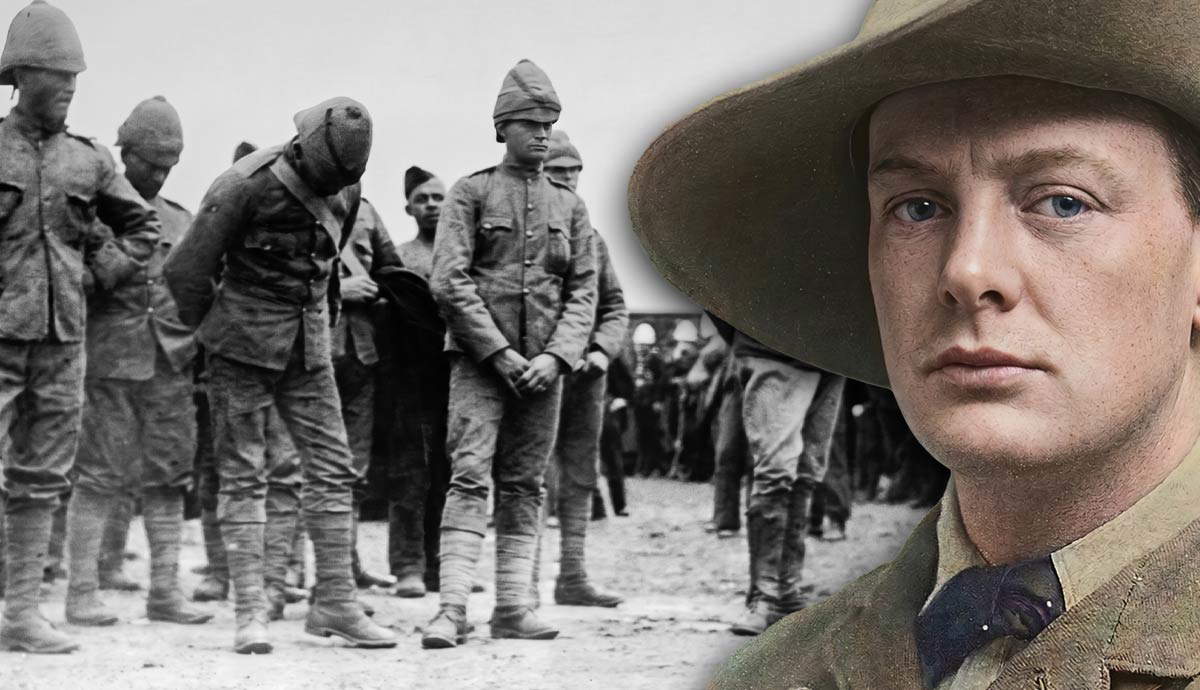
In 1899, Winston Churchill managed to sneak out of a schoolhouse being used as a prison by the Boers. He managed to travel 300 miles to freedom with limited supplies and no knowledge of local languages. This event helped catapult him to fame and launched his political career.Why Was Churchill in South Africa?Winston Churchill and other reporters right before the war, 1899. Source: HistorynetThe Great Anglo-Boer War of 1899-1902 attracted an enormous press contingent, making it one of the most covered conflicts up to that point. Journalists could telegraph their dispatches to their newsrooms rapidly. The British Education Act of 1870 helped increase literacy in Britain drastically, creating a desire for up-to-date coverage. Portable cameras became more widespread as well, making it easier for reporters to take photographs without having to carry heavy equipment. Since South Africa had already attracted a lot of media attention even before the outbreak of war, it was no surprise that a lot of journalists wanted to witness the coming storm. Several hundred reporters from around the world covered both sides of the war.Enter Winston Churchill. In October 1899, he arrived in Cape Town as a war correspondent for The Morning Post. Britain was preparing for hostilities with the semi-independent Boer (AKA Afrikaners) Republics. A military man, Churchill viewed war and the resulting fame as a necessary springboard for his political career. He had unsuccessfully run for Parliament in July 1899 and believed that war heroism would make him a more attractive candidate in the next election. His late father Lord Randolph Churchill had significant experience of the region and Winston himself hoped to get himself as close to the fighting as possible.In November, he convinced his friend Captain Aylmer Haldane to take him on a reconnaissance mission. Haldane consented, bringing him on board an armored train headed north from the town of Estcourt. At the time, British forces were preparing to launch a relief operation to save the besieged garrison of Ladysmith. Like Churchill, British commanders underestimated the Boers, assuming that they were a group of ill-equipped farmers. They were in for a rude shock.The Seizure of Churchills TrainDamaged train carriages following the derailment. Photograph by Ren Bull. Source: www.angloboerwar.comOn November 15, 1899, Boer commandos led by the future South African statesman (and, ironically, future friend) Louis Botha ambushed Churchills train. On board were detachments of the Dublin Fusiliers and Durham Light Infantry. Near the Blaauwkrantz River, Boer riflemen hit the engine and forced the train to reverse onto rocks which they had placed on the tracks to stop the train. Churchill, Haldane, and the other soldiers disembarked and began firing towards the Boers. The engineer was hit and panicked, hoping to flee. Churchill kept him on the locomotive and helped get the rest of the contingent organized. However, the Boer riflemen were lethal shots and killed and wounded several soldiers before they could react.About 40 to 50 wounded men were crammed into the trains locomotive before it steamed off as the unwounded soldiers ran beside it, using the locomotive to block Boer fire. However, several men remained on the track, Churchill and Haldane included. The fighting was brutal and four men were killed, and 30 wounded. The British stretched themselves thin on the tracks, hoping to present a smaller target. They took cover behind several train cars, though they proved little impediment to the projectiles fired by the Boers. Churchill himself got separated at one point from the men when he tried clearing some of the debris off the tracks.When he returned to join Haldane and the stranded soldiers, he ran into a detachment of Boer commandos that were lying in wait. One of them, Field Kornet (commander) Sarel Oosthuizen, ordered him to surrender. Since Churchill left his revolver on the train, he had no choice but to be taken prisoner. Haldane and 56 others were captured, many of them wounded. Churchill had witnessed conflict before as a reporter and in his prior years as a soldier. However, this was the first time he came face-to-face with soldiers from an enemy army.Prison in Staats Model SchoolA picture of Churchill and other British POWs in Pretoria, 1899. Source: Smithsonian MagazineChurchill was lucky that his captors treated him as a normal prisoner. Because he was technically a civilian with a weapon, they could have shot him out of hand. However, he wore army khaki and had one of the helmets of the Fusiliers. Even though he pleaded to be let go on account of his status as a journalist, the Boers knew who he was and figured that the British would offer a good deal of money to ransom him. Therefore, they sent him along into captivity with the rest of the captured Brits. Despite his bravery, some British officers thought he was too reckless.After briefly being held in an armory, Churchill was taken to the city of Pretoria, then the capital of the Transvaal, one of the two Boer Republics. He was sent to a school where the Boers kept British officers as prisoners. This school, the Staats Model School, was a single-story brick building, divided into five sections. The building was surrounded by a ten-foot-high iron fence and was located in the central part of Pretoria. By the time the British liberated the prison, they found around 160 prisoners were held there, mostly officers.Unlike conditions for enlisted men in squalid camps, the Staats Model School proved to be nicer for officer prisoners. They had access to a library and could receive news from sympathetic locals, such as a man nicknamed the Dog Man who whispered updates while walking his St. Bernard. There was a garden and playground area where Churchill and others spent their nights plotting escapes. He was miserable and angry, often arguing with his captors over the righteousness of the war. It wasnt long before he began to execute a plan to break out.The Daring EscapeThe Staats Model School, where Churchill was held. Photograph by Janek Szymanowski, 1988. Source: Wikimedia CommonsAfter four weeks in captivity, Churchill managed to make his escape. He spoke with Captain Haldane and a sergeant named Brockie and they agreed to sneak out through a gap in the fence near the latrine. On December 12, Churchill made it out and waited an hour near the compound until it became clear that his comrades could not follow. His decision to continue was risky; he didnt have many rations, a map, or a compass. He also didnt speak Dutch, Afrikaans, or any native African languages.Wearing civilian clothing, he snuck through the streets of Pretoria at night past several policemen who were supposed to be watching for saboteurs and spies. Many people were out and about, but few paid him any mind. Churchill did not attempt to linger for long; he knew that the Boers would discover his absence and begin to hunt him down. He didnt have a map, but he could use the stars to navigate and he also knew that Pretoria had a railway headed for Delagoa Bay in the Portuguese colony of Mozambique. He began walking down the track for the long trek east.The next morning, the Boer guards at the school realized that he was missing during the morning roll call. He had stuffed his bed with items he didnt want to bring because he wanted the guards to assume he was still in bed. He even left a note taunting the Boers. The Transvaal government issued warnings to its border posts and police stations that they needed to search for him. A 25 reward was issued for his arrest and hundreds of people were involved in searching for him.Hundreds of Miles Through the VeldtA Map of Churchills route on December 13-14, 1899 after escaping from prison. Source: International Churchill SocietyThe initial walk was very difficult. He stumbled through the veldt (plain) and almost drowned in a river. However, he managed to sneak aboard a coal train headed to Mozambique, covering himself with coal to hide from any observers. When the train had to stop at a station, he jumped off before the police could find him. He knew that there was a reward for him and a lot of people were involved in trying to arrest him. Search parties were systematically checking farmhouses and outbuildings, assuming that he was hiding in one.His lack of rations became a real problem. Any farmer that he wanted to ask for food from could turn him over to the police. He walked for several nights, drinking any water he could obtain and stealing food from local farms. One night, he almost collapsed due to exhaustion. When he came upon a coal mine near the town of Witbank, he knocked on the door, fearing that he would die without getting help. To his surprise, an Englishman named John Howard answered. He was the manager of the Transvaal and Delagoa Bay Colliery. Howard and his colleagues, Charles Burnham and an engineer named Dewsnap, agreed to hide Churchill at the bottom of the mine. They slipped him food and water in a tin and plotted to get him to the border. He waited at the mine for six days until the Boer patrols stopped coming around the area.At approximately 2:00 a.m. on December 19, Howard and Burnham smuggled Churchill onto a freight train at the Witbank siding. Burnham had arranged for a train to carry wool and cotton bales to Delagoa Bay and Churchill was to be transported on it. They carved out a small cavity in the center of a rail truck, where Churchill was bundled with a few provisions, including a pistol and some whiskey. For 60 hours, he waited motionless while the train thundered towards the border.Freedom in Loureno MarquesChurchill after his escape in the uniform of the South African Light Horse, c. 1900. Source: HistorynetAt last, on December 21, his train crossed the border to Mozambique. After the train pulled into the station at Loureno Marques, Churchill jumped out, filthy and covered in wool fibers. He walked straight to the British Consulate, where the Union Jack was flying. When the staff tried to turn him away, he yelled, I am Winston Bloody Churchill! Come down here at once! The staff got his story and gave him a room so he could clean up. He took the next steamship headed for the South African port of Durban so that he could get back to reporting on the war. Having been out of touch with much of the outside world, he was stunned to learn of the international attention paid to his story of escaping Pretoria.When his ship docked in Durban on December 23, he was met with a reception usually reserved for conquering generals, as his escape had become a rare spot of good news for a British public reeling from early war defeats. Almost every British colonial official and military officer in the city wanted to meet with him. He was lifted onto the shoulders of the crowd and carried in a jubilant procession through the streets of Durban to the steps of the Town Hall. There, he gave a speech predicting victory over the Boers and decided to run for Parliament again.Churchill still hoped to cover the war from up close. While still on contract with The Morning Post, he joined a newly-created cavalry regiment called the South African Light Horse. He witnessed some of the worst fighting of the war at the Tugela River and at Spion Kop. In a stunning turn, he even personally rode to the Staats Model School to liberate his old comrades. When Britain had its so-called Khaki Election in 1900, he won a seat in Oldham for the Conservative Party. His exploits in South Africa were just one chapter in his journey to fame.
0 Commentarios
0 Acciones
32 Views

 English
 Arabic
 French
 Portuguese
 Deutsch
 Turkish
 Dutch
Dutch
 Italiano
 Russian
 Romaian
 Portuguese (Brazil)
 Greek
Greek