Early Christian church found under fish market
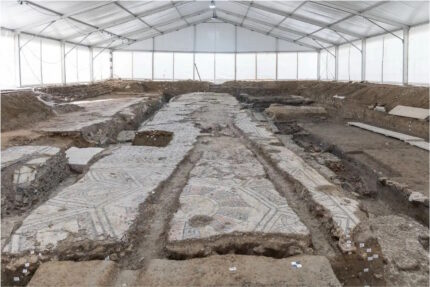
Polychrome mosaic floors of an early Christian basilica have been discovered in the excavation of the former fish market of Oderzo, an ancient town in Italys northeastern Veneto region. The layout of the building and the motifs of the mosaics date it to the late 4th or early 5th century, making it the citys first known Christian place of worship.Originally a 10th century B.C. pile dwelling settlement of the ancient Veneti, Opitergium came to prominence under Rome with the construction of the Via Postumia road (completed 148 B.C.) linking Genoa on the west coast of northern Italy to Aquilea on the east coast, and thus the Mediterranean to the Adriatic seas. The city, whose Venetic population was already Romanized by this time, was granted municipium status and the rights of a Roman city that came with it.Roman Opitergium prospered from its location at a major crossroads, and by the 2nd century it had a population of 50,000 and was one of the most important cities in the region. At the dawn of the 5th century, it was faced with debilitating attacks by Visigoths, followed by Huns and Ostrogoths. When the Byzantine Empire reconquered northern Italy in the middle of the 6th century, Opitergiums fortunes were restored as an administrative and religious center until it was destroyed by Lombards in 667 A.D.The excavation of the former fish market began in November 2025 in anticipation of a new planned residential development. The site was outside the city walls of ancient Opitergium, but archaeological remains including mosaics, tombs and a Byzantine fort, had been found in the area before, so the Superintendency of Padua ordered a thorough excavation.Test trenches soon revealed fragments of mosaic pavement, and the broader excavation uncovered an area of approximately 325 square feet with extensive polychrome floors, the foundations of massive perimeter walls and external buttresses. The foundations were made of bricks and mortar but were supported the same way the Veneti had supported their modest dwellings a thousand years earlier: with wooden piles driven deep into the alluvial soil.The building was rectangular and divided into three east-west naves. The floors are mostly preserved on the southern and central nave, although remnants of the northern one survive as well. The polychrome mosaics have intricate geometric and vegetal designs, including octagons with guilloche borders, overlapping circles adorned with acanthus leaves, ivy, pelta and lozenges with crosses in the middle.The most complex panel features a large central octagon with a Solomons knot in the middle surrounded by a velarium (awning) motif. The polygons exterior sides then become the sides of large squares with double frames. Double-framed lozenges bridge the space between the squares.The excavation also uncovered four inhumation burials right outside the southern perimeter of the church between the buttresses. Unusually, three of the four are two-person burials. None of them have grave goods.The human remains and the wood piles will be radiocarbon dated to date the church more precisely. The site itself will be preserved and new architectural solutions are being explored now that will allow the mosaics and remains of the church to be accessible to the public. The new residential complex will still be built, but it will now include a dedicated space for heritage tourism.




 English
 Arabic
 French
 Spanish
 Portuguese
 Deutsch
 Turkish
 Dutch
Dutch
 Italiano
 Russian
 Romaian
 Greek
Greek