


ALLTHATSINTERESTING.COM
What Was FDRs Second Bill Of Rights And Why Did It Never Come To Fruition?
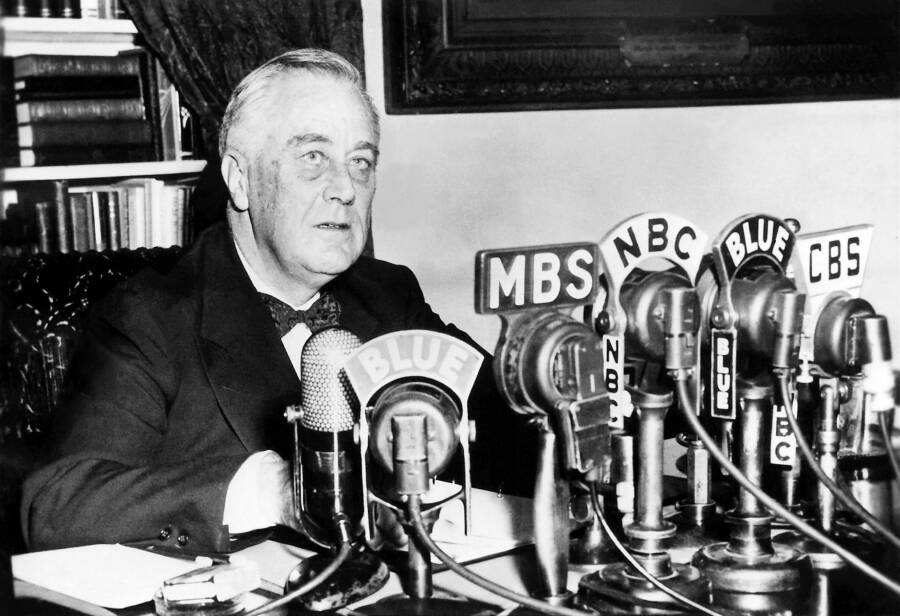
Public DomainPresident Franklin D. Roosevelt delivering his 1944 State of the Union Address, which outlined his Second Bill of Rights.During his 1944 State of the Union Address, President Franklin D. Roosevelt introduced an agenda that both polarized Americans and inspired future politicians for generations to come: the Second Bill of Rights.His plan, which was also known as the Bill of Economic Rights, was meant to raise the standard of living and provide social and financial security for all Americans. Roosevelt wanted to guarantee every citizen employment, housing, medical care, and education.The president tried to implement his agenda by assigning Executive Branch personnel to Senate committees, but this resulted in such intense backlash that lawmakers passed an act providing funds for Congress to staff its own committees. The Second Bill of Rights never came to fruition. Roosevelt died before his administration could submit any actual legislation, and subsequent presidents had more conservative policies. But in Roosevelts wake, politicians and activists like John F. Kennedy, Martin Luther King Jr., and Bernie Sanders championed similar agendas that would provide equality in the pursuit of happiness.The Presidency Of Franklin D. RooseveltIn 1944, President Franklin D. Roosevelt was serving his third term in office. The nation was in the midst of World War II, and many citizens were still reeling from the effects of the Great Depression.FDR Presidential Library & MuseumPresident Franklin D. Roosevelt in June 1936.Roosevelt had been serving in public office since 1910, when he was elected to the New York State Senate. He went on to become the assistant secretary of the Navy, and in 1928, he took office as the governor of New York. His term began on Jan. 1, 1929 just 10 months before Black Tuesday and the Wall Street crash of 1929 that ushered in the Great Depression. This experience would form the basis for his Second Bill of Rights.As governor, Roosevelt advocated for unemployment benefits for struggling New Yorkers, forming the Temporary Emergency Relief Administration in 1931 to create jobs for constituents who needed them. In 1930, he signed the states Old Age Security Act into law, providing pensions and financial assistance to residents over the age of 70.By the time Roosevelt announced his candidacy in the 1932 presidential election, unemployment rates were nearing 25 percent. Shantytowns known as Hoovervilles were popping up across the country, and millions of Americans spent hours each week lined up outside soup kitchens. Public DomainUnemployed men line up at a soup kitchen in Chicago. February 1931.In response to this economic catastrophe, Roosevelt ran on the agenda of a New Deal that would provide federal aid to the American people similar to the policies that hed enacted in New York. He was elected in a landslide victory, securing 472 electoral votes to incumbent President Herbert Hoovers 59.Franklin D. Roosevelt spent his time as president enacting this New Deal. He created the Federal Deposit Insurance Corporation (FDIC) in 1933, providing consumer protection to bank customers. He also established the Securities and Exchange Commission (SEC) to federally regulate financial markets. Public DomainA poster promoting benefits for the elderly outlined in the Social Security Act.Perhaps the crowning jewel of the New Deal was the Social Security Act, which codified old-age pensions and unemployment insurance. But for Roosevelt, these programs werent enough to guarantee financial security to all Americans. So, he drafted the Second Bill of Rights.FDRs Second Bill Of Rights AgendaPresident Roosevelt first proposed his Second Bill of Rights during his State of the Union Address on Jan. 11, 1944. He was too ill to appear in front of Congress at the time, so he spoke to America over a Fireside Chat from the White House.In his speech, Roosevelt praised the troops fighting in World War II before stating, It is our duty now to begin to lay the plans and determine the strategy for the winning of a lasting peace and the establishment of an American standard of living higher than ever before known.Public DomainDesperate citizens tried to withdraw their funds from banks as thousands of financial institutions failed during the Great Depression.We cannot be content, Roosevelt continued, no matter how high that general standard of living may be, if some fraction of our people is ill-fed, ill-clothed, ill-housed, and insecure.Roosevelt declared that the inalienable rights of life and liberty provided by the founding documents of the United States were no longer sufficient. [T]hese political rights proved inadequate to assure us equality in the pursuit of happiness, said the president. We have come to the clear realization of the fact that true individual freedom cannot exist without economic security and independence People who are hungry and out of a job are the stuff of which dictatorships are made.Roosevelt then proposed a Second Bill of Rights under which a new basis of security and prosperity can be established for all regardless of station, race, or creed.The president went on to outline his agenda:The right to a useful and remunerative job in the industries or shops or farms or mines of the Nation;The right to earn enough to provide adequate food and clothing and recreation;The right of every farmer to raise and sell his products at a return which will give him and his family a decent living;The right of every businessman, large and small, to trade in an atmosphere of freedom from unfair competition and domination by monopolies at home or abroad;The right of every family to a decent home;The right to adequate medical care and the opportunity to achieve and enjoy good health;The right to adequate protection from the economic fears of old age, sickness, accident, and unemployment;The right to a good education.Millions of Americans embraced Roosevelts agenda but just as many criticized the presidents lofty ambitions.Why Did The Second Bill Of Rights Fail?Roosevelts critics immediately latched onto his ideas as a prime example of government overreach. It would have given the federal government too much control over the economy, expanded presidential power, and redistributed wealth in a way that more conservative citizens opposed.Even Americans who did agree with Roosevelts plan had some criticisms. They pointed out the hypocrisy of fighting for these social and economic rights while more than 100,000 Japanese Americans were locked in internment camps against their will after having their homes and businesses stripped from them.U.S. National ArchivesJapanese American children at Californias Tule Lake Segregation Center, the largest internment camp in the U.S. September 1944.The presidents efforts to enact his agenda also faced pushback. Roosevelt assigned staff from the Executive Branch to help draft the legislation in Congress, blending the powers of the two branches of government. In 1946, lawmakers passed the Legislative Reorganization Act to fund their own staff and prohibit Executive Branch personnel from developing policy on Congressional committees.But by then, the Second Bill of Rights had already fallen through the cracks. Franklin D. Roosevelt died on April 12, 1945, and while his successor, Harry Truman, expanded his New Deal policies, he did not take up the Second Bill of Rights as a key part of his own agenda.However, in the decades that followed, other politicians, leaders, and activists echoed Roosevelts ideas. When John F. Kennedy ran for president in 1960, the official Democratic Party platform stated that his administration would reaffirm the Economic Bill of Rights which Franklin Roosevelt wrote into our national conscience 16 years ago. It will reaffirm these rights for all Americans of whatever race, place of residence, or station in life.In 1967, Martin Luther King Jr. announced plans for the Poor Peoples Campaign, a six-week protest on the Washington Mall that demanded economic rights for impoverished Americans, such as guaranteed employment and more low-income housing. King was assassinated just weeks before the campaign, but it went forward without him and brought about a few small changes, such as additional funding for free school lunches in Alabama and Mississippi.Public DomainDemonstrators march during the Poor Peoples Campaign in Washington, D.C. June 1968.Roosevelts idea for a Second Bill of Rights is even inspiring politicians to this day. In the 2020 presidential race, Senator Bernie Sanders called for a 21st Century Bill of Rights. As reported by CBS News in 2019, Sanders stated in a speech, Over 80 years ago, Franklin Delano Roosevelt helped create a government that made transformative progress in protecting the needs of working families. Today, in the second decade of the 21st century, we must take up the unfinished business of the New Deal and carry it to completion.Although Roosevelts Second Bill of Rights got swallowed in the black hole of American history, the sentiment of his final address to America lives on today through both political advocates and the remnants of the New Deal that continue to provide aid to millions of Americans. After reading about FDRs Second Bill of Rights, learn about Giuseppe Zangaras failed assassination attempt on Roosevelt in 1933. Then, look through some of the New Deal Works Progress Administration posters that helped lift America out of the Great Depression. The post What Was FDRs Second Bill Of Rights And Why Did It Never Come To Fruition? appeared first on All That's Interesting.
0 Comments
0 Shares
25 Views

 Arabic
 French
 Spanish
 Portuguese
 Deutsch
 Turkish
 Dutch
Dutch
 Italiano
 Russian
 Romaian
 Portuguese (Brazil)
 Greek
Greek