6th c. B.C. Picene princely and noblewoman burials found
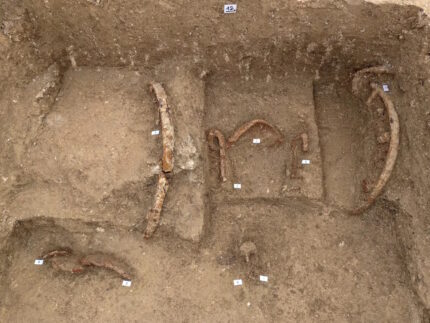
An excavation in Sirolo, a town in the province of Ancona in central Italys Le Marche region, has uncovered a princely chariot burial of the Picene people dating to the 6th century B.C. The burial is the center of a monumental circle and contains the remains of a currus, a two-wheeled chariot symbolic of the deceaseds aristocratic rank. Grave goods include a helmet, axe and other weapons.The chariot burial is part of a large Picene funerary complex from the 6th century B.C. The necropolis is organized around the monumental circle and was reserved for Picene nobles and aristocrats.Among the most surprising elements is the structure of the monument itself. Unlike other large funerary circles in the Piceno region, which are generally bounded by an annular ditch, the Sirolo complex was enclosed by a circular palisade, identified thanks to a regular sequence of post holes containing small ritual deposits with selected ceramic fragments. This is a solution previously unrecorded in this region.Also of particular interest are several large bronze vessels discovered in the chariot tomb. Still sealed with ceramic lids, they contained organic material, animal remains, and ceramic fragments that may represent evidence of the funeral banquet held during the burial or food offerings intended for the deceased.A second grave found next to the chariot burial, this one of a woman, is notable for its exceptional state of preservation. Remains of organic materials including textiles and shoes were uncovered. The clothing and shroud she was buried in were secured with a number of fibulae which have all survived, and one particularly large fibula with an amber stone in the middle found behind the deceaseds head which may have been part of a headdress or used in an intricate hairstyle. Archaeologists hope this burial will shed new light on the role of Picene women in the aristocracy.This discovery, emphasized archaeologist Stefano Finocchi, the excavations scientific director, finally allows us to reconstruct the original context of the warriors tomb discovered in 2020 and to place it within a larger funerary complex organized around a princely burial with a chariot. For the first time, we can observe not a single tomb, but an entire aristocratic group, with hierarchical and symbolic relationships that open up new perspectives on the structure of the elites who led the great Picene center that developed in the area of present-day Conero. The monumentality of the complex, the quality of the grave goods, and certain artifacts still under study outline the profile of ruling groups embedded in a dense network of relationships that connected the central Adriatic to the major centers of central Italy.




 English
 Arabic
 French
 Spanish
 Portuguese
 Deutsch
 Turkish
 Dutch
Dutch
 Russian
 Romaian
 Portuguese (Brazil)
 Greek
Greek