Why Did the Maginot Line Fail to Stop the 1940 Invasion of France?
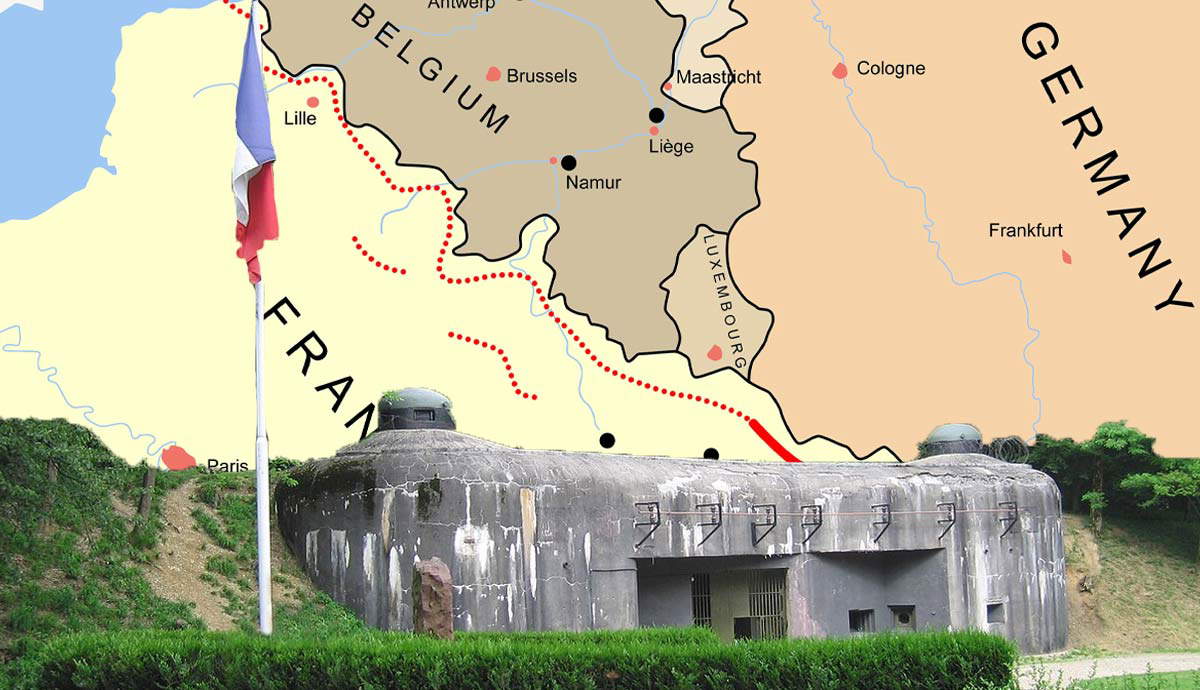
Informed by the massive loss of life in the First World War, France planned to avoid pointless mass casualties by choosing not to fight a soldier-intensive war of movement on the open battlefield, instead channeling its funds into a belt of armor dubbed the Maginot Line. The strategy became a foundational element of French military doctrine. It favored a methodical, deeply entrenched defense system supported by massive firepower over rapid maneuvers.Construction and Design of the Maginot LineEntrance to Ouvrage Schoenenbourg, Maginot Line in Alsace. Source: Wikimedia CommonsNamed after the French Minister of War Andr Maginot, who strongly supported the project, construction began in the late 1920s. The line was largely finished by late 1938 at an eventual cost of several billion francs. The enormous system consisted of concrete bunkers, obstacles, and mountings along Frances borders, with the heaviest fortifications, known as grands ouvrages, featuring a maze of underground connecting corridors linking barracks, electric generators, hospitals, ammunition stores, and warehouses to rooftop or near-rooftop fighting blocks. The blocks featured armed artillery bunkers, machine gun nests, observation cupolas, and disappearing (retractable) turrets.It Was Not Finished All the Way to the Belgian BorderMap of the Maginot Line. Source: Wikimedia CommonsAmong the questions most frequently asked today is why the project didnt extend down to the English Channel. Many people who make this argument seem to ignore the French-Belgian foreign policy of the era.The French did not extend heavy fortifications all the way to the sea for geographic, economic, and diplomatic reasons. Historically speaking, Belgium and France were close allies up until the Belgian neutrality crisis of 1936. In 1936, Belgium declared it would remain neutral if war came. The Belgians were afraid that if France built a wall on the French-Belgian border, the French would just leave them to be occupied by the Germans. As a result, the French agreed not to build heavy permanent fortifications on that border so that the Belgian army would still cooperate with French forces in the event of a German attack.Germany Invades France Through the ArdennesFrench soldiers on the Maginot Line. Source: Wikimedia CommonsWhen Germany invaded Belgium and the Netherlands on May 10, they used the Blitzkrieg tactic of fast-moving armored spearheads accompanied by close air support to catch Allied commanders by surprise. The German army started by making a strong attack through Belgium and the Netherlands to draw Allied forces northward. At the same time, German generals sent their main force of about 45 divisions, including most of their panzers, through the Ardennes forest. The French High Command was not expecting the main attack to come through the Sedan region. At the time, France and Britain had concentrated their best mobile troops in Belgium.Sedan, located between the Maginot Line and the northern armies defending Belgium, was left only lightly defended with out-of-date equipment and reservist troops. The German Meuse River crossing attack at Sedan, carried out by General Heinz Guderians panzer corps and other German units, soon overwhelmed French defenders. The Germans were able to rush to the English Channel after breaking through at Sedan, effectively dividing the Allied armies. They then attacked the French forces in the east, including many covering the Maginot Line.Army Group As AdvanceKeitel, Brauchitsch, Hitler, and Halder (from l. to r.) studying a map of France during the 1940 campaign. Source: Bundesarchiv / Wikimedia CommonsBetween May 13 and May 20, 1940, Germanys Army Group A advanced roughly 150 miles into France just five days after crossing the Meuse River. Frances 3-billion-franc defense system was simply bypassed overnight, a grotesque demonstration of the difference between outdated static fighting strategies and the more agile Blitzkrieg. By June 17, the invaders had reached Switzerlands border and cut off the French forces from behind the lines.Around 90,000 French soldiers were killed. Some 200,000 men were wounded, and 1.9 million French prisoners of war were taken during the six-week campaign. This was significant compared to German casualties of around 27,000 killed and 111,000 wounded. Soon, France surrendered, and the terms of the Compigne armistice were signed on June 22, 1940, in the very same railway car used during the 1918 armistice in which Germany signed the ceasefire agreement ending World War I. The agreement split France into occupied and unoccupied zones.




 English
 Arabic
 French
 Spanish
 Portuguese
 Deutsch
 Turkish
 Dutch
Dutch
 Russian
 Romaian
 Portuguese (Brazil)
 Greek
Greek