


WWW.THECOLLECTOR.COM
The 1898 Campaign That Made Puerto Rico an American Territory
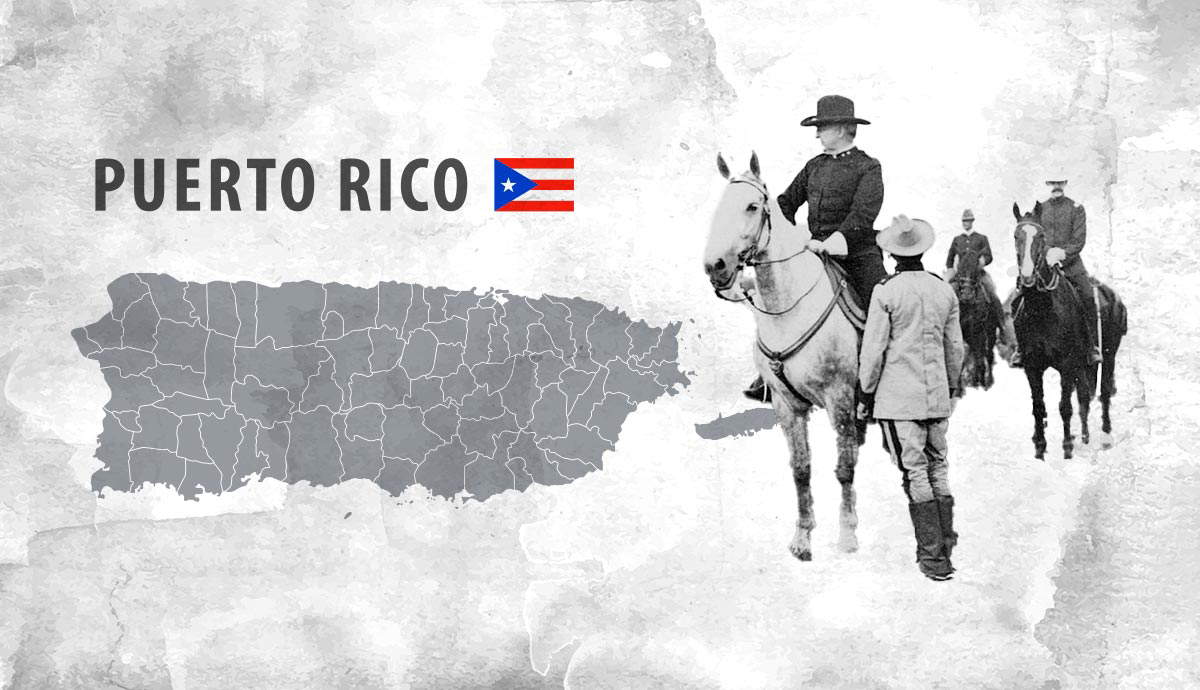
One of the most successful US military campaigns at the end of the 19th century was the conquest of Puerto Rico. Unlike the other battles to conquer Spanish-controlled territory, the seizure of Puerto Rico came at a low cost in lives and led to the US gaining control over a strategically significant territory.Why Did the United States Invade Puerto Rico in 1898?A map of every theater of the Spanish-American War in 1898. Source: United States Military Academy Department of HistoryAfter the sinking of the USS Maine in Havana in February 1898, the United States declared war on Spain, taking the opportunity to occupy as many Spanish colonies as possible. Washington hoped to establish itself as a dominant force in the Western Hemisphere and to show Europe that its military was a force to be reckoned with. Its main targets were Cuba, Puerto Rico, the Philippines, and Guam.Puerto Rico was a Spanish-controlled island that had long been on the radar of American policymakers as a strategic base. Unlike Cuba, it did not have an active revolution taking place there when the US invaded. In 1897, Spain decided to grant the island a degree of autonomy to avoid a repeat of the revolutions then convulsing what remained of the ailing Spanish empire.The locals were divided: some wanted more autonomy or full independence, others supported the status quo. The economy was based almost entirely on agro-exports and life was difficult for most of the one million-or-so inhabitants. The population was a mix of Spanish-born peninsulares, island-born criollos, and a significant population of African descent, with slavery having been abolished only 25 years earlier in 1873.The influential naval theorist Alfred Thayer Mahan argued for years that American control over Puerto Rico was crucial for American power projection. The Office of Naval Intelligence had been gathering information on Spanish defenses on the island since 1896. As early as 1894, the college began formulating plans for a war with Spain including an invasion of Puerto Rico. In the months before the landings, American spies traipsed the island to gather intelligence about Spanish manpower on the island.How Did General Nelson A. Miles Execute the Gunica Landing?General Miles after landing on Gunica Bay, 1898. US Library of CongressAfter the American declaration of war, the US Navy began bombarding Spanish ports in Puerto Rico to prevent Spanish ships from attacking American transport ships heading for Cuba and Puerto Rico. From May to August, American warships launched salvos at the fortifications of San Juan, the islands capital. Additionally, the US Navy devastated Spanish vessels sailing to intercept them. Over several months, two warships and several smaller steamships were sunk by the blockading American forces.These successes enabled the Americans to prepare an amphibious assault against Spanish positions. The grizzled combat veteran Major General Nelson Miles was assigned command of an American force numbering around 16,000 men. He planned to land the vanguard of his forces on the southern part of the island in Gunica Bay.Afterwards, he would launch a multi-pronged assault on San Juan. His force consisted of two divisions and several independent brigades of regulars and volunteers. The Spanish under Governor-General Manuel Macas y Casado had a similar number of men stationed all over the island, but many of their best troops had been sent to Cuba.On July 25, a detachment of American sailors and marines seized the Gunica Lighthouse. American troops began to pour ashore, helped by the fact that most Spanish troops were on the northern part of the island. General Miles had disregarded his orders and his landing on the southern shore surprised both the Spanish and his own superiors. He advanced quickly towards the city of Ponce and continued to attack Spanish positions in southern Puerto Rico.What Role Did Puerto Rican Civilians Play in the American Advance?A portrait of Jos Julio Henna Prez, a Puerto Rican activist who encouraged the US to invade the island. Source: FamilySearchAmerican forces were pleasantly surprised to be welcomed by the locals. Many Puerto Ricans had a poor standard of living and resented the declaration of martial law issued in 1898. While Spain had conceded autonomy and many Puerto Ricans served in Spanish uniform, Madrid never truly commanded the respect of the masses, while America was seen as a more successful, industrialized nation than Spain. The Cuban Revolutionary Party had a Puerto Rican section that encouraged pro-American sentiment on the island before the invasion.After the occupation of Ponce, General Miles issued his Proclamation to the Inhabitants of Porto Rico. He declared that the United States was a liberating force that would protect local property and rights. Additionally, he promised that US forces would treat the civilian population well. Its benevolent tone and the correct behavior of US troops encouraged large numbers of locals to provide intelligence to the Americans. No major insurgency developed in the rear of General Miless forces. US troops found themselves liberally supplied with food and other necessities by gracious Puerto Ricans.General Miles did face some challenges from the locals. A minority of islanders remained in Spanish ranks, either fighting pitched battles against the Americans or staging ambushes. Additionally, bands of peasants known as Partidas Sediciosas attacked major farms and stores due to the collapse of law and order. While these bands technically helped the Americans, they caused a problem because Miles did not want chaos to engulf the island while he seized it. He was forced to deploy troops to suppress these bands.What Were the Major Battles of the Puerto Rican Campaign?American troops near the town of Arroyo, 1898. Source: Fundacin Luis Muoz MarnGeneral Miles brought reinforcements ashore soon after seizing Ponce and divided his force into four columns. He planned to exploit the Spaniards confusion and use speed as a strategic weapon. All four columns were to unite outside San Juan for the final assault on the capital. Over the next several weeks, American and Spanish forces fought a series of engagements that led to the American conquest of the island.On August 5, Brigadier General Peter C. Hainss column moved east from Ponce to capture the port of Guayama. His men trounced a smaller Spanish force, but halted before formidable fortifications on Guaman Heights. A couple of days later, Major General James H. Wilson fought one of the most intense engagements of the campaign when he conducted a multi-front offensive against Spanish positions at Coamo. Notwithstanding a slight failure to seize the lighthouse at Fajardo, American forces made steady progress towards San Juan.As the US columns converged on the central mountain range, they faced their toughest test at Asomante, near Aibonito. For several days, American troops conducted reconnaissance of Spanish positions, aided by Puerto Rican scouts. On the morning of August 12, American troops under Colonel Samuel Reber attempted to storm Spanish artillery positions on the high ground. However, Spanish forces and local auxiliaries poured fire into the American attackers, forcing them to withdraw. Later that day, retreating Spanish forces were attacked on the Guacio River, leading to hundreds of casualties. On August 13th, a ceasefire was declared between both countries and Miles ordered his forces to halt before they could take control over San Juan.How Did the Treaty of Paris Solidify American Control?Exchange of the ratifications of the Treaty of Paris with Spain, 1899. Source: Library of CongressAfter conducting negotiations in France, American and Spanish diplomats made a peace agreement. On December 8, 1898, the Treaty of Paris was signed, ratifying a major victory for the United States. Spain was not only stripped of most of its overseas possessions, it also lost control over the Caribbean markets. The negotiations primarily concerned the future of Cuba and the Philippines, but the treatys provisions concerning Puerto Rico turned out to be very important for the islands future.Under Article II of the treaty, Spain officially ceded Puerto Rico to the United States. The US was granted full ownership of all former Spanish military installations and approximately 120,000 acres of public land previously owned by the Spanish Crown.Crucially, Article IX of the treaty specified that the civil rights and political status of the native inhabitants shall be determined by the Congress. This allowed the US to rule the island as an unincorporated territory indefinitely. This ambiguity caused significant problems because it allowed the United States to defer the decision on whether the island should be granted independence or statehood.For the next couple of years, the US maintained a military occupation of the island. The US implemented freedom of speech, press, and religion, established an eight-hour workday for government employees, and abolished the government lottery. However, a major hurricane devastated the island, killing thousands and causing a mass exodus of islanders. The US passed the Foraker Act in 1900, transferring the island to civilian control. However, the Supreme Court ruled in the Insular Cases that Puerto Rico was a territory that could not be granted full statehood. These decisions polarized Puerto Rican opinion and led to campaigns to change Puerto Ricos status.The Legacy of the Puerto Rican CampaignA protestor holds up a sign demanding independence for Puerto Rico, 2021. Source: The Progressive MagazineThe invasion of Puerto Rico was a textbook amphibious assault by the United States that secured the island at minimal cost. General Nelson Miles highlighted his military competence by exploiting Spanish weaknesses and driving the enemy back repeatedly. He did this without the customary 3-to-1 numerical advantage that an attacker usually requires when assaulting a defending force. In doing so, he secured control over an island that still plays a crucial role in US defense policy.Decisions by the United States over the following decades did not endear Washington to many Puerto Ricans. Despite American promises of liberty and economic advancement, much of the islands public remained in poverty for decades, thanks to poor decisions from the islands administrators and the wreckage from the hurricane. The Insular Cases made many islanders feel like second-class citizens. Additionally, much of the American public held deeply racist views towards Puerto Ricans.In the decades that followed, the islanders made gains to reverse some of the decisions made by the US in the aftermath of the war. The Jones Act of 1917 granted Puerto Ricans US citizenship. In 1948, Luis Muoz Marn became the first locally-elected governor. However, many hardliners continued demanding independence through force. The 1950s saw several terror attacks, including an attempted assassination of President Harry Truman.Since the 1960s, Puerto Rican politics has been dominated by the rivalry between the PPD (pro-commonwealth) and the PNP (pro-statehood), with multiple non-binding referendums consistently showing a population deeply divided over its future. The US may have occupied the island in an efficient manner, but it has failed to identify a sustainable path forward for its residents.
0 Kommentare
0 Geteilt
18 Ansichten

 English
 Arabic
 French
 Spanish
 Portuguese
 Turkish
 Dutch
Dutch
 Italiano
 Russian
 Romaian
 Portuguese (Brazil)
 Greek
Greek