


WWW.THECOLLECTOR.COM
Shock Therapy in Russia: The Economic Upheaval of the 1990s
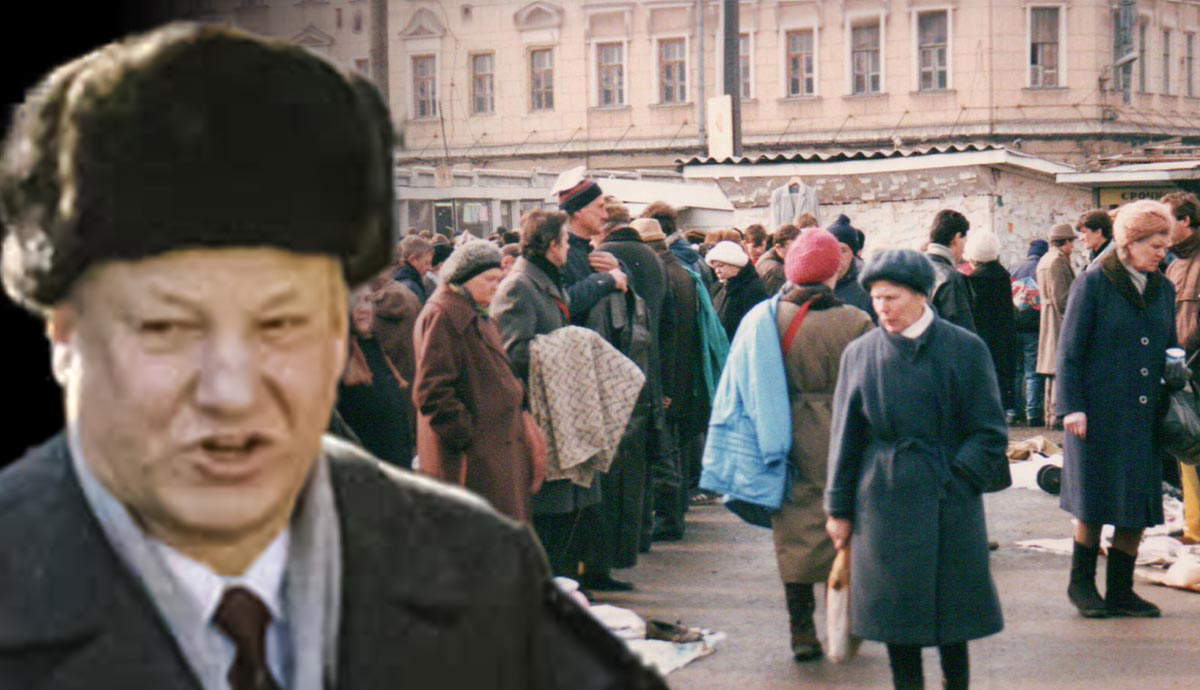
When the Soviet Union ended in 1991, the Russian economy was plunged into uncertainty. The newly independent nation was faced with the task of transforming a centralized economy reliant on government subsidies and incentives into a market-based system. To do this, Boris Yeltsin and his allies used shock therapy economics to revitalize the Russian economy to drastic effect. This article answers the question of what shock therapy was in Russia and looks at its many consequences, including the immediate and long-term economic and social repercussions.The Collapse of the Soviet Union: Causes & ConsequencesGorbachev Giving A Speech To The Communist Party, 1989. Source: Russia in Photo / Multimedia Art Museum of MoscowThe end of the Soviet Union in 1991 was the culmination of a decades-long stagnation and political upheaval that brought about the end of the communist system. The collapse was made possible by a combination of structural flaws, stagnation, and economic problems that made peoples lives increasingly difficult. The Soviet system was characterized by a rigid lack of flexibility that relied on the centralized planning initiatives that were successful in the early years of the USSR but failed to address modern problems. The end of the Soviet Union itself was foreshadowed by the collapse of the Soviet economy in the 1980s caused by falling oil prices and a lack of innovation in the industrial sector. By 1990, the Soviet economy was reduced in value to less than half that of its main rival, the United States.When Mikhail Gorbachev took office in 1985, he attempted to breathe new life into the Soviet economy and society with two policies: Glasnost, which promised openness, and Perestroika, which strove to rebuild the broken economy. However, instead of slowing the decline of the USSR, Gorbachevs policies merely accelerated it as political turmoil increased, and the Soviet republics began to demand more autonomy within the system and eventually called for independence.When the USSR finally broke up in December 1991, fifteen newly independent countries were created, with the bulk of the Soviet Unions industry and resources inherited by Russia. President Boris Yeltsin was tasked with taking a broken Soviet economy and turning it into a modern capitalist market. This was a monumental undertaking as Russia also inherited the economic obligations of the USSR, including a huge military budget. These challenges prepared the groundwork for a drastic policy known as shock therapy.How the Soviet Economy Worked Before 1991Soviet Garment Factory Workers, 1967. Source: Wikimedia Commons / RIA Novosti archiveBefore it collapsed, the Soviet economy was centralized in Moscow, where various economic targets were set, prices were fixed, and a planned structure was followed. This planned economy was first put in place during the collectivization policies that Joseph Stalin used to modernize the economy in the 1930s. In the 1930s, centralized planning involved strict state control over all economic activity, intensive industrialization, and collectivization of agriculture. While the planned Soviet economy was initially successful in achieving widespread industrialization of the USSR, it could not compete with the increasing digitization that transformed the West.The Soviet economy in the 1970s and 80s was plagued by a chronic shortage of consumer goods, an overabundance of certain items that resulted from the absence of market mechanisms, and a lack of profit incentives or competition. The problems of the Soviet economy were made even worse by widespread corruption that flourished under a system that was held back by a stifling bureaucratic class. As the Soviet Union entered the 1980s, the economy stumbled, and the standard of living for many fell far below that of the West.Russia Begins a Transition to a Market EconomyYeltsin Near a Polling Station During a Referendum of the Future of the Soviet Union, 1991. Source: Vladimir Vyatkin / Smart HistoriesIn the early 1990s, Boris Yeltsin implemented several drastic measures to accelerate the transition to a market economy. One such measure was the shock therapy doctrine, which aimed to liberalize the financial sector in a matter of weeks.The shock therapy approach involved the rapid removal of pricing controls, the signing of new free trade agreements, and the privatization of state-owned businesses. By letting market forces decide how to allocate resources, Yeltins government aimed to end the persistent shortages that had been a daily struggle during the Soviet Union.However, these policies caused inflation to spiral out of control as the cost of previously subsidized commodities increased dramatically. The newly introduced trade liberalization also made it possible for foreign companies to compete in domestic markets, which was disastrous for local industries that were used to the isolation of the Soviet Union and were not ready for such a quick transition.The Soviet Economy Meets PrivatizationVladimir Golovlev Chairman of the Chelyabinsk Investment Fund, 1992. Source: Russia in Photo / State Historical Museum of the Southern UralsOne of the main components of the shock therapy period was privatization, which sought to move Russia from a state-run command economy to one that was focused on the influences of the free market. Privatization aimed to give the private sector ownership of state-owned firms in order to increase competition, efficiency, and innovation. However, the procedure was convoluted, divisive, and full of major obstacles and unexpected repercussions.One goal of privatization was to shift enormous amounts of public property into private ownership, creating a new class of business owners and boosting economic growth. However, the process was largely unfair, as former Soviet industry leaders who held sway over the economy were given priority when it came to privatization. As a result, corruption became widespread.Yeltsins Disastrous Loans-For-Shares SchemeSeller Offers Vouchers On The Streets, 1992. Source: Russia in Photo / State Historical Museum of the Southern UralsIn an effort to spread the wealth of privatization, the Russian government gave out privatization vouchers, or shares of the countrys wealth, to the Russian people between 1992 and 1994. The goal was to disperse ownership broadly and encourage public participation in the recently privatized economy. The reality, however, was quite different: many people, driven by financial need and ignorant of market dynamics, sold their vouchers for a low price to local business owners and enterprising individuals. This led to an unequal concentration of vouchers in the hands of a select few who obtained huge shares in massive state-owned companies.The Russian government launched a more contentious stage of privatization in 1995 with the loans-for-shares program. In this strategy, the government pledged shares in significant state-owned firms as collateral in exchange for borrowing money from private banks. The shares were auctioned off at rates much below their market value, and the banks that had given the loans were frequently the winners. As a result, a new class of oligarchsextremely wealthy, politically connected people who gained substantial control over vital industries like oil, gas, and natural resourceswere created.The Key Figures and Influencers in Russian Economic ReformRussian President Boris Yeltsin and Acting Chairman Of The Russian Government Yegor Gaidar (left), 1992. Source: Russia in Photo / Yeltsin CentreDuring the years of shock therapy, a number of significant individuals shaped Russias economic transformation. Leading the charge was Russian President Boris Yeltsin, whose vision for Russia was based on quick and drastic changes to the market. Yeltsin supported radical economic policies because he thought quick change was better than slow reform.Anatoly Chubais, who served as Yeltsins principal economic counselor and subsequently as his deputy prime minister, played a crucial role in the privatization effort. He was the driving force behind voucher privatization, which aims to disperse public assets. However, Chubaiss initiatives drew criticism from the Russian people as they encouraged corruption and economic inequality.The mastermind of the shock therapy doctrine was Yegor Gaidar. As acting prime minister in 1992, Gaidar pushed forward significant economic reforms such as fiscal de-regulation and pricing liberalization. Internationally, influential thinkers such as American economist Jeffrey Sachs also had an impact. Sachs worked with reformers in Russia to develop shock therapy policies and persuaded the Russian government to go ahead with quick changes to the market based on comparable policies undertaken by governments in Eastern Europe and Latin America. However, because of the unique complexity of the Soviet economic system that Russia had inherited, such advice proved disastrous.The Immediate Economic Impact of Shock TherapyA Street Market In Rostov-On-Don, 1992. Source: Wikimedia Commons / Brian KelleyShock therapy had immediate and catastrophic consequences for ordinary people. Inflation reached unimaginable heights in the 90s, rapidly diminishing the purchasing power of the average Russian and making them much less well off than they were under the Soviet Union. Inflation rates reached over 2,500% in 1991-1992, which completely devalued savings and fixed incomes. The abrupt elimination of price controls and the liberalization strategy that allowed market forces to set pricesconverting the state-subsidized economy into a free market in a matter of monthswere the main causes of this hyperinflation.Millions of people lost their jobs when hundreds of state-owned businesses collapsed or downsized due to an inability to survive in the new competitive climate, and government subsidies were cut. During this period, Russias GDP plunged dramatically, shrinking by about 40% between 1991 and 1996. The banking industry also had difficulties, with numerous banks failing due to the strain of abrupt shifts in the economy and unstable financial markets. The volatility of the Russian currency made foreign investment and international trade even more difficult.The Social Consequences of Economic DeclineEmpty Shelves In A Shop After Price Liberalization, 1992. Source: TASSThe economic disaster of the 1990s caused by shock therapy had dire societal repercussions. The economic collapse led to mass poverty, reduced life expectancy, and a massive decline in living standards. For the majority of Russians, shock therapy meant economic ruin. Some studies have since shown that by the mid-1990s, approximately 40% of the population was living below the poverty line.The consequences of shock therapy also caused a sharp rise in inequality. A tiny number of oligarchs and well-connected people gained enormous wealth as a result of privatization, while the majority of people saw their living standards deteriorate and their salaries decline. This widening gap made social unrest worse, added to the general disenchantment with Yeltsins reforms, and made people wish for a return to the relative stability of the Soviet Union.Formerly essential components of Soviet social policy, such as healthcare and education, saw severe underfunding and a decline in quality. A catastrophic drop in life expectancy coincided with the emergence of public health concerns, such as the rise in drug and alcohol abuse, infectious illness outbreaks, and alcoholism. The new economic realities proved too much for social safety nets like pensions and unemployment benefits, which left many vulnerable people, especially the elderly and those with disabilities, in abject poverty.The Legacy of Shock TherapyWoman Exits Kiosk Shop, 2020. Source: Public Domain / PexelsShock therapy left the Russian economy with a divided legacy. On the one hand, the privatization of state-owned businesses did result in the establishment of a more vibrant private sector. Increased international investment and trade contacts also contributed to Russias enhanced integration into the global economy.On the other hand, the Russian economy continued to be highly dependent on the export of natural resources, specifically oil and gas, which left it vulnerable to changes in the price of commodities globally. Rapid privatization left behind a lopsided income distribution and a class of super-rich oligarchs that used their wealth to influence the politics of the nation.While some Russians saw their standard of living rise, many still had to deal with inequality and economic instability. Russias political and economic environment today is a result of the long-lasting damage caused by the social and economic upheaval of the 1990s.
0 Commentarios
0 Acciones
23 Views

 English
 Arabic
 French
 Portuguese
 Deutsch
 Turkish
 Dutch
Dutch
 Italiano
 Russian
 Romaian
 Portuguese (Brazil)
 Greek
Greek