Lewis Carroll vs. the Biscuit tin
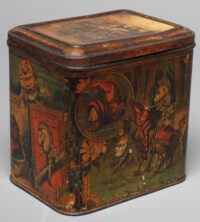
Biscuit tins became a thing in Britain after 1860 when the first time the Refreshment Houses Act and the Treaty of Commerce allowed printed paper labels to be affixed to food and beverages. Once colorful, eye-catching labels could be added to food packaging, new processes were developed to make it easier. In 1877, offset lithography was patented that made printing directly onto tin containers of various shapes possible.Decorative tinware took off, reaching its pinnacle of intricate, creative design before World War I. Lewis Carrol got on the biscuit tin trade in 1891 when manufacturers Barringer, Wallis and Manners contacted him with the idea of making an Alice in Wonderland-themed tin. It would be printed with polychrome scenes based on the illustrations by John Tenniel for Carrolls Through the Looking Glass and What Alice found there, the sequel to Alices Adventures in Wonderland published in 1871. The original illustrations were printed in black and white, so the idea of a vividly colored version decorating a cookie tin seemed a cant-miss idea to appeal to children and their parents who had grown up with the books.Barringer, Wallis and Manners created a tin with a rectangular base , straight sides and rounded corners. The sides and outside of the lid were printed with the labelled illustrations : The Red King Asleep, The Battle Between the Red and White Knights, Alice the White King and the Messenger, Alice and the Fawn, Alice and the Red Queen, Tweedledee & Tweedledum, Humpty Dumpty Offering his Hand to All and The White Knight Sliding Down the Poker.Tenniel had illustrated Alices Adventures in Wonderland and found Carroll a micromanaging tyrant, so much so that he refused Carrolls first request that he illustrate the sequel, and only agreed after he received assurances that he could work at his own pace. Barringer, Wallis and Manners soon found themselves on the business end of Carrolls control freakery and whiplash-inducing changeability.The initial offer was Carroll would receive 50 gift tins. He declined on the grounds that it was too many and hed look like a sellout. Then he changed his mind and wrote them that actually 50 wasnt enough and he needed 100 to give away to his friends and family, including Alice Liddell, model for Alice in the books. Then he got mad that they included a note that the tin was compliment of Charles Dodgson, exposing his real name to the factory workers. Then he got mad that the tin came with a W.R. Jacob & Co label on the inside of the lid. They were the makers of the biscuits so naturally they added a label to that effect, but Carrolls preferred cookies were Huntley and Palmers so he was offended.Then he did something so deranged, the poor tin makers must have wanted to choke him. He insisted that the rest of the tins should be sent to his recipients WITHOUT ANY BISCUITS INSIDE. Yes, he was sending gift biscuit tins to friends and family, many of them children, so they would open the lid with all the enthusiasm a kid can muster for cookies, only to find theyd been sent an empty container.Today the Alice biscuit tins are prized collectors items, found in museums including the V&A, the Guildford Museum and the Museum of Oxford. One came up for auction on the 17th with a pre-sale estimate of 600 900. It sold for 2900 even though theres small but noticeable areas of damage to the lithography. The story of Lewis Carroll vs. the biscuit tin has made them all the more desirable.




 English
 Arabic
 French
 Spanish
 Portuguese
 Turkish
 Dutch
Dutch
 Italiano
 Russian
 Romaian
 Portuguese (Brazil)
 Greek
Greek