


WWW.THECOLLECTOR.COM
7 Mythical Weapons That Arent Swords
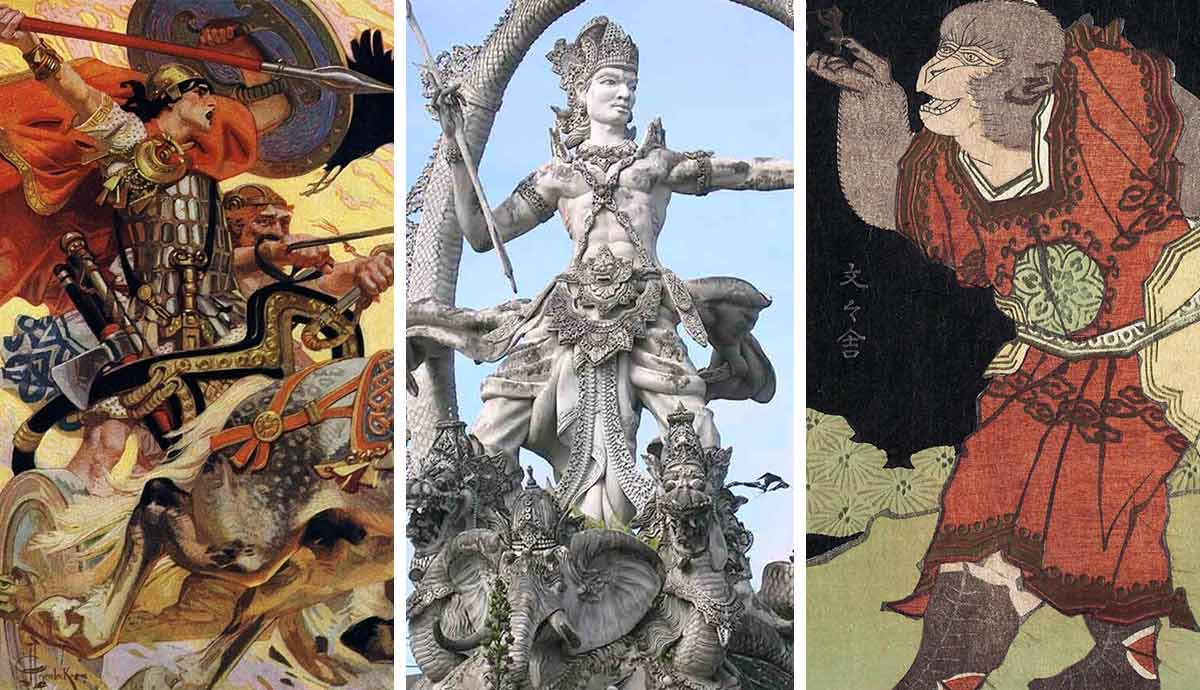
Special weapons are a common element in ancient myths and legends, often wielded by a hero or a deity. Most famous mythical weapons featured in stories retold today are swords. The sword has a reputation for heroic mystique stemming from stories of Excalibur, Zulfiqar, and other weapons. However, there are just as many divine weapons that are not swords, for various reasons that the tale-tellers of the time felt appropriate.If you want to learn the values that a culture cherishes, be it ancient or modern, look to the heroes of its stories and how they are depicted. A spear might represent discipline or martial skill, a club might represent raw ferocity, and a bow might denote calmness under pressure, or a regal demeanor.1. SharurNinurta with his thunderbolts pursues Anz, who has stolen the Tablet of Destinies from Enlils sanctuary, from Monuments of Nineveh, 2nd Series, by Austen Henry Layard, 1853. Source: Wikimedia CommonsThe god Ninurta, son of Enlil and Ninlil, one day was in celebration of a festival honoring him and the other gods. As he was feasting and drinking, the lion-headed mace Sharur, which belonged to Ninurta, flew and kept watch over the world. It spoke, warning Ninurta of the primordial demon Asag, born of the earth itself, who commanded the stones, and his aim of usurping Ninurtas rule.The storm god went forth with Sharur and other weapons at his side and fought with the demon, their battle wreaking havoc upon the land and upon the peoples of the area. Sharur took the form of a winged lion and devoured his enemies. Ninurta went on to dictate the uses of the different types of rock that Asag had raised in rebellion.The above is documented in Lugal-e, a Sumerian praise poem dedicated to Ninurta, who was said to have dominion over agriculture, storms, and war. Such a diverse portfolio is common amongst earlier polytheistic deities. The weapon Sharur (said to mean smasher of thousands) symbolizes the wrath of thunderstorms, a motif common for war deities. The weapon also possesses sentience and the ability to speak and move independently, acting as a valued counsel to Ninurta.2. GandivaIllustration of Draupadi garlanding Arjuna, c. 1899. Source: Wikimedia CommonsLong ago in India, two factions of a family warred for power: the Pandavas and the Kauravas. The third of the five Pandavas, named Arjuna, was said to be the mightiest and most devoted warrior. He was said to have the aspect of Indra, the god of war and the sky. After his youth spent learning the arts of war, Arjuna is said to have gone into exile for twelve years for breaking a covenant with his other two brothers. During this time, he refined his skills and received several celestial weapons, one of which was the bow Gandiva.It was given to him by the water goddess Varuna at the request of the fire god Agni for burning down the Khandava Forest and killing all the living beings in it for the god to eat, replenishing his power so that the forest could be cleared away for new growth. This is, by modern standards, a horrific act, but what must be remembered about myths and legends is that they are often allegories for natural phenomena and historical occurrences. In this case, Arjuna, as a member of the kshatriya, was bound by oaths of fealty to the gods.State of Arjuna in Bali. Source: Wikimedia CommonsArjunas exploits are recorded in the Mahabharata, one of the two epic poems of India. The bow Gandiva has 108 strings, one of which is made of indestructible celestial sinew, and two quivers that contain an infinite supply of arrows. The bow is so heavy and so hard to draw that only Arjuna among half-mortals was able to use it. This is a common motif among divine weapons, wherein only a certain entity can wield it.Gandiva was created by Brahma for use against those who would defy the cosmic order, and passed down through several owners before Arjuna. He later used it to slay much of the opposing army in the Kurukshetra War.3. Pelian SpearThe Education of Achilles by Chiron, fresco from Herculaneum, 1st century AD. Source: Wikimedia CommonsNear the top of Mount Pelion in Thessaly grew a forest of ash. Made from one of these trees, possibly by the centaur Chiron, was a sacred spear destined to be used by the greatest heroes of Greek myth. Chiron presented the spear as a gift at the wedding between Peleus and Thetis.The divine essence of the weapon showed in its point, which was described as having an appearance of divine sunlight or fire. Given the time period, the spear likely would have had a bronze tip, and its appearance could be attributed to being exceptionally polished. It was also extremely heavy, to the point that only Peleus could wield it, but perfectly balanced in his hands.Peleus passed the weapon down to Achilles, who bore it across the Aegean Sea to fight in the Trojan War. One seldom-mentioned myth about the Pelian Spear was its supposed healing abilities. After a duel with Telephus, the king of Mysia, Achilles was said to have let a few droplets of rust fall into the wound, causing it to heal almost instantly.4. Ame-no-NubokoIzanagi with Ame-no-Nuboko, silk print, by Kobayashi Eitaku, 1880s. Source: Wikimedia CommonsBefore the universe was created, all of existence was a dark, cold, jellylike mass of roiling chaos, the raw energy of creation. Looking down from the Floating Bridge of Heaven, the kami Izanagi-no-Mikoto took the sacred spear Ame-no-Nuboko, which was given to him by the elder kami, and dipped the point into the ocean. When he withdrew it, droplets of water fell and coalesced and became the islands of Japan. So it is written in the Kojiki and the Nihon Shoki, the two foundational texts of Shinto.Ame-no-Nuboko is most often drawn as a yari, one of the most basic spear designs. Sometimes, though, it is depicted as a naginata, with sacred magatama jewels hanging from it.Unusually, this weapon has little confirmed role beyond the creation of the Japanese islands, but sometimes it is said to be the weapon that Izanagi used to kill the fire kami Kagutsuchi upon his birth.5. Ruyi Jingu BangThe Monkey King Songoku, from the Chinese Sun Wukong, by Yashima Gakutei, 1824. Source: The Met MuseumThe story of the Monkey King, Sun Wukong, resonates throughout Chinese literary culture and has been retold a number of times. One of the most persistent aspects of the story is the Ruyi Jingu Bang, Sun Wukongs staff. Unlike many of the other examples weve listed, this weapon doesnt come from Chinese mythology, but is rather a literary invention. In the novel Journey to the West, the staff is said to have originally been used by Yu the Engineer, or Yu the Great, to measure the depths of rivers and lakes to combat floods.Sun Wukong is said to have retrieved the Ruyi Jingu Bang from the Undersea Dragon Kings palace, where it was a support pillar. The name of the staff means something akin to compliant golden-ringed rod, and it has the ability to change its size to whatever the user wants it to be.The staff was said to be made of celestial black iron and weigh 17,000 lbs (exact translations vary), obviously far too heavy for anyone else to lift. The theme of a weapon being too heavy or unwieldy for any but its chosen warrior is a common theme amongst mythologies around the world.6. MjolnirThor, Hymir, and Jormundgandr, 1765-66. Source: Norse-Mythology.orgMjolnir hardly needs an introduction. The hammer of Thor, forged by the dwarves Brokr and Eitri/Sindri, is perhaps the second most well-known weapon in mythology, aside from Excalibur. The name Mjolnir means crusher and is derived from a proto-Indo-European word for lightning. Like lightning, Mjolnir could be thrown at a target at blinding speeds and made to instantly return to Thors hand. He used it this way frequently to slay jotnar, one of his most common foes.Unlike in the Marvel depiction, Mjolnir had no discrimination of so-called worthiness. It was simply a matter of strength, and even Thor himself needed to wear magical gloves and a belt to grant him enough strength to wield it. In the Prose Edda, Thors greatest feat with Mjolnir will occur during Ragnarok, the end of the world. He will use it to slay the World Serpent, Jormundgandr, in a mutual kill.Mjolnir has more than just a destructive, violent background: it was often used, or represented, in many consecration and healing rituals. Although Thor is considered a warrior deity, he is also a protector. Mjolnir was seen as a tool of protection and, strangely, fertility. This could tie into the symbolism of lightning clearing the way for new growth from fertile soil.7. Gae BolgCu Chulainn with spear, 1910. Source: Wikimedia CommonsThe spear Gae Bolg, made from the bones of a sea monster, is perhaps the most recognized weapon in Irish mythology. It was used mainly by Cu Chulainn, but passed through many hands throughout its existence, such as those of Scathach, who also taught Cu Chulainn how to fight.There are several different interpretations of its name, such as belly spear, barbed spear, or grievous death. It is one of the more brutal weapons on this list. Upon being thrust into an enemy, the spear would erupt a series of barbs in all directions, making the spear impossible to pull out without the barbs breaking off inside the victim.One of the most unusual properties of Gae Bolg is its method of wielding: it could be used as a normal spear, or it could be thrown by being gripped in between the big and second toes.
0 Commentarios
0 Acciones
21 Views

 English
 Arabic
 French
 Portuguese
 Deutsch
 Turkish
 Dutch
Dutch
 Italiano
 Russian
 Romaian
 Portuguese (Brazil)
 Greek
Greek