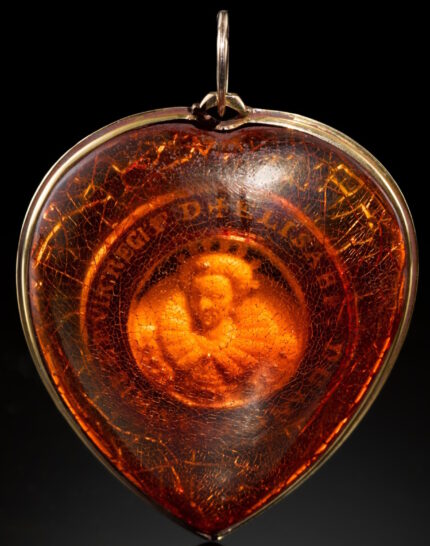
Amber pendant with microcarved portrait of Queen Elizabeth I
An extremely rare amber pendant with an embedded portrait cameo of Queen Elizabeth I will be going under the hammer at Sothebys on July 1st. It dates to around 1600, the very end of Elizabeths reign. What makes the heart-shaped Baltic amber pendant so rare is the microcarved portrait of Elizabeth encased inside it. The level of detail is so exceptional it makes the pendant one of the most sophisticated amber objects in existence today.Its not possible to determine the material the portrait was carved out of, but based on other highly-prized amber objects from the period, it was probably made out of white amber or a compound with a high proportion of tin. A concave hollow was cut from behind into the amber heart and the portrait embedded under it. The curved surface served to magnify the image.The painstaking technique is typical of the work of the finest amber jewelry makers in the town of Knigsberg on the Baltic coast in the late 16th century. It is therefore attributed to Hans Klingenberg or Georg Schreiber, goldsmiths and amber carvers at the court of Albert Frederick, Duke of Prussia, in Knigsberg between 1593 and 1648. The marked similarities with the incredibly gorgeous amber chessboard King Charles I brought to the scaffold on the day of his execution makes Georg Schreiber the leading candidate.Carved after a 1592 engraving by Crispijn de Passe the Elder, the portrait is surrounded by an inscription that reads: ELISABET D G ANG: FRAN: HIB: ET: VIR: REGI: F: D + [ELIZABETH THANKS BE TO GOD QUEEN OF ENGLAND, FRANCE, IRELAND AND VIRGINIA DEFENDER OF THE FAITH]. The same inscription frames Crispijn de Passes engraving. The reverse of the pendant has a cameo of a parrot or popinjayThe jewel also holds strong symbolic significance. At the time, encasing a portrait in amber was seen as a way of preserving its memory. The figure of Elizabeth I, enveloped in the golden radiance of the material, thus appears eternally preserved, as if to safeguard the memory of the Elizabethan era. On the reverse side is a depiction of a parrot, a symbol traditionally associated with the Virgin Mary and puritya clear reference to the image of the Virgin Queen that Elizabeth promoted throughout her reign.Its documented provenance goes back to the 19th century when it was acquired by the Scottish politician John Malcolm, 1st Baron Malcolm of Poltalloch, who amassed one of the most important art collections in Britain. His Old Master drawings, including works by luminaries including Michelangelo, Raphael, Rembrandt, Rubens and Canaletto, was so important the British Parliament gave the British Museum a grant to acquire it.The pendant was in the Malcolm family by descent until last year when it was sold to a private collector who is now selling it at auction. The pre-sale estimate is 100,000-150,000 ($132,000-198,000).




 English
 Arabic
 French
 Spanish
 Portuguese
 Deutsch
 Turkish
 Dutch
Dutch
 Russian
 Romaian
 Portuguese (Brazil)
 Greek
Greek