


WWW.THECOLLECTOR.COM
How the Athenian General Miltiades Beat the Superior Persians at Marathon
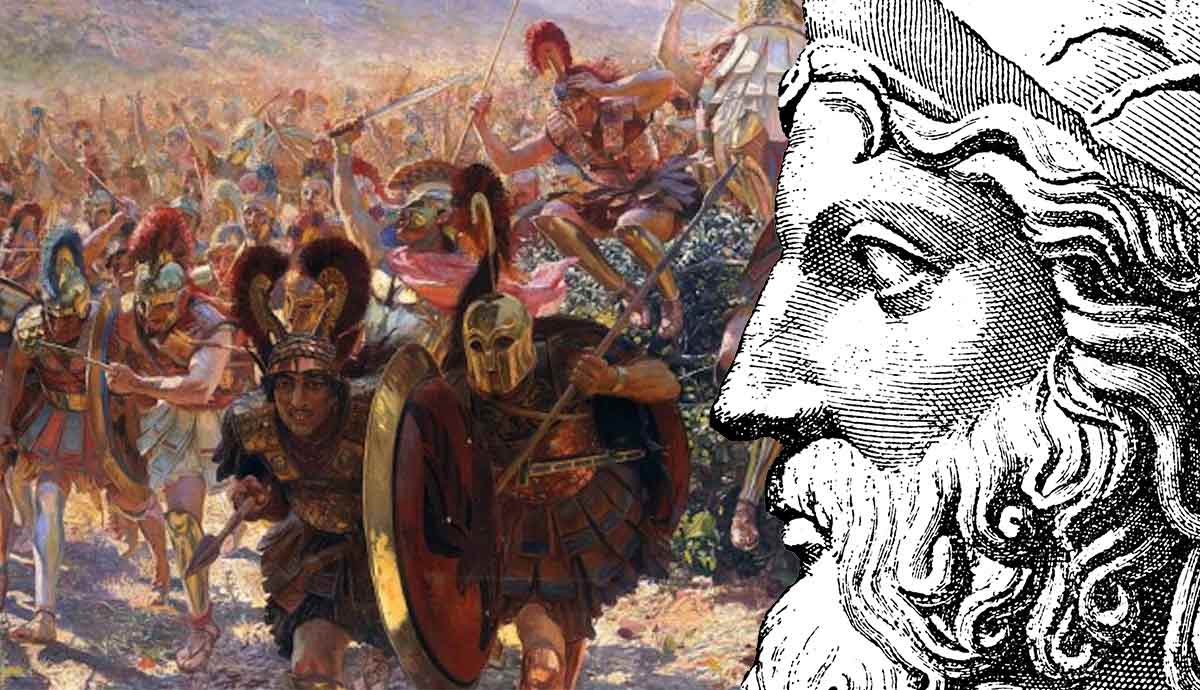
The Battle of Marathon is one of the most famous battles of antiquity. Perhaps best known for inspiring the long-distance race of the same name, the battle has also been regarded as the triumph of freedom over despotism. Victory at Marathon owed much to the Athenian general Miltiades, who had previously fought alongside the Persians and knew how to exploit their weaknesses. His bold tactics ensured a lopsided victory against an enemy hitherto considered invincible.Son of Athens, Vassal of PersiaThe Helmet of Miltiades, 6th century BC. Source: Archaeological Museum of OlympiaMiltiades was born in Athens in c. 550 BC to a prominent family known for their chariot-racing prowess in the ancient Olympic games. He was named after his uncle Miltiades the Elder, who was the ruler of the Athenian colony on the Thracian Chersonese, the present-day Gallipoli Peninsula.The younger Miltiades grew up in Athens in the household of his father, Cimon. The historian Herodotus claims that Cimon was killed by the sons of the Athenian tyrant Peisistratus because they were jealous of him winning three Olympic chariot-racing prizes in a row. However, Miltiades served as archon or chief magistrate of Athens in 524 BC, suggesting that he was on good terms with Hippias, the son of Peisistratus.Miltiades the Elder died in 520 BC and was succeeded by his nephew Stesagoras, Cimons eldest son. Stesagoras was an unpopular ruler who was murdered in 516, Hippias dispatched the younger Miltiades to succeed his brother as tyrant (i.e. autocrat) of the Chersonese. To consolidate his position, Miltiades pretended to be in mourning for his brother and proceeded to arrest the local elites when they called on him.Relief of Darius the Great, Persepolis, 500 BCMiltiades realm was separated from Persian-ruled Asia Minor by the narrow straits of the Bosporus and the Dardanelles. The Persian king, Darius the Great, was the ruler of the largest empire the world had ever seen. The Persians were accomplished archers and spearmen on horseback and on foot, but a volley of Persian arrows was usually enough to put the enemy to flight.In 513, Darius launched his campaign against the Scythians in Ukraine. His march took him through the Thracian Chersonese, and Miltiades quickly submitted to the Persians. He accompanied Darius during the Scythian campaign up to the River Danube and was able to observe Persian battle tactics at close quarters.While Darius returned to Persia, he left behind a large army under his cousin Megabazos, which marched into Thrace and occupied parts of present-day Bulgaria and northern Greece. Miltiades may have joined Megabazoss campaign, since he married Hegesipyle, the daughter of King Oloros of Thrace.As a Persian vassal, Miltiades may have also conquered the nearby islands of Lemnos and Imbros.The Ionian RevoltThe Roman Stoa of Miletus. Photograph by Jimmy Chen, 2024. Source: Jimmy ChenWhile Miltiades was ruling the Thracian Chersonese, the Athenian tyrant Hippias was overthrown by a Spartan invasion in 510 BC. While the Spartans hoped that the new Athenian government would support Spartan interests, the Athenian statesman Cleisthenes filled the power vacuum and introduced democratic reforms, leading to the prospect of further Spartan intervention.In the face of Spartan aggression, Athens sought an alliance with the Persian Empire. An agreement was made in 507, but while the Athenians believed they had entered into an alliance of equals, the Persians considered it a show of submission. News of the agreement led to the disintegration of the Spartan-led coalition that was preparing to invade Athens in 506, but the confusion over its terms would eventually lead to hostilities between the Athenians and the Persians. The deposed Athenian tyrant Hippias had sought assistance from the Persian court, but the Athenians refused a Persian demand to reinstate him.In 499 BC, the Ionian Greeks in northwestern Anatolia rose in revolt against Persian rule. After some early success, the Ionians requested assistance from the Athenians, who sent 20 ships and joined a successful raid on the city of Sardis in 498. Greek fortunes declined thereafter as the Persians assembled their forces on land and sea and gradually pushed back the Greeks. By 494 the Persians captured and sacked Miletus, the epicenter of the Ionian Revolt.Miltiades allegiances during the conflict is unclear. Darius appears to have regarded him as a loyal vassal, but Miltiades decision to return to Athens in 493 BC indicates that his true loyalty lay with his native city. However, the Athenians soon put him on trial for his previous association with Hippias and for his submission to the Persians. Miltiades was acquitted, but suspicion remained.The Persian InvasionMap of the Greek world during the Persian Wars. Source: Wikimedia CommonsAlthough Athens played no further part in the hostilities after the sack of Sardis, Herodotus claims that the city was now firmly in Darius crosshairs for repudiating the agreement of 507. By summer 493, Darius began building a fleet for the invasion of Greece and sent envoys to the Greek city-states requesting their submission. While many complied, Athens and Sparta defied the King of Kings by executing the Persian envoys. Among the advocates for this hardline policy were Miltiades and Themistocles, the Athenian commander who would later defeat the Persians in the naval battle at Salamis in 480.In 492, a Persian force commanded by Darius nephew and brother-in-law Mardonios made further encroachments into Greece, taking over the northern regions of Thessaly and Macedon. The campaign set the stage for the invasion of 490 under the joint command of Darius nephew Artaphrenes and a general named Datis.According to Herodotus, the Persian invasion fleet amounted to 600 triremes, while later writers claimed that the Persians had up to half a million men. Modern estimates suggest that the Persians had 60,000 men at most, with 24,000 soldiers and 36,000 rowers. Such a force was insufficient for a full-scale campaign in Greece, suggesting that Dariuss primary objective may have been to capture the Cyclades Islands, including the large island of Naxos and the important religious site of Delos.Having successfully achieved these objectives, the Persians nevertheless continued towards mainland Greece in an effort to subjugate the Greek cities that had not yet submitted. After capturing the city of Eretria on the island of Euboea, Athens was next in line.Athens AloneBust of Miltiades, courtesy of Greek ReporterWith the Persians poised to land in Attica, the Athenians sent requests for assistance throughout Greece. They received positive responses from nearby Plataea, a traditional ally with no more than 1,000 soldiers, and Sparta, a traditional rival who happened to be as hostile towards the Persians.Athens was the largest of the Greek city-states and could field as many as 10,000 citizen hoplites and a similar number of light infantry. In spring 490, Miltiades had been elected one of the ten generals in Athens, perhaps owing to his experience in Persian service. While some Athenians believed they could survive a Persian siege, Miltiades proposed that as soon as the Persians landed in Attica, the Athenians should leave the city and advance against them. His motion was duly passed by the Athenian assembly.The exiled Athenian tyrant Hippias accompanied the Persian invasion force and was a source of valuable intelligence. Hippias advised Datis to land at Marathon, since it was close to Eretria and offered relatively open ground suited to Persian cavalry. In accordance with Miltiades policy, the Athenian army marched north to confront the Persians.Before embarking on the march, the Athenian generals sent an urgent message to their Spartan allies. According to Herodotus, the runner Pheidippides (otherwise known as Philippides) covered the 150-mile distance in a day-and-a-half. The Spartans informed the messenger that they were prepared to help, but they could not leave straight away. The Spartans were particularly pious and were celebrating the Karneia, a festival dedicated to Apollo and the most important religious event on the Spartan calendar. By the time 2,000 Spartan hoplites arrived at Marathon, the battle was already over.Victory at MarathonThe heroes of Marathon.Georges Rochegrosse, 1859. Source: Wikimedia CommonsWith the exception of the small Plataean contingent, the Athenians would have to face the Persians alone. Although the decision to march to Marathon was taken on Miltiades initiative, he was only one of ten Athenian generals who were subordinate to Callimachus, the polemarch or commander-in-chief. When the Athenian generals were evenly divided on whether to wait for the arrival of the Spartans, Miltiades persuaded Callimachus to vote in favor of a battle.Nevertheless, Miltiades did not attack immediately. A popular theory suggests that Miltiades was encouraged to attack after seeing the Persians embark part of their army to target Athens directly, though there is little evidence for this. Historian Peter Krentz argues that Miltiades had observed the Persian preparations over several days and decided to attack early in the morning before the Persian cavalry was in position (Krentz, p. 143).While the Athenians may have been outnumbered at Marathon, they were more heavily armored and had an advantage in close-quarters combat. Given his previous experience with the Persian army, Miltiades believed that victory could be possible so long as the Athenians closed with the enemy quickly enough before they were overwhelmed by the Persian archers and cavalry.On the morning of battle, conventionally dated to September 12, 490 BC, the Athenian army drew up in formation and marched across the Plain of Marathon towards the Persian camp. They paused around a mile away to dress their line, which was equal in length to the Persian line with strong flanks and a weak center.Map of the Battle of Marathon showing the Greek attack, by Goran tek-en. Source: Wikimedia CommonsAfter Callimachus conducted a favorable sacrifice, Miltiades gestured towards the Persians and shouted Rush at them! While Herodotuss description of the battle has had scholars questioning the feasibility of heavily armed hoplites being able to run almost a mile while remaining in a condition to engage the enemy, Peter Krentz suggests that hoplite armor was lighter than assumed and that the Athenians could comfortably cover the distance at a jog (Krentz, p. 150).Although the Persian archers released a volley of arrows, the Athenians continued to advance undaunted, and the two armies engaged in a protracted hand-to-hand fight. While the Persians broke through the weak Athenian center, the Athenians defeated the Persians on each flank and combined to defeat the Persians who had broken through their lines.As the Persians fled towards their ships, the Athenians gave chase, killing many Persians in the process. Persian casualties are estimated at 6,400, while the Athenians lost only 192 men, whom they cremated and buried in a large mound that remains a prominent feature on the battlefield. Among the Athenian dead was Callimachus, the nominal commander-in-chief.The Battle of Marathon is inextricably associated with the marathon race. The familiar tale is that after a battle, an Athenian soldier ran a distance of 26.2 miles in full armor to announce the victory before collapsing dead on the spot. Although the story was first mentioned by Plutarch in the 2nd century AD and does not appear in Herodotus, posterity has identified the man as Pheidippides, the Athenian runner who achieved the more impressive feat of running to Sparta and back within a few days.Downfall and DeathThe tomb of the Athenians at Marathon. Source: Hellenic Ministry of Culture and SportsThe heavy losses at Marathon prevented the Persians from continuing their campaign. Although they had failed to defeat the Athenians, the Persians had defeated Eretria and claimed the Cyclades. While he may have regretted the casualties at Marathon, Darius could still consider the campaign a victory. The Battle of Marathon showed other Greek city-states that the Persians were not invincible.Ten years later, Darius son Xerxes would personally lead a larger army into Greece. This second invasion force was delayed by Leonidas at Thermopylae, turned back by Themistocles at Salamis, and destroyed by Pausanias at Plataea, securing Greek victory in the Greco-Persian Wars.Although he was not formally in command of the Athenians at Marathon, Miltiades has been credited with the strategy and tactics that not only ensured that the Athenians fought the Persians, but that they won. Miltiades was around 60 years old and did not have long to savor his glory, and he continued to have enemies in Athens.In 489, Miltiades led a large Athenian fleet on a campaign to take back the Cyclades from the Persians. He suffered a serious leg wound during an unsuccessful attempt to take the island of Paros, and he returned to Athens in disgrace. In a demonstration of the fickleness of Athenian democracy, he was charged with treason and found guilty. Although his death sentence was commuted to a large fine, he soon died in prison from his leg wound.Miltiades son Cimon followed in his fathers footsteps to become a prominent Athenian general and statesman. His leadership of the pro-Spartan aristocratic faction made him a rival of Pericles, the populist champion of Athenian democracy.SourceKrentz, P. (2010). The Battle of Marathon. Yale University Press.
0 Comments
0 Shares
27 Views

 Arabic
 French
 Spanish
 Portuguese
 Deutsch
 Turkish
 Dutch
Dutch
 Italiano
 Russian
 Romaian
 Portuguese (Brazil)
 Greek
Greek