Unique bronze votive cart found at Tartessian site
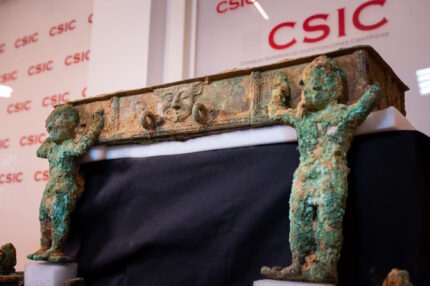
A unique bronze votive miniature cart has been unearthed at the Tartessian culture site of Casas del Turuuelo, in Guarea, southern Spain. It is the only example of a bronze chariot like this ever discovered in the Iberian peninsula. The only comparable examples have been found at Etruscan sites in Italy. It dates to the 5th century B.C.The cart is decorated on the front with an image of the underworld river deity Achelous. Two griffins are depicted on the sides. Two bearded Atlantes with raised arms support the cart. Excavation co-director Esther Rodrguez:We have found some in Etruria, such as the one in the Orvieto museum, but they are very different from the one at Turuuelo, except for the structure: a solid bronze platform on wheels. There are some sources that mention this type of votive chariot, but this is the first time we have seen it. Thus, possibly transported from Etruria, with a central axle system made of iron that allows the wheels to turn and a frame with decorative cordage, the chariot presents unique elements. For example, the skirt worn by the figures supporting the chariot, which harks back to the Egyptian world. Or the fact that the river deitypresent in the Greek culture of the time, but also in Etruriais sticking out its tongue.Thats why at first we thought it was a Gorgon [the terrifying deities of the underworld], but it isnt, because it has horns. Until now, in fact, no Achelous had appeared with its tongue sticking out. Guiomar Pulido [another member of the excavation team] believes it may be a kind of hybrid between an Achelous and an underworld deity, because of that somewhat Dionysian expression, the archaeologist adds.The Bronze Age Tartessian culture (8th-4th century B.C.) at its peak occupied much of todays western Andalusia, Extremadura and southern Portugal. It was renowned for its metalwork, influenced by Phoenician techniques and the cultural object spread throughout the Mediterranean by Phoenician traders during the Orientalizing Period (8th-7th centuries B.C.).This is the 8th year of excavations at the Casas del Turuuelo site. Previous campaigns discovered the largest mass sacrifice of animals in the ancient western Mediterranean and the first figural depictions of Tartessian people. This seasons dig took place in April and May and focused on the tumulus 295 feet in diameter and 20 feet high which covers a large building that was deliberately sealed and buried in the late 5th century B.C. This is the main building at the site, a sanctuary used for religious purposes that is unique on the Tartessian archaeological record.The cart was found in a room next to the banquet room, so-called because of the remains of the final feast before the closing of the building were discovered there. Because of its location, archaeologists believe the cart was used in the banqueting rituals, perhaps to make embers or burn aromatic resins. The space also contained two bronze braziers, a cauldron and the handles of a podanipter, a foot basin that was used to wash feet before rituals and celebrations.The excavation of the tumulus unearthed evidence of the strong Tartessian links to Mediterranean commerce during the Bronze Age. In addition to the votive cart, archaeologists uncovered ceramic, alabaster and more than 200 ivory fragments incised with mythological creatures, animals and human figures. The ivories are typical of Phoenician design, and the ceramics and alabaster were likely imported from Greece and Egypt.Casas del Turuuelo is in the Guadiana river valley, 30 miles from the nearest seaport. That so many high-end trade goods made it to this site in the interior of the peninsula underscores the importance of the city and the wealth of its residents.




 English
 Arabic
 French
 Spanish
 Portuguese
 Deutsch
 Turkish
 Dutch
Dutch
 Russian
 Romaian
 Portuguese (Brazil)
 Greek
Greek