


ALLTHATSINTERESTING.COM
From The Real-Life Mowgli To The Human Pet, Learn The Bizarre Stories Of 9 Feral Children From History
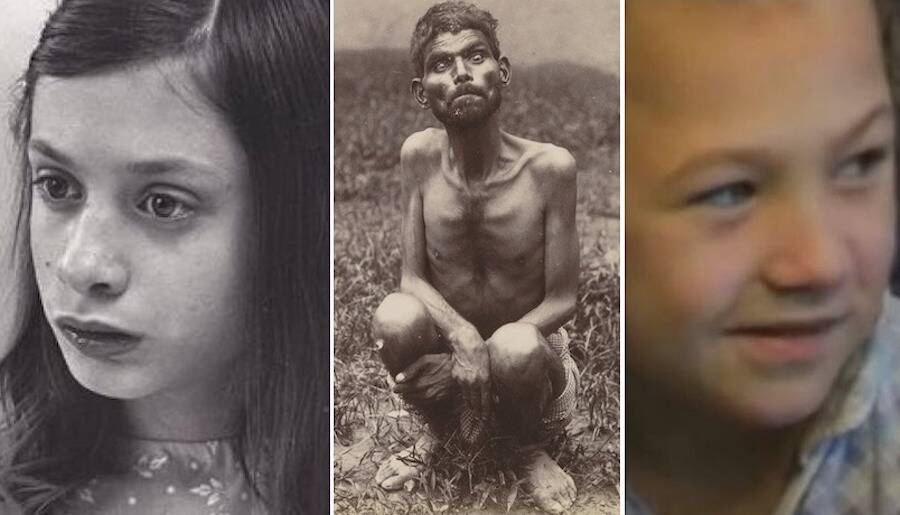
If the history of human evolution has taught us anything, its that the most human trait of all is our ability to adapt. Though survival on this planet has certainly gotten easier over time, these nine stories of feral children remind us of our roots and the perils of life in the wild.Defined as a child who has lived in isolation from human contact from an early age, a feral child often struggles to learn human language and behavior once they make contact with people again. While some feral children were able to make progress, others struggled to even form a complete sentence.Facebook; Wikimedia Commons; YouTubeFrom children who were raised by wolves to victims of severe isolation, these stories of feral people are tragic.The phenomenon of feral children is exceptionally rare, as there have only been about 100 known cases throughout all of human history. Some of these stories show how malleable we are as a species, while others reveal how vital human contact truly is in our formative years.All of these cases, however, explore the resilience of humankind in face of abandonment and being forced to fend for oneself. See some of the most remarkable, shocking, and heartbreaking stories of feral people below.Dina Sanichar: The Feral Child Who Helped Inspire The Jungle BookWikimedia CommonsA portrait of Dina Sanichar taken when he was a young man, at some point after his rescue.Raised by wolves in Indias Uttar Pradesh jungle, Dina Sanichar spent the first few years of his life thinking that he was a wolf. Its believed that he never learned how to interact with human beings until hunters found him in 1867 and took him to an orphanage. There, he spent years attempting to adapt to human behavior inspiring Rudyard Kiplings The Jungle Book.But Sanichars story was no fairytale. The hunters had first encountered Sanichar at a wolf den, where they were shocked to see a six-year-old boy living among the pack. They decided it wasnt safe for the child to be out in the jungle, and so they decided to transport him to civilization.However, the hunters realized early on that they would have difficulty communicating with Sanichar, as he behaved much like a wolf would by walking on all fours and only speaking in wolf-like grunts and howls. Ultimately, the hunters smoked the pack out of the cave and killed the mother wolf before taking the feral child back with them.Taken to Sikandra Mission Orphanage in the city of Agra, Sanichar was welcomed by the missionaries there. They gave him a name and observed his animal-like behavior. Even though he was no longer with the animals, he continued to walk on all fours and howl like a wolf.Sanichar would only accept raw meat as food, and sometimes even chewed on bones to sharpen his teeth a skill he had clearly learned out in the wild. Before long, he became better known as the Wolf Boy.Though missionaries attempted to teach him sign language by pointing, it was soon clear that would be a lost cause. After all, since wolves have no fingers, they arent able to point to anything at all. So Sanichar likely had no idea what the missionaries were doing when they pointed their fingers.Wikimedia CommonsSanichar eventually learned how to dress himself and became a smoker.That said, Sanichar was able to make some progress while at the orphanage. He learned how to walk upright, put his own clothes on, and eat from a plate (although he always sniffed his food before eating it). Perhaps the most human trait of all that he picked up was smoking cigarettes.But despite the strides he made, Sanichar never learned a human language or fully adjusted to life among other people at the orphanage. He ultimately died of tuberculosis in 1895 when he was just 35 years old.Genie Wiley: The Feral Child Subjected To Extreme Isolation And AbuseWeird History/FacebookGenie Wileys father isolated and abused her for 13 years.When it comes to feral children found in America, perhaps none of them have suffered as much cruelty as Genie Wiley. Born in 1957 near Los Angeles, she endured horrific abuse at the hands of her father Clark Wiley.For 13 years, Clark kept Genie isolated in a room that was more akin to a prison cell. Most of the time, Genie was kept strapped into a toddler toilet, and sometimes she was even placed in an actual cage. When Clark wasnt beating her with a plank of wood, he was growling at her like a rabid dog.Most crucially, Genie had almost no interaction with anyone else but her immediate family during those formative years and was never allowed outside until she and her mother Irene escaped the home in 1970. Since Irene was nearly blind, she would later claim that her disability prevented her from helping Genie while her daughter was being abused.Shortly after fleeing the home, Irene accidentally walked into a Los Angeles social services office instead of an office that offered aid to the blind. Welfare workers took one look at Genie and immediately knew that she was in need of their help. At first, they thought that she might simply be autistic but then they learned the grim truth about the feral child.Wikimedia CommonsGenie Wiley was studied by scientists for four years before being placed back in the care of her mother.Child abuse cases were opened against both of Genies parents, but Irene was able to convince authorities to drop the case against her, claiming she was also a victim. As for Clark, he killed himself instead of facing his trial, leaving behind a note that read: The world will never understand. What the National Institute of Mental Health desperately wanted to understand, however, was how extreme isolation in a persons formative years shaped their lives. And a group of scientists was highly interested in finding out what part language has in a persons development and vice versa. They saw Genie as a blank slate an ideal opportunity for research.So, from 1971 to 1975, Genie was subjected to scientific experimentation at the behest of the researchers. During this time, experts made some discoveries. For example, Genie disproved the theory that one could not learn a language after puberty (though she struggled with grammar). However, many felt this experimentation was too rigorous to be ethical.Many of the scientists were also accused of having a conflict of interest, as she lived with many of them during the study. In 1979, her mother filed a lawsuit against the hospital and many of the scientists who had studied Genie, claiming that they exploited her for prestige and profit. The suit was settled in 1984, and Genie would cease all contact with the researchers.Though Genie lived with her mother for a brief period, she was eventually placed in foster homes, some of which were abusive. These experiences caused her to regress, and she never recovered from the trauma even when she was removed from the homes and reunited with her mother.And while she is reportedly still alive today in an assisted living facility in Los Angeles, Wiley is believed to be a mere shell of a person.The post From The Real-Life Mowgli To The Human Pet, Learn The Bizarre Stories Of 9 Feral Children From History appeared first on All That's Interesting.
0 Comentários
0 Compartilhamentos
57 Visualizações

 English
 Arabic
 French
 Spanish
 Portuguese
 Deutsch
 Turkish
 Dutch
Dutch
 Italiano
 Russian
 Romaian
 Greek
Greek