11 Of Ancient Earths Most Unbelievable Prehistoric Animals
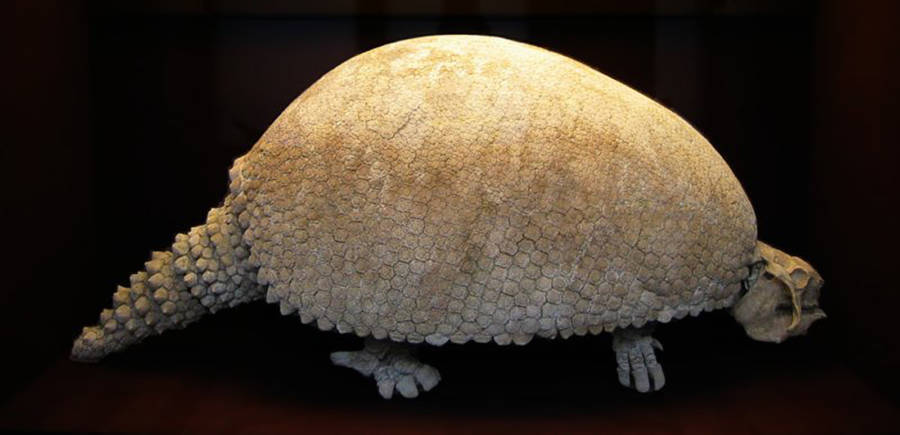
Prehistoric animals once roamed and ruled planet Earth.Some of them, like the giant sloth or the woolly rhino, were generally gentle. Others, like the saber-toothed tiger and the dire wolves, dominated their environment with their size and fearsome fangs.For millions of years, these ancient animals stalked through grasslands, climbed trees in the jungle, and chased prey into tar pits. Though vastly different, they all died out in similar ways due to changing climate, poaching, or disease.Today, they exist as just a whisper of their former might a bone here, a tooth there but in their prime, these prehistoric animals would have struck fear and awe into early humans.Glyptodon: The Prehistoric Armadillo The Size Of A CarWikimedia CommonsA fossil of the prehistoric animal known as glyptodon.Between 5.3 million to 11,700 years ago, a peculiar creature called the glyptodon meaning grooved tooth walked the Earth. Ten feet long and weighing as much as 4,000 pounds, this giant armadillo existed in present-day North and South America. Though the glyptodon had a powerful tail and an armored back made of 1,000 bony plates, it likely lived a fairly peaceful existence. An herbivore, it mostly ate grass and didnt have to worry about any bloody tussles over game.That said, the glyptodon could defend itself even against other glyptodons if need be. Its powerful tail could crush a human skull, and its shell-like back offered a strong defense. Based on the damage found on glyptodon shell fossils, scientists believe that the beasts often fought each other. To settle disputes over territory or mates, theyd pummel their opponents shell with their strong tail. But this ancient animal often had to contend with humans, too. Early hunters likely stalked the glyptodon for its meat and shell. To kill it, however, they had to turn it on its back no small task and spear its soft underbelly. Wikimedia CommonsEarly humans might have even used these ancient animals massive shells as shelter. Researchers first discovered the glyptodon in 1823, when Uruguayan naturalist Dmaso Antonio Larraaga came across a giant femur. The bone weighed about seven pounds and stretched six to eight inches long. Most believed, however, that hed found the bones of a giant sloth called Megatherium. Further discoveries convinced scientists that they were dealing with a different prehistoric animal, however, and biologist Richard Owen dubbed it a glyptodon because of its curved teeth. The reign of the glyptodon came to an end shortly after the last Ice Age. Climate change, and aggressive human hunting, drove the giant armadillo into extinction. Today, only their massive bones speak to their existence. As recently as 2020, an Argentinian farmer found several glyptodon shells in his yard. Titanoboa: The Monster Snake Of The Paleocene EpochRyan Sommma/FlickrA depiction of Titanoboa devouring an alligator.Imagine a snake. Now, imagine that its 45 feet long and weighs 1.25 tons. Thats what the terrifying Titanoboa cerrejonensis, or Titanoboa looked like. The snakes body was so wide that if it were moving down the hall and decided to come into my office to eat me, it would literally have to squeeze through the door, explained Jason Head, a paleontologist who studied Titanoboa. The monstrous snake lived some 60 million years ago. After the extinction of the dinosaurs, it zipped up the food chain and quickly came to dominate the tropical jungles of present-day South America. When its killer gaze latched onto five-foot giant turtles or 20-foot long crocodiles, the Titanoboa likely waited in shallow water for its prey to approach. Once the unfortunate animal got close enough, the snake would strike and crush its meal to death. Florida Museum/Jeff GageThe vertebrae of the Titanoboa, left, compared to the vertebrae of an anaconda. Though this ancient animal terrorized the world for millions of years, it took a long time for modern-day humans to realize that it had even existed. In 2002, a fossilized leaf discovered in a Colombian coal mine convinced scientists that a rainforest had once flourished at the same site. Indeed, they soon found fossils of giant turtles and crocodiles, as well as early bananas, avocados, and bean plants.But of all the finds, one stood out: a massive vertebra. Convinced that it had once belonged to a snake, possibly one caught in a muddy landslide, researchers scoured the ground for more bones. In the end, they found the remains of not one but 28 enormous snakes. Thrillingly, they also found three snake skulls which can be elusive. Snakes use the muscles in their mouths to kill, not their bones, and skulls often disintegrate over time. As for those crocodile and turtle fossils? Likely the giant snakes unfortunate victims. Titanoboa, surmised the scientists, had once dominated the animal kingdom. The post 11 Of Ancient Earths Most Unbelievable Prehistoric Animals appeared first on All That's Interesting.




 Arabic
 French
 Spanish
 Portuguese
 Deutsch
 Turkish
 Dutch
Dutch
 Italiano
 Russian
 Romaian
 Portuguese (Brazil)
 Greek
Greek