


WWW.THECOLLECTOR.COM
4 Villains From the Arthurian Legends Who Really Existed
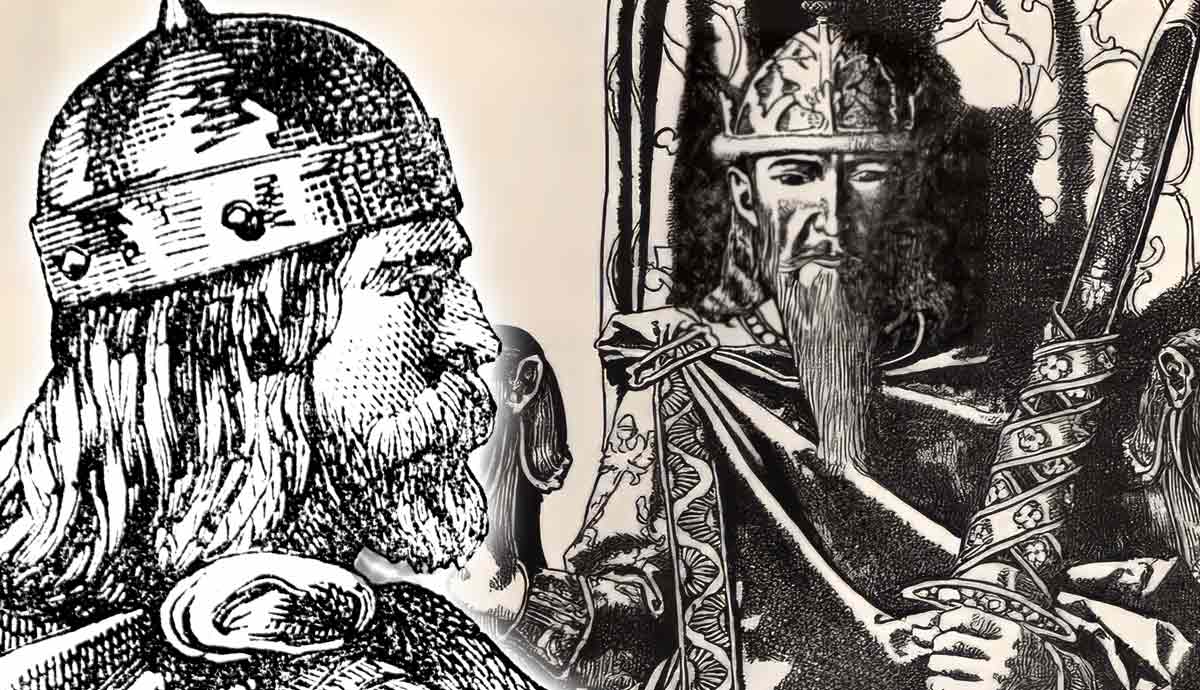
Despite best efforts, researchers have been unable to verify whether King Arthur was a real historical figure, but they do agree that the Arthurian legends are set in a real historical setting of 5th and 6th-century Britain. While Arthur has not been identified in the surviving records of Dark Age Britain and the Anglo-Saxon conquests, many of the other characters who appear in the legend can be, including some important villains.Historians are still unsure whether King Arthur was a real historical figure. Take a look at the evidence.1. King Mark of CornwallIllustration of King Mark of Cornwall from The Champions of the Round Table, Howard Pyle, 1905, Source: Rochester UniversityKing Mark of Cornwall appears in the Arthurian legends about Tristan and Isolde. He is described as Tristans uncle by marriage. It is very likely that the legendary King Mark can be identified as the historical Conomor, a ruler of part of Brittany in the mid-6th century.The earliest piece of evidence for this claim is the 9th-century document known as the Life of St Paul Aurelian. The author sttes that the king known as Quonomorus was also named Mark. The only Quonomorus in this era was Conomor of Brittany. Just like King Mark of the Arthurian legends, Conomor of Brittany was infamous for his villainy involving marriages and obsession.An inscribed stone from Cornwall dating to about the 6th century includes the name Conomor. It also, according to the most recent scholarship, includes the name of Tristan, confirming the close connection between the two.2. Rhita the GiantStatue of Geoffrey of Monmouth at Tintern Station, Wales. Source: Visit MonmouthshireA somewhat more obscure villain from the Arthurian legends is Rhita Gawr, whose epithet means Giant. He appears in European and English tales as Rions or Rience. Geoffrey of Monmouth referred to him as Ritho, a form much closer to the Welsh spelling. According to most versions of the Arthurian legends, Rhita Gawr was a giant who lived in North Wales. He was an evil king who had killed various other monarchs and wore their beards on a garment. He challenged Arthur to a duel, but the young and newly appointed king killed the giant.Like many Arthurian legends, this story is full of fanciful elements, including the very nature of Rhita as a giant. Nevertheless, we can make a plausible identification of this character with a historical figure from the period. Bede, the 8th-century English historian, referred to an Irish figure named Reuda. He founded the kingdom of Dal Riata, which was named after him.Map of Argyleshire, broadly equivalent to the medieval kingdom of Dal Riata, from Imperial Gazetteer of Scotland, by John Marius Wilson. Source: The Internet ArchiveNotice the similarity between Reuda or Riata and the name of the legendary giant, Rhita. However, we need more than just a similar name to make a convincing case. Although Bede himself does not give a date for Reudas reign, later records place the founding of Dal Riata at the very end of the 5th century. This would logically place Reuda in the early Arthurian period.Later Irish records say that Dal Riata was founded by three brothers. The son and successor of the most prominent of these three, Fergus Mor, was named Domangart Reti. Given the apparent conflict between Bedes account of the founding of this kingdom and the later Irish versions, it seems very likely that Bedes Reuda was this Domangart Reti. Thus, the founder referred to by Bede was the son of one of the three brothers who allegedly conquered the territory originally.Dunadd hill fort, possible capital of Dal Riada. Source: BritannicaPresumably, Domangart consolidated his familys rule of the area, thus coming to be known as its founder in some traditions. Domangart Reti is recorded as dying in the early 6th century, and this matches with the placement of Rhitas death in the Arthurian legends. With this evidence in view, it is very likely that the Rhita Gawr of Welsh tradition is identical to the historical Domangart Reti, Bedes legendary Reuda.Although it is true that there is no tradition of the kings of Dal Riata dominating North Wales, we would do well to consider the earliest version of the legend. Geoffrey of Monmouths account is the earliest surviving source. He does not specifically say that Rhita (or Ritho, as he calls him) ruled over North Wales. He simply says that North Wales is where the battle between him and Arthur took place. Since most Welsh traditions place Arthur in South Wales, meeting a king from Dal Riata halfway between their respective territories, which would be North Wales, is a reasonable scenario.3. Lucius TiberiusMap of the Western Roman Empire, over which Timasius fought Magnus Maximus armies, c. 400 CE. Source: Wikimedia CommonsAs well as describing battles in Britain, the Arthurian legends describe Arthur fighting battles on the continent against the Romans. As scholar David Dumville argued, this part of the legend almost certainly came from Magnus Maximus usurpation of the Western Roman Empire, when he invaded from Britain. However, beyond this basic connection, relatively little research has been done on the intricate connections between the legend and its historical basis.The figure who serves as Arthurs primary antagonist in the legend is a certain Lucius Tiberius. Although some online sources describe him as an emperor, the earliest version of the legend only ever calls him a military leader.The two Roman leaders of the army of Emperor Theodosius at the climax of Maximus usurpation were Flavius Promotus and Flavius Timasius. Of the two of them, the latter is clearly the better option for the legendary Tiberius. When we consider the customs of medieval scribes, this identification is all but certain.Magnus Maximus, from The Llanbeblig Hours, manuscript NLW MS 17520A, c. 1390-1400. Source: National Library of WalesFirstly, it should be noted that the letter r and the letter s in some medieval Welsh manuscripts are almost identical. In the name Atroys, for instance, found in the Harleian MS 3859, we see both letters in the same name. It is only by a minuscule difference that the letters are distinguishable from each other. For this reason, these two letters were often swapped by mistake.The other main difference between Timasius and Tiberius is the b instead of the m. In fact, both letters were sometimes used to represent the same sound. An example of this is seen in the work of Gregory of Tours, who referred to Conomor of Brittany with a b in the place of the m. Sometimes, the letter f or v was used in place of both, masking whether b or m had been there originally.Therefore, we can see that the evolution from Timasius to Tiberius (a much more familiar name to the medieval scribes) would have been exceedingly easy. Therefore, Timasius can very likely be identified as the Roman military leader Tiberius from this Arthurian legend.Do you know the story of King Arthurs expedition to the European mainland?4. Osla Big-KnifeDepiction of Cerdic of Wessex, grandson of the likely Osla, from Theatre, by John Speed, 1611. Source: Cambridge UniversityOsla Big-Knife is a very obscure villain from the Arthurian legends. His epithet appears as Gyllellfawr in the Welsh texts. He appears in the late Mabinogi tale known as The Dream of Rhonabwy. This work presents the story of the prelude to Arthurs famous Battle of Badon. In this tale, the leader of the Saxons is named Osla. Interestingly, a separate Welsh tradition records the name of the leader of the Saxon army as Cheldric. These two bits of information can help us to identify Osla.The Cheldric who appears as Arthurs enemy in the Arthurian legends is almost certainly Cerdic of Wessex. He was a historical Saxon leader who fought against the Britons in the south in exactly the era in which Arthur was alive, according to legend, fighting against the Saxons. Notably, Anglo-Saxon genealogies make him the grandson of an otherwise unknown figure called Esla. Very likely, this Esla is the figure recorded as Osla in Welsh tradition. It may be that Cerdic was a young commander in charge of the armies of his grandfather, accounting for the two seemingly contradictory traditions about the leader of the Saxons at Badon.Do you know where the Battle of Badon took place?Historical Villains of the Arthurian LegendsAn illustration from The Mabinogion, by Charlotte Guest, 1877. Source: Wikimedia CommonsAn illustration from The Mabinogion, by Charlotte Guest, 1877. Source: Wikimedia Commons[/caption]Thus, several villains from the Arthurian legends can be identified as historical figures. Several heroic figures can be identified as well, such as Sir Uriens of Gorre and Sir Ywain. This verifies that, despite fantastical and supernatural elements, the Arthurian legends were tied to historical Britain.Meet the heroes from the Arthurian legend who can be identified as real historical figures.
0 Comments
0 Shares
1 Views

 Arabic
 French
 Spanish
 Portuguese
 Deutsch
 Turkish
 Dutch
Dutch
 Italiano
 Russian
 Romaian
 Portuguese (Brazil)
 Greek
Greek