


WWW.THECOLLECTOR.COM
When the US and Great Britain Nearly Went to War Over a Pig
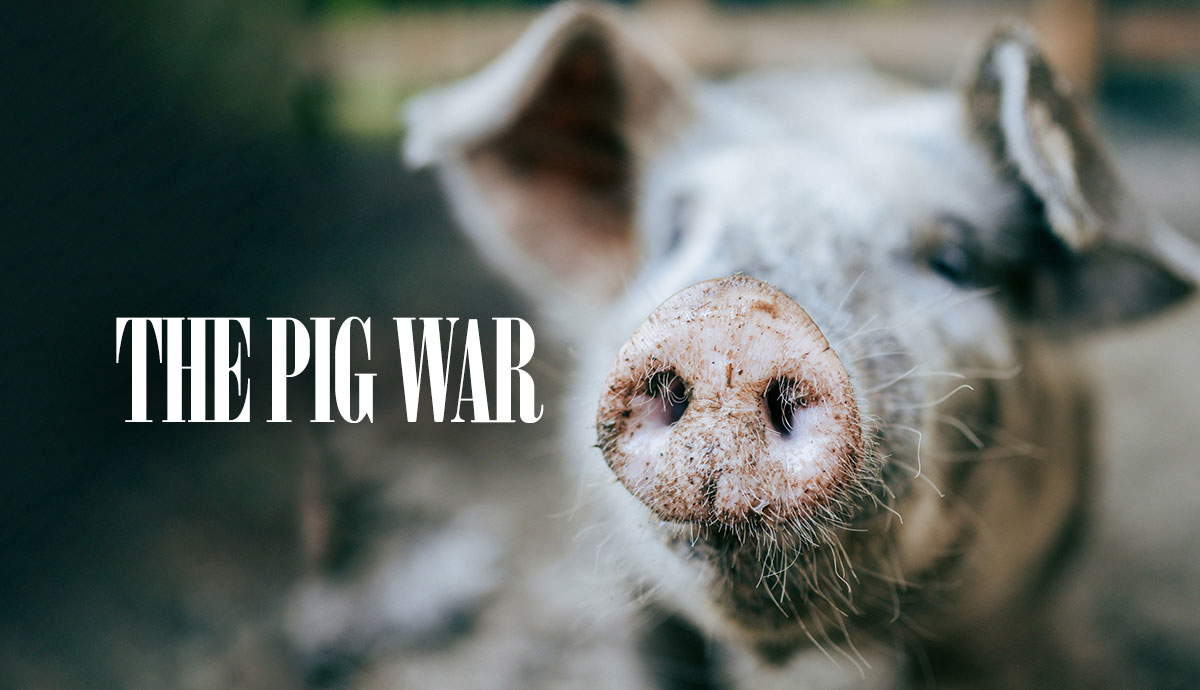
As the US expanded across the North American continent, new lands brought new territorial disputes. In 1859, an island off the coast of the Washington Territory became the source of global tensions between the US and Great Britain. A property dispute between two settlers brought soldiers from each country rushing to the island. Yet, despite high tensions, there was never any fighting. This strange conflict, in which the death of a single pig nearly plunged two nations into war, marks a unique bloodless chapter in the history of American expansionism.Border Ambiguity: Oregon Territory DisputeMap of the San Juan border dispute by Ameli Sanchos. The proposed US border is shown in blue, the British proposal in red, and the compromise line in purple. Source: Wikimedia CommonsFollowing the westward expansion of the United States and Great Britain, both nations disputed the ownership of the Oregon Territory. Americans were fueled by Manifest Destiny, or the belief that it was their God-given right to expand across the continent, and this mindset extended to what would later become the modern U.S. states of Oregon and Washington. The Hudsons Bay Company, a British trading company, was interested in controlling the Columbia River that flowed through central Washington and northern Oregon to support the lucrative fur trade. Both sides completely ignored the sovereignty and disregarded the territory of Pacific Northwest indigenous communities in the process.In 1846, the Oregon Treaty was signed to divide the disputed territory between the two nations along the 49th parallel from the Rocky Mountains to the West Coast. However, under the terms of the treaty, the border was left ambiguous in certain areas, such as the San Juan Islands off the coast of the modern state of Washington. This ambiguity led to confusion over which nation had rightful ownership over the islands. The treaty stated that the boundary line would continue through the middle of the channel which separates the continent from Vancouvers Island, but the exact location of that channel remained unclear. The British argued that the boundary extended through the Rosario Strait, while the Americans contended it was the Haro Strait.Belle Vue Sheep Farm, September 1859. Source: National Park ServiceTo strengthen their claim, the Hudsons Bay Company took action in 1845 by claiming the San Juan Islands. By 1851, they had established settlements on the islands, asserting British dominance in the region. Meanwhile, the Washington Territory, part of the United States, formally claimed the islands in 1853, which spurred increased British settlement in the area. In December of that same year, the Hudsons Bay Company further solidified its position by establishing the Belle Vue Sheep Farm on the islands, bringing with it a flock of 1,369 sheep.During this period, the U.S. Army built Fort Steilacoom near modern-day Tacoma, Washington in 1849. The fort served two purposes: protecting American settlers from British forces and preventing raids by indigenous tribes from the north. By 1854, both the U.S. Navy and Revenue Marines (which later became the Coast Guard) were patrolling Washingtons coastal waters, while the British Royal Navy did the same around Vancouver Island. Both American and British forces had several violent encounters with local tribes.The situation grew more complex when gold discoveries in the 1850s drew waves of American prospectors into British Columbia. The Fraser Canyon Gold Rush of 1858 brought an estimated 30,000 American miners north into British territory. This alarmed British authorities, who feared losing control of the region to American settlers. The sudden influx of American settlers and increasing military operations on both sides led to a tense situation that ultimately set the stage for the Pig War.From Property Dispute to International CrisisThe Cattle Point Peninsula and American Camp, tracing made in 1872. Source: National Park ServiceIn 1856, both nations formed a Boundary Commission to survey the channels, but commissioners were unable to agree, and the territory continued to be disputed. By the spring of 1859, 18 Americans had made claims on San Juan, leading to increasing local property disputes. The dispute reached a boiling point on June 15, 1859, when an American settler, Lyman Cutlar, shot a pig belonging to a British settler, Charles Griffin, after it crossed into his garden. Cutlar offered $10 to Griffin as compensation for the pig, but Griffin demanded $100, which Cutlar refused.British officials threatened arrest and sent military forces to the island to establish control. American settlers reached out to General William S. Harney, Commander of the US Armys Department of Oregon. Harney responded by sending Captain George E. Pickett with 64 soldiers to the island, which led to a standoff. Pickett landed on the island on July 27 and began constructing fortifications and an American camp. James Douglas, Governor of Vancouver Island, responded by sending additional warships under the command of Captain Geoffrey Hornby.Despite the growing military presence, the occupation remained largely peaceful. Both sides were reluctant to engage in fighting even under the severe threat of violence. While both countries appeared ready for war, neither side wanted to start one, leading to a prolonged argument over who owned the islands.Standoff and Joint OccupationCamp San Juan Island in 1874. Source: National Park ServiceBy August 1861, there were over 2,600 American and British soldiers on the island. Despite the growing military presence, both sides maintained good relations, engaging in social gatherings together, including Fourth of July and Queen Victoria Day celebrations. Perhaps the soldiers understood that war over such a trivial matter would be absurd, and the human element of the conflict helped maintain peace. Regardless, it appeared that all parties involved wished to avoid war.Concerned about the potential conflict, officials in Washington, D.C. sent General Winfield Scott, a veteran of the Mexican-American War, to deescalate the situation. Scott arrived on the island in October 1859 and proved to be an adept diplomat, negotiating with British officials to find a satisfactory, albeit temporary, compromise.Both sides agreed to a temporary joint occupation of the island, with each side limiting their military presence to just 100 soldiers. The American troops established a camp on the southern end of the island, and the British troops established a camp on the northern end. The physical separation and agreement to joint occupation potentially alleviated tension between the two garrisons. This agreement helped avoid a direct military conflict while both sides waited for the border to finally be decided.Portrait of Captain George Bazalgette, first commandant of the English camp. Source: National Park ServiceThe success of this agreement clearly demonstrated that neither side wished for war. For the U.S., the rift between northern and southern states was reaching its boiling point with Bleeding Kansas (1854-1859). As the Civil War seemed more and more likely, perhaps the U.S. wished to avoid dragging foreign powers into the conflict. For the British, the costly Crimean War (1853-1856) likely tempered ambitions and made officials more hesitant to engage in costly conflicts over trivial territory.Ultimately, the outbreak of the American Civil War caused the San Juan border dispute to become less of a concern, as it was not of immediate importance. During the Civil War, General Harney remained loyal to the Union, while Captain Pickett joined the Confederacy as a general, famously leading the disastrous Picketts Charge on July 3, 1863. During this time, the Trent Affair of 1861, in which Confederate officials were discovered aboard a British vessel, damaged U.S.-British relations. Another major point of tension was the British ships built for the Confederacy, which wreaked havoc on Union trade. Following the end of the Civil War, American politicians demanded reparations from Britain for British-built Confederate ships and the Fenian Raids in Canada. Finally, the San Juan boundary dispute came up again, and, this time, Americans pushed for a final decision.A German Kaiser Steps InPortrait of Kaiser Wilhelm I, c.1858. Source: Wikimedia CommonsIn 1871, the San Juan border issue was brought before Kaiser Wilhelm I of Germany for international arbitration. Wilhelm placed the boundary through the Haro Strait and awarded the islands to the United States. In response, British troops withdrew from the island, but Americans wouldnt withdraw until 1874.In the end, the only casualty of the Pig War was a single pig, but the incident highlighted the potential for major international conflicts over relatively minor disputes in a growing age of nationalism and imperialism. While there were no battles or casualties, the conflict still serves as a poignant illustration of ongoing US expansion and the colonization of North America.Peaceful ResolutionA picnic at English Camp, likely taken between 1869 and 1872. Source: National Park ServiceThe Pig War is most likely the strangest conflict in U.S. history, and it invites speculation about how different history might have been had the two nations gone to war, with a possible invasion of Canada. Occurring just two years before the start of the American Civil War, had it become a full-fledged military conflict, it may have delayed the outbreak of the Civil War or led the British to play a more active role in the conflict. Some historians suspect that George Pickett and William S. Harney intended to use the incident to unite the North and South against the British while staving off the impending civil conflict.Luckily, war was ultimately avoided due to rational military leadership on both sides and a hesitancy to engage in conflict. However, it did illustrate that despite internal issues, the United States was still keenly interested in expanding its territory.SourcesProsch, Charles. Reminiscences of Washington Territory: Scenes, Incidents and Reflections of the Pioneer Period on Puget Sound, 1904.Vouri, Mike. The Pig War: Standoff at Griffin Bay. Pullman, WA: Griffin Bay Bookstore, 1999.
0 Commenti
0 condivisioni
13 Views

 English
 Arabic
 French
 Spanish
 Portuguese
 Deutsch
 Turkish
 Dutch
Dutch
 Russian
 Romaian
 Portuguese (Brazil)
 Greek
Greek