


ALLTHATSINTERESTING.COM
The Collyer Brothers, The New York City Hoarders Found Dead In 1947 Surrounded By 120 Tons Of Rubbish
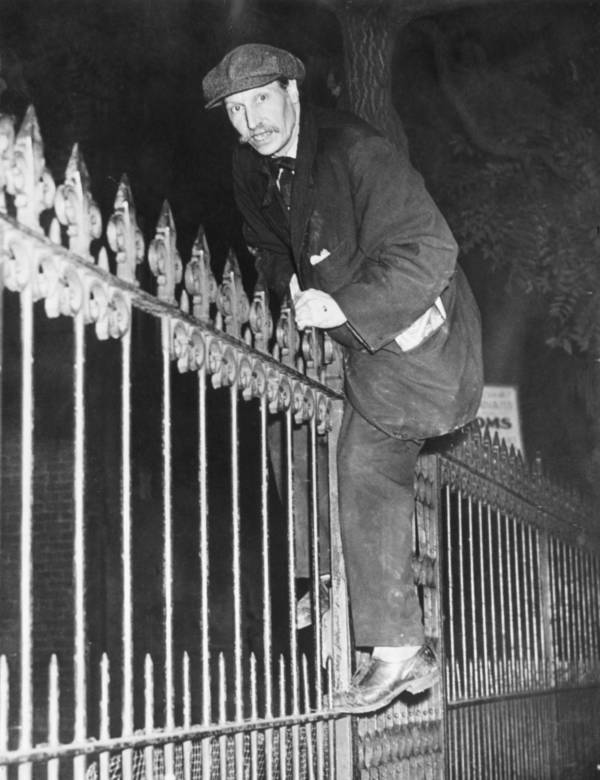
Click here to view slideshowOn March 21, 1947, an anonymous caller notified New York's 122nd Police Precinct about the smell of decomposition emanating from the dilapidated house at 2078 5th Avenue. It belonged to the Collyer brothers, Homer and Langley, and who were known to be eccentric and reclusive.An officer was dispatched to investigate but, upon arriving at the property, couldn't find a way inside. The doors were locked, there was no doorbell, and the basement windows, through broken, were reinforced with iron bars. The officer called for backup, but even once the men got inside, they found themselves facing a vertible fortress of debris.Indeed, the Collyer brothers' foyer was packed with newspapers, boxes, and a melange of other items, including chairs, half a sewing machine, and part of a wine press. Officers ultimately broke through a second story window, only to find more debris. With no other choice, they started to dig.Hours later, they came across the body of Homer Collyer. But it would take them weeks to find the remains of Langley.This is the strange story of the Collyer brothers, the infamous Harlem hoarders.How The Collyer Brothers Became ReclusesThe sons of Herman Livingston Collyer and Susie Gage Frost Collyer, the Collyer brothers were born in the 1880s. Homer Lusk Collyer was born on Nov. 6, 1881, and his brother Langley Wakeman Collyer was born roughly four years later, on Oct. 3, 1885. As The New York Times reports, their father was a prominent gynecologist; their mother was an opera singer. FPG/Getty ImagesLangley Collyer caught climbing over a fence. Location unspecified. 1935.Both the Collyer brothers attended Columbia University. Homer studied law; Langley became a pianist who performed at Carnegie Hall. Meanwhile, their parents bought the brownstone at 2078 5th Avenue in 1909, and when Herman and Susie separated, Susie took over the property. Her sons lived with her and, when their parents died, they inherited her home. Though they filled the brownstone with books and their father's old medical equipment, the Collyer brothers didn't start hoarding objects until the 1930s. Then, in 1932, Homer suffered a stroke that caused him to go blind. Langley devoted himself to taking care of Homer and the brothers slowly but surely withdrew from the world.How The Collyer Brothers Started HoardingAs the sons of a doctor, the Collyer brothers believed they knew best when it came to Homer's care. Langley fed his brother a diet of 100 oranges a week, alongside black bread and peanut butter, which he claimed would cure Homer's blindness. Langley also saved newspapers, so that when Homer's sight was restored, he could read them. Homer never again left the house. Langley left only occasionally, usually to forage for food. Meanwhile, they survived without any of the basic necessities, as their gas, water, and electricity had been cut off because they failed to pay the bills. Langley fetched water from local parks, and the brothers otherwise relied on a kerosene stove and lamp. "We've no telephone, and we've stopped opening our mail," Langley Collyer told a reporter in 1939, according to The New York Times. "You can't imagine how free we feel."Bettmann/Contributor/Getty ImagesLangley Collyer shouting from his window. September 28, 1942.Indeed, the Collyer brothers were no longer interacting with the outside world but Langley Collyer increasingly brought the inside world to them. He began hoarding items including baby carriages, rusted bikes, records, empty bottles, and tin cans. He also bought unused instruments, books, and fabrics, and Langley continued to collect newspapers. And their behavior soon attracted notice. In 1939, Con Edison workers forced their way into the brownstone to collect two old gas meters, an event which attracted hundreds of spectators. In 1942, when the Collyer brothers failed to pay their mortgage, the police arrived, only for Langley to quickly hand them a check for $6,700 (more than $130,000 today). Local boys started throwing stones at the brownstone and Langley's paranoia about the neighborhood (which had begun to transition from white to Black) increased. He responded by wearing shabby clothing outdoors ("They would rob me if I didn't.") and filling the brownstone with elaborate booby traps.Eventually, these traps are precisely what did him in.The Sad End Of The Infamous HoardersOn March 21, 1947, police found the body of Homer Collyer after an anonymous caller notified them of a bad smell emanating from the property. He'd been dead, of starvation and heart disease, for approximately ten hours. Initially, police suspected that Langley who had seemingly vanished had anonymously called police, possibly after killing Homer, and then skipped town. Indeed, rumors began to spread that Langley had fled the scene of the crime and boarded a bus to Atlantic City.But police needed to be sure that Langley Collyer was not still in the building. So, they started to clean it out.Bettmann/Contributor/Getty ImagesThe Collyer brothers' home was packed with debris."The second day of the police search through the Collyer home at 2078 Fifth Avenue produced five tons of assorted junk and a sick cat yesterday, but no sign of Langley Collyer, missing since Thursday," The New York Times reported at the time. "The police patiently started to work their way through the piled-up newspapers, furniture and cardboard boxes, but scarcely made a dent in the mountains of debris that almost completely fill the three-story brownstone house." In the end, they removed at least 120 tons of refuse, roughly the weight of a blue whale. The debris included toys, kitchen items, bowling balls, portraits, some 25,000 books, eight live cats, fourteen pianos, and more than $30,000. Not to mention stacks and stacks of old newspapers. Then, after nearly three weeks, police found the body of Langley Collyer. He seemingly tripped over one of his own booby traps, which buried him in a mountain of debris. Langley died less than ten feet from his brother. Police believed that it was his remains, and not Homer's, which were actually the source of the smell of decomposition. Six months after the Collyer brothers died, their house was torn down. Today, all that remains of their memory in is a tiny park in Harlem, the Collyer Brothers Park. Jim.henderson/Wikimedia CommonsThough their house is long gone, the Collyer brothers are remembered in Harlem, thanks to a small neighborhood park that bears their name."Sometimes history is written by accident," Parks Commissioner Adrian Benepe told The New York Times. "Not all history is pretty and many New York children were admonished by their parents to clean their room 'or else you'll end up like the Collyer brothers.'"After reading about the Collyer brothers, the infamous hoarders of Harlem, read the tale of "Dead Shot Mary" Shanley, one of the first female police officers in New York City. Then, look through these 55 heartbreaking images of New York during the Great Depression.The post The Collyer Brothers, The New York City Hoarders Found Dead In 1947 Surrounded By 120 Tons Of Rubbish appeared first on All That's Interesting.
0 Σχόλια
0 Μοιράστηκε
24 Views

 English
 Arabic
 French
 Spanish
 Portuguese
 Deutsch
 Turkish
 Dutch
Dutch
 Italiano
 Russian
 Romaian
 Portuguese (Brazil)