


ALLTHATSINTERESTING.COM
How Ted Kaczynski Went From A Child Math Prodigy To The Unabomber
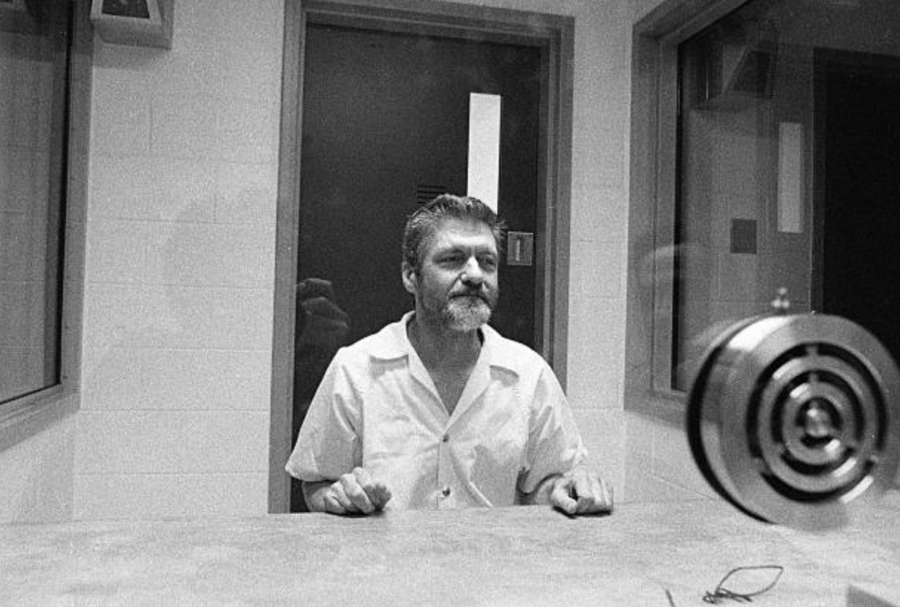
Internet ArchiveThe Unabomber, Ted Kaczynski, in a supermax prison in 1999.In September 1995, The Washington Post printed a 35,000-word manifesto written by the mysterious Unabomber who had been terrorizing the United States for nearly two decades. An FBI task force had been working tirelessly to identify the suspect who was mailing bombs across the country, but theyd come up empty-handed time and time again. Then, a few months after the Unabombers essay was published, a man alerted the agency that he believed it was the work of his brother, Ted Kaczynski.Agents raided Kaczynskis cabin in rural Montana in April 1996 and found bomb components, thousands of pages of notes detailing the Unabombers crimes, and even a live bomb ready for its next victim. After 18 years, the FBI had found their man.But why had he done it? The answer was in the manifesto, which was titled Industrial Society and Its Future. Kaczynski blamed modern technology for the destruction of the environment. Hed targeted people he blamed for what he believed was the downfall of society, from scientists and computer technicians to university professors and airline executives. Ted Kaczynski was sentenced to life in prison without parole, as his bombs had killed three people and injured 23 others. He died behind bars in 2023, but the legacy of the Unabomber has not been forgotten.The Deadly Crimes Of The UnabomberBetween 1978 and 1995, Ted Kaczynski terrorized the country with homemade bombs that he either mailed to his victims or hand-delivered to locations where his targets would find them.Each device the Unabomber sent out was uniquely constructed. Many of the bombs were made of, or with, wood. In most cases, the explosives were crafted from gunpowder, match heads, and other readily available items. One resembled a cigar box and was left in a Northwestern University common area. Another, disguised as a wooden board with protruding nails, appeared in front of a computer store.Among the earliest and most complicated devices was a package fitted with a barometer that would trigger an explosion once an airplane hit cruising altitude. That bomb didnt kill anyone, but as the years went by, the Unabomber learned from his mistakes. Each device became more powerful, more concealable, and more deadly than the last.Because the terrorist sent bombs to universities and airlines, the FBI began referring to the case as UNABOM, an acronym for University and Airline Bomber. The news media dubbed the person behind the attacks the Unabomber.Public DomainA 1995 ad for FBIs UNABOM tip line.The Unabomber meticulously filed away all of his fingerprints from his bombs components. Other times, he seemingly treated pieces with acid. His devices were virtually untraceable. To further cover his tracks, the Unabomber would sometimes mail packages with insufficient postage so that they would be returned to the sender written on the box who was his actual target.The victims were seemingly random, with attacks in Illinois, Utah, Tennessee, California, Washington, Michigan, Connecticut, and New Jersey. They were academics, lobbyists, airline executives, and computer store owners. Many were maimed and lost fingers, limbs, and eyes. Three were killed. The only link between the targets seemed to be a tenuous connection to technology or the destruction of the environment.Even with an FBI task force comprising 150 full-time agents, analysts, and support staff, investigators had few leads. When one early bomb failed to completely explode, they found some twigs and leaves inside the device. The letters FC were also welded or carved into most of the bombs. But other than that, there was little to go on.Queerbubbles/Wikimedia CommonsA reproduction of one of Ted Kaczynskis bombs from an exhibit at the Newseum.FBI agents believed they were looking for a blue-collar mechanic or someone who was good with their hands. A popular theory was that the suspect was a disgruntled former airline employee looking to get back at the big shots. But what investigators would not realize until much later was how close their first discarded guess had come to the truth.In a report for the FBIs Behavioral Sciences Unit, profiler John Douglas had posited that the terrorist was a white male in his late 20s or early 30s and an asocial obsessive-compulsive loner of above-average intelligence, as reported by the New Yorker in 1996. He suggested that since the earliest bombings were at Northwestern University he was probably from Chicago and had connections to academia.When Ted Kaczynski was finally arrested in 1996, investigators would find that Douglas description of the Unabomber fit him nearly perfectly.Ted Kaczynski, The Man Behind The BombsBorn in Chicago in 1942, Ted Kaczynski had a fairly normal, middle-class suburban childhood for the most part. He had two loving parents and a younger brother, David, who idolized him. He played the trombone and collected coins. He was quiet, sensitive, and shy with others, but he loved animals and being outdoors. He also had an IQ of 167, placing him on the same level as Stephen Hawking and Albert Einstein.Kaczynski Family PhotoTed (left) and David Kaczynski circa the 1960s.Kaczynskis mother, Wanda, had grown up in a poor immigrant family in Southern Ohio. For her, education had been a gateway to a better life, and she believed the same would hold true for both her sons. When Kaczynski was 15, he graduated early from high school and, with his parents encouragement, applied to Harvard. He was accepted, and he started his freshman year in 1958 at age 16.But this opportunity would turn out to be a terrible mistake.During his first year, Ted Kaczynski was quarantined in special housing set aside for the youngest and least mature freshmen. Although the gesture was intended to be a nurturing one, in practice, it only encouraged Kaczynskis introverted nature. He made few, if any, friends and spent most of his time in his room or the library when not in class. Sophomore year was even worse.That fall, Wanda Kaczynski received a permission slip in the mail. Kaczynski had been accepted into a psychological study for gifted young men, overseen by his professor, Dr. Henry Murray. As a minor, however, he could not consent to his own participation. Wanda was enthusiastic. Shed long worried about her sons mental health and once considered testing him for autism.Kaczynski Family PhotoBrothers David and Ted Kaczynski in the mid-1960s.At nine months old, Teddy had a severe allergic reaction and was stuck in the hospital for a week, poked and prodded away from his parents, and shed always felt it had affected his relationships with other people. He had no friends outside of his family and seemed far more comfortable playing with younger children than those his own age.In Kaczynskis second year at Harvard, these emotional problems got even worse.The Psychology Of The UnabomberAs a former officer for the Office of Strategic Services during World War II, Henry Murray had completed a psychological profile of Adolf Hitler. After the war, he returned to Harvard as a chief researcher.At the time, one of the CIAs biggest projects apart from undermining Communist regimes around the world was an internal one: MKUltra, a study of mind control. Some have alleged that Murrays Harvard research was part of MKUltra.During this operation, Murray and other CIA-funded scientists were allegedly tasked with exploring the means of making and breaking an individuals personality and developing techniques for brainwashing and mind control, including torture, sleep deprivation, and psychedelic drugs, all of which were often used on unsuspecting victims.Harvard University Department of PsychologyHenry Murray, the psychology professor whose experiments may have helped shape the Unabomber.When he was still an impressionable teenager, Ted Kaczynski signed up to be a test subject in one of Murrays studies on the effects of stress on the human psyche.Kaczynski would go to Murrays lab, write essays about his deepest beliefs, values, and ideals, and debate another student while his vital signs were monitored. Hooked up to electrodes and facing a one-way mirror with bright lights pointed at his face, Kaczynski was put up against a law student who was instructed to berate, mock, and belittle everything he held dear.Murray would record the data of the subjects anger and embarrassment and then take the time to show the subject the video recording of their experience and specifically point out their expressions of impotent rage. Kaczynski described it as the worst experience of my life, but he spent hundreds of hours taking part in the study. According to David Kaczynskis book Every Last Tie: The Story of the Unabomber and His Family, Ted Kaczynski later explained, I wanted to prove that I could take it. That I couldnt be broken.After graduation, Ted Kaczynski attended the University of Michigan to pursue a masters degree and then a Ph.D. in mathematics. It was here that he started to come undone. He hated his teachers and fellow students.In his bedroom, he thought he could hear his neighbors whispering about him. Once, in a manic fit of sexual frustration, he decided the only way he could touch a woman was to become one. He made an appointment with the campus health center to discuss a possible gender reassignment surgery, but he had a change of heart in the waiting room.Kaczynski Family Photo/George Bergman/Wikimedia CommonsTed Kaczynski at UC Berkeley in June 1968.Embarrassed and angry with himself, his rage shifted to the thought of killing the psychiatrist he was waiting to see. This, he found, made him feel better. According to a later psychiatric assessment that was printed by the Los Angeles Times in 1998, Kaczynski wrote after the experience:Like a Phoenix, I burst from the ashes of my despair to a glorious new hope. I thought I wanted to kill that psychiatrist because the future looked utterly empty to me. I felt I wouldnt care if I died. And so I said to myself why not really kill the psychiatrist and anyone else whom I hate. What is important is not the words that ran through my mind but the way I felt about them. What was entirely new was the fact that I really felt I could kill someone. My very hopelessness had liberated me because I no longer cared about death. I no longer cared about consequences and I said to myself that I really could break out of my rut in life and do things that were daring, irresponsible or criminal.Eventually, he decided, I will kill but I will make at least some effort to avoid detection so that I can kill again. But he wouldnt start just yet.After completing his doctoral studies, 25-year-old Ted Kaczynski became the youngest-ever mathematics professor at the University of California, Berkeley. But the assessments from most of his students were less than stellar. He did not explain things well. He was too impatient with slow learners. At the end of his second year of teaching in 1969, he abruptly quit his job.Ted Kaczynski Retreats Into The WildKaczynski told his family that technological progress would prove disastrous for humanity in the near future, and as such, he could not, in good conscience, facilitate the process by working as a math professor. His loved ones were cautiously supportive of his views.David, his younger brother, admired his commitment to his principles. His parents began providing him with an allowance. Secretly, his mother worried that her son wasnt making a stand but rather running away from a society he doesnt know how to relate to, as David wrote in Every Last Tie.U.S. Forest Service/FlickrTed Kaczynski lived near the Flathead National Forest in Montana.Together with his brother, Kaczynski started looking for a rural plot of land to call his own. After his application for a Canadian homestead permit was rejected, Kaczynski stayed with his parents for a brief spell and then followed his brother to Montana. He wanted them to buy some land together.In 1971, the Kaczynski brothers settled on a 1.4-acre plot outside of Lincoln, Montana, about an hour east of Missoula and not far from the Flathead National Forest. Kaczynski built his own 10-foot by 12-foot one-room cabin.The home had no electricity and no running water, though a stream was available for bathing. An outhouse served as the only bathroom. At first, David planned to build a second cabin nearby. However, he realized he didnt want to live shackled to his civilization-hating older brother. He instead took a teaching job in Iowa in 1973.The Kaczynski family always expected or rather, hoped that their troubled son would leave the woods eventually and rejoin society. Instead, he was still living in that cabin in 1996 when federal agents arrested him for his crimes.The Early Crimes Of Ted KaczynskiFor a few years, Ted Kaczynski truly seemed to hope that solitude would soothe his troubled mind. He dedicated himself to reading, learning survival skills, hunting, identifying edible plants, and even experimenting with crossbreeding new types of carrots. But he soon realized that he could not find true solitude anywhere.Kaczynski Family PhotoTed Kaczynski standing outside of his cabin in Montana, circa 1971.So, in May 1978, he decided to finally act on his rage. He addressed his first mail bomb to Buckley Crist, a professor of materials engineering at Northwestern University, using his return to sender strategy. However, Crist became suspicious because he hadnt mailed any packages recently, so he contacted campus security. The officer who arrived on the scene opened the box and suffered minor injuries from the explosion. The following year, Kaczynski sent his cigar box bomb to Northwestern University, injuring a graduate student. As he carried out these crimes, his anger with the world continued to grow. Where once there had been just three people living in the entire valley around his home, new houses were erected, and ATVs, motorcycles, snowmobiles, and other recreational vehicles became more common. The worst in his opinion, however, were the airplanes and helicopters.In July 1979, he hiked far out into the woods and was relaxing in a hunting camp as far from civilization as he could manage. Still, he heard the sound of airplanes followed by a sonic boom That day, as recorded in the book Unabomber: The Secret Life of Ted Kaczynski, he wrote in his journal: This was the last straw and it reduced me to tears of impotent rage. But I have a plan for revengeHe began trying to shoot passing helicopters and low-flying planes with his hunting rifle, but he never succeeded, and it never helped. He remained so upset by the incident that he kept writing about it for several months.FBIAn FBI composite sketch of the Unabomber. 1987.It is not the noise in itself that bothers me, but what that noise signifies, Kaczynski wrote, It is the voice of the Octopus the octopus that will allow nothing to exist outside the range of its control. The outdoors had been tainted for him, he said, I still love it. I suppose it is the same way a mother loves a child who has been crippled and mutilated. It is a love filled with grief.Then, in November 1979, Kaczynski utilized his barometer device to attempt to explode a package in the cargo hold of an American Airlines plane mid-flight. It did put off smoke, leading to an emergency landing, but it could have been much worse. Frustrated that this plan hadnt worked out, Kaczynski decided to go straight to the source of his anger and mailed a bomb to Percy Wood, the president of United Airlines, who suffered severe cuts and burns.At this point, the FBI formed the UNABOM task force to determine who was behind these bombs. But it took Ted Kaczynskis own brother to finally bring him down.The Manifesto Of The UnabomberBetween 1978 and 1995, the Unabomber killed three victims with his devices and injured nearly two dozen others.The first fatality from one of Kaczynskis bombs came in December 1985, when computer store owner Hugh Scrutton found a box containing the device in the parking lot of his shop in Sacramento. Nine years later, Kaczynski mailed a lethal explosive to Thomas Mosser, an advertising executive who had helped repair Exxons public image after the Exxon Valdez oil spill. And in 1995, Gilbert Murray, the president of the California Forestry Association timber industry lobbying group, opened a package addressed to his predecessor, who had recently retired. He died in the resulting explosion.Two months after Murrays death, The New York Times and The Washington Post received packages of their own. They contained copies of a 35,000-word manuscript titled Industrial Society and Its Future. The packages also held instructions from the Unabomber: He wrote that if one of the newspapers didnt publish his manifesto, he would send a bomb to an unspecified location with intent to kill. If they did print it, he would desist from terrorism.The Washington PostThe Unabombers manuscript as it appeared in The Washington Post in September 1995.In the text, Kaczynski tore into what he perceived to be a technocratic superstructure pushed by capitalism, the search for knowledge, and misguided optimism about material progress. He pointed to the automobile once a luxury and now a necessity to argue that advancement eroded personal freedom and created new norms that individuals had to adopt in order to remain in society. He argued that progress in the political, economic, and media structures would destroy individuality and ecological stability. He attacked leftism and the push for social reforms.Kaczynski also questioned the ability of even well-meaning individuals to resist the negative consequences of technology. He accused moralistic media of being propaganda that blinded people to the reality of their own motives. The only solution to such a dystopia, the Unabomber concluded, was violent resistance.The FBI ultimately approved the manifestos publication in hopes that, if nothing else, someone might recognize the writing style. It was their last resort and it worked.According to FBI Files: The Unabomber, Linda Patrik, David Kaczynskis wife, asked her husband, Has it ever occurred to you, even as a remote possibility, that your brother might be the Unabomber?The Biggest Manhunt In FBI HistoryDavid Kaczynski was taken aback. His wife had never even met his reclusive sibling. How could she accuse him of terrorism? But his wife pointed out the fixation on technology and its impact on society as the same things that his brother was obsessed with, the same beliefs shed heard David and his mother attempt to understand at countless worried family meetings.Ted Kaczynski was disturbed, David knew, but he wasnt violent. He couldnt be the Unabomber. Still, if only to change the subject, he promised to read the manifesto.But even after reading it, David was unconvinced. His brother had never been particularly political, even at Berkeley. For all his love of nature, he wasnt even much of an environmentalist. At the end of his first reading, David first concluded that there was maybe one chance in a thousand that Ted might have written it.But his wife remarked that one in one thousand was still too close for comfort. Reluctantly, David agreed.Over the next few months, the couple pored over the manifesto and compared it to the letters Kaczynski had sent his brother. Finally, David acknowledged, there was a 50-50 chance his brother was the Unabomber. At that point, they called the FBI.Public DomainTed Kaczynskis 1996 booking photo.Despite being the longest and most expensive investigation in FBI history, agents were no closer to identifying their suspect in 1995 than they had been when the bombings started in 1978.In 1987, a witness had briefly caught a glimpse of the Unabomber dropping off one of his bombs at a Salt Lake City parking lot and provided the FBI with a description. Unfortunately, she had seen Kaczynski from across a parking lot, and he had been wearing sunglasses and a hooded sweatshirt. He had also shaved his beard down to a mustache.Kaczynski was meticulous in his efforts to avoid capture. He rarely went out in public without a disguise. He even planted false evidence like a couple of hairs hed picked up at a bus station in one devices electrical tape. But, in the end, what would give Kaczynski away was his ego.On April 3, 1996, Ted Kaczynski was sitting in his cabin with a loaded gun near his side when a voice called from outside. The U.S. Forest Service wanted to talk to him about the border of his property line, a topic Kaczynski was eager to angrily discuss. As he walked out the door, federal agents immediately arrested him. This was more fortunate than they could have known.Attached to a string beside Kaczynskis bed, there was an incendiary device designed to set his cabin on fire, in turn destroying all his journals and other evidence. He planned to grab his gun and run north into the dense forest if he were ever cornered, recovering stashes of food, ammunition, and other supplies he had buried in hiding places he memorized until he made it into Canada.U.S. Marshals ServiceThe Unabombers coded journals.This enormous amount of evidence was not the only thing spared from the flames. Underneath Kaczynskis bed, there was another bomb, ready to mail, which would have detonated in the conflagration.Along with this bomb were books on anthropology, history, metallurgy, and chemistry. Investigators found bomb-making components, a typewriter, and the original copy of Industrial Society and Its Future. They also found tens of thousands of pages of diary entries dating back to the early 1970s detailing Kaczynskis crimes and frustrations with modern society. It was essentially a decades-long confession.The hunt for the Unabomber was over.Ted Kaczynskis Incarceration And Death Behind BarsTed Kaczynskis defense team initially planned to argue that he was insane, but Kaczynski refused to go along with it, even if it meant that he was sentenced to death. If society labeled him crazy, he feared that his ideas and his manifesto would be ignored as the rantings of a mentally disturbed man. So long as he was officially sane, he reasoned, it would be harder to dismiss his arguments.Bob Galbraith/AFP/Getty ImagesTed Kaczynski with officers outside of a federal courthouse in Sacramento. January 1998.So, in January 1998, Kaczynski pleaded guilty and was sentenced to life in prison without the possibility of parole. He was incarcerated at ADX Florence, a supermax prison in Colorado. There, he became friends with Timothy McVeigh, the man behind the 1995 Oklahoma City bombing. He also published two books from prison: Technological Slavery and Anti-Tech Revolution: Why and How. The Unabomber never showed remorse for his crimes. The closest he ever came was a 1999 interview with TIME magazine in which he stated, I dont know if violence is ever the best solution, but there are certain circumstances in which it may be the only solution.Ted Kaczynski was diagnosed with rectal cancer in 2021 and was transferred to the Federal Medical Center near Butner, North Carolina. He underwent chemotherapy for two years, but his prognosis remained poor. So, in 2023, he declined further treatment and hanged himself with a shoelace in his cell. He was 81 years old.In the years since his incarceration and death, Kaczynski has been the subject of several films and documentaries. He has also inspired other terrorists and extremists. But more than anything, his crimes have led to unending debates about how the life of a brilliant child math prodigy could go so wrong.After reading about the life and crimes of Unabomber Ted Kaczynski, learn about James Fitzgerald, the FBI agent who helped bring Kaczynski down. Then, look through 27 horrifying photos of the 1993 World Trade Center bombing.The post How Ted Kaczynski Went From A Child Math Prodigy To The Unabomber appeared first on All That's Interesting.
0 Reacties
0 aandelen
25 Views

 English
 Arabic
 French
 Spanish
 Portuguese
 Deutsch
 Turkish
 Italiano
 Russian
 Romaian
 Portuguese (Brazil)
 Greek
Greek