


WWW.THECOLLECTOR.COM
A Complete Timeline of the Civil Rights Movement
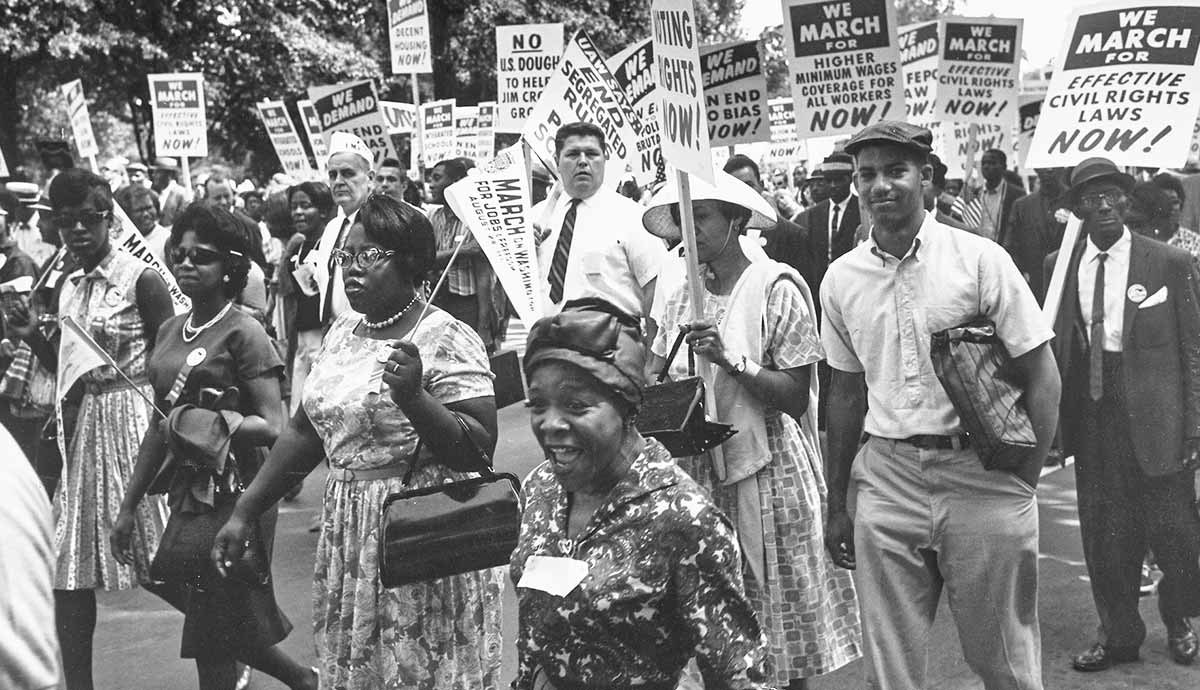
During the American Civil Rights Movement, the US saw advancements in social and political reforms concerning racial segregation and voting rights for Black Americans. Though slavery had been abolished at the end of the American Civil War, African Americans continued to face discrimination and abuse due to the color of their skin. Tired of segregation laws and prejudice, they rallied together to stand up against the oppression they faced on a daily basis. The following timeline will explore the key moments of the American Civil Rights Movement.Timeline of the Civil Rights MovementYearEventWhat Happened18651866Black CodesAfter the Civil War, Southern states passed laws restricting freedom and opportunities for freed Black Americans.Late 1870s1960sJim Crow LawsEnforced segregation in schools, restaurants, transport, and other public spaces under the separate but equal doctrine.19511954Brown v. Board of EducationStudents in Virginia challenged segregated schools; NAACP backed their case. Supreme Court ruled segregation in public schools unconstitutional (1954).19551956Montgomery Bus BoycottRosa Parks refused to give up her seat; she was arrested. Black residents boycotted buses for over a year, led by Martin Luther King Jr.1957Little Rock NineNine Black students attempted to integrate Little Rock Central High School; met with violent opposition. Eisenhower sent federal troops to escort them.1961Freedom RidesCORE members rode interstate buses to test desegregation rulings. They faced violence but gained national media attention.1963 (Spring)Birmingham CampaignMartin Luther King Jr. led protests against segregation in Birmingham; children were attacked with dogs and hoses.1963 (August)March on WashingtonOver 250,000 people gathered in DC demanding jobs and freedom. Martin Luther King Jr. delivered his I Have a Dream speech.1964Civil Rights ActSigned by President Lyndon B. Johnson. Outlawed discrimination in public places and employment based on race, sex, or religion.1965Voting Rights ActAddressed barriers like literacy tests and poll taxes that prevented Black Americans from voting. Federal oversight enforced registration.The American Civil Rights MovementColored waiting room sign at a bus station in Durham, North Carolina by Jack Delano, 1940. Source: Library of Congress, Washington DCTo understand the significance of the American Civil Rights Movement, it is important to first understand the segregation laws that Black Americans faced in the American South.Though African Americans were freed from slavery after the American Civil War (1861-1865) ended and the Reconstruction Era (1865-1877) began, they still faced prejudice and abuse as Southern states were slowly reintegrated into the United States. Black Codes were passed in 1865 and 1866, which controlled the freedom and job prospects for formerly enslaved people. Along with this, Black Americans faced torture and even murder from hate groups like the Ku Klux Klan, a terroristic, far-right white supremacist group.Jim Crow laws were later established in the South in the late 1870s and would remain well into the 1960s. These laws racially segregated communities across the Southern states, especially in public facilities like bathrooms, pools, restaurants, hotels, and even schools.While Jim Crow laws claimed to promote separate but equal policies, in reality, facilities for Black Americans were severely underfunded and poorly made as compared to facilities for white Americans. Schools for Black Americans were prime examples of this.Brown v. Board of Education, 1954Angry protestors after the Brown v. Board of Education ruling, 1954. Source: The Michigan ChronicleIn 1951, fed up with their racially segregated school district enforced by Jim Crow laws, Black students at Robert Russa Moton High School in Virginia demanded change. They complained that their school was underfunded, overcrowded, and inferior compared to schools for white students.The students, led by 16-year-old Barbara Johns, along with the backing of the National Association for the Advancement of Colored People (NAACP), staged a strike to demand desegregation of their school. Their actions set in motion years of protests and strikes for equal education opportunities for Black students.In May 1954, after listening to five separate cases related to school segregation, the US Supreme Court ruled in Brown v. Board of Education that racially segregating public schools was unconstitutional. This ruling overturned the 1889 separate but equal principle initiated with Plessy v. Ferguson.The ruling in Brown v. Board of Education demonstrated that reforms could be implemented within the US legal system, giving Black Americans the hope that changes could be achieved toward equal rights and freedom.Montgomery Bus Boycott, 1955Rosa Parks being fingerprinted by Lieutenant D.H. Lacke for her involvement in the Montgomery Bus Boycott, photograph by Gene Herrick, February 22, 1956. Source: Wikimedia CommonsOn December 1, 1955, civil rights activist Rosa Parks refused to give up her seat to a white person on a bus in Montgomery, Alabama, igniting a key event in the American Civil Rights Movement known as the Montgomery Bus Boycott.At the time, segregation laws in Montgomery declared that if a bus was full, Black passengers were obliged to stand up and give their seats to a white passenger. However, Parks refused to comply with this rule and was subsequently arrested for her choice.With the news of her arrest, Black residents of Montgomery began boycotting buses across the city. This affected the income of the citys bus company, since up to 70% of its customers had been Black people. Alongside the boycott, Dr. Martin Luther King Jr. led nonviolent protests calling out discrimination against the Black population and segregation on public transportation.The impact of the Montgomery Bus Boycott was substantial, as it showed the effectiveness of peaceful protests and the economic power of Black Americans. Though the boycotts did not change all of the segregation lawsBlack people were still prohibited from entering whites-only restaurantsthe federal district court ruled in June 1956 that the segregation of the Montgomery bus system was unconstitutional. In November, the US Supreme Court affirmed the ruling.Little Rock Nine, 1957The Little Rock Nine are escorted by the 101st Airborne Division to Little Rock Central High School, 1957. Source: Wikimedia CommonsIn light of the Brown v. Board of Education decision, most states desegregated public schools. However, some states, like Arkansas, resisted school integration. On September 4, 1957, nine African American students enrolled in Little Rock Central High School and attempted to attend classes.However, the governor of Arkansas, opposed to school integration and wishing to prevent potential riots from breaking out, sent the National Guard to stand outside the high school and stop the Black students from entering the premises. The Black students faced threats and violence as they attempted to get through the blockade of guards to receive the same education as white students. Despite the abuse they endured, they peacefully stood their ground and never retaliated.When President Eisenhower heard that the Black students were being harassed and prohibited from entering the school, 1,000 US troops were sent to protect them and enforce the school integration order that the federal courts had made.The students became known as the Little Rock Nine, and their resilience and bravery inspired others around the world to stand up for their civil rights. Their actions significantly influenced the passing of the Civil Rights Act of 1957 and furthered the Civil Rights Movement across the American South.Freedom Rides, 1961New York Freedom Riders leaving for Washington DC to protest segregation, 1961. Source: Library of Congress, Washington DCIn 1960, the US Supreme Court declared that segregation in bathrooms, waiting areas, and restaurants was unconstitutional and therefore illegal. Interested in testing out this ruling, in 1961, 13 members of the Congress of Racial Equality (CORE) traveled from Washington DC down the East Coast to New Orleans, Louisiana.CORE members wanted to see with their own eyes how the South had been adapting to the ruling and if changes were being made to initiate desegregation. As they traveled South, the Freedom Riders faced countless incidents of threats, harassment, and even violence as they attempted to desegregate facilities that had not already been integrated. Despite fearing for their personal safety, the Freedom Riders persisted, garnering media attention for their efforts.The Freedom Rides were significant as they showed the rest of the country what life was like for Black Americans in the South through the vast media coverage of their protests. White people in Northern states were appalled by the segregation that continued in the South and became inspired to take action to assist Black Americans in their pursuit of civil rights.Due to the Freedom Rides, the US government mandated that interstate bus companies eliminate segregation in the waiting areas and bathrooms of their stations along the interstate. By the end of 1961, the government ended the segregation of bus stations across the country, as well as in airports and railways.Birmingham, Alabama Campaign, 1963Young children protesting during the Birmingham Campaign led by Dr. Martin Luther King Jr., 1963. Source: Wikimedia Commons/FlickrIn early 1963, Dr. Martin Luther King Jr. selected Birmingham, Alabama, as the location for his campaign of nonviolent civil disobedience. He chose Birmingham due to its longstanding history of racism and segregation, as it was one of the most segregated cities in America. Police brutality against Black people was also common in Birmingham, and the local KKK was particularly brutal towards the Black population in the area.On May 2, 1963, Dr. Martin Luther King Jr. and his followers led a demonstration to protest segregation. Children were placed at the front of the march to appeal to viewers emotions. Ignoring the repercussions that the Birmingham Police Department might face if they intervened with force, the Police Chief ordered water cannons and dogs to attack the marchers. The police also arrested hundreds of children.As the march progressed into the third and fourth days, many policemen disobeyed the Police Chiefs orders as they began to realize how badly the Birmingham Police Department looked to the rest of the country, let alone the rest of the world. Local businesses became concerned about the negative publicity and worried their trade might be affected.The Birmingham campaign was successful as negotiations were made in favor of the rights of Black Americans. In exchange for ending the demonstration, the city agreed to desegregate bathrooms, water fountains, and lunch counters in a three-month period.The negative publicity the police department received also worked in favor of the American Civil Rights Movement as Americans across the country and others across the world began to see the brutality and inequality Black Americans, including innocent Black children, continued to receive in the South. Many began reaching out to their local politicians and finding ways to assist in the Civil Rights Movement.The March on Washington, 1963Celebration of Juneteenth in Washington DC during the Poor Peoples March on Washington, 1968. Source: WHYYIn late summer of 1963, thousands of people gathered in Washington DC to take part in the largest nonviolent, peaceful protest the nation had ever seen. This demonstration became known as the March on Washington for Jobs and Freedom. Those participating in the march demanded substantial changes to civil rights legislation and opportunities for Black Americans. Marchers also called for an end to discrimination and prejudice in such spheres as housing, employment, and education.Leaders of the event, including Dr. Martin Luther King Jr., met with members of Congress and President John F. Kennedy. The march ended at the Lincoln Memorial with music and speeches, including Kings I Have a Dream speech. The iconic speech was a poignant reminder of the perils that Black Americans had faced for hundreds of years in America and the need for change.In the speech, King emphasized the need for nonviolent, peaceful demonstrations and explained that Black and white people must stand together in the fight for equality and freedom:We must forever conduct our struggle on the high plane of dignity and discipline. We must not allow our creative protest to degenerate into physical violence. Again and again we must rise to the majestic heights of meeting physical force with soul forceWe cannot walk alone. (King, I Have a Dream, 1963)The March on Washington was a pivotal event in the civil rights movement, as it is credited with contributing to the passage of the Civil Rights Act of 1964. It also laid the groundwork for the Selma Voting Rights Movement, which then led to the passing of the Voting Rights Act of 1965. The success of the march demonstrated to the rest of the world that nonviolent demonstrations could foster positive advancements and lead to consequential changes on a political scale.Civil Rights Act, 1964 & Voting Rights Act, 1965Photograph of President Lyndon B. Johnson and Dr. Martin Luther King Jr. at the signing of the Civil Rights Act, 1964. Source: LBJ Presidential LibraryThe actions and demonstrations by leaders and participants in the American Civil Rights Movement, along with pivotal events like the Freedom Rides and demonstrations in Birmingham, put pressure on the US government to introduce a new civil rights bill.The Civil Rights Act (1964) prohibited discrimination on the basis of race in all public places in the nation. Any business employing over 25 people was not allowed to discriminate on the basis of nationality, religion, sex, or race. States could now be brought to court by the Justice Department if they discriminated against Black Americans.However, though the new civil rights bill created positive changes regarding employment opportunities for Black Americans, many supporters of the civil rights movement felt that voting rights and housing discrimination needed to be addressed.A year later, the Voting Rights Act established voting rights for Black Americans. Though Black Americans had technically been given the right to vote in 1870, many faced profound obstacles as they attempted to vote. For example, many Black Americans had to take literacy tests, fill out complicated forms, and take part in long interviews just to register to vote, with even a small error preventing them from being able to cast their ballot.With the passing of this new bill, literacy tests were banned and poll taxes were removed. The Justice Department monitored states to ensure that the new changes were being implemented. Federal examiners were sent to states to register Black Americans if the registration process was not being conducted properly. The bill removed the last of the Jim Crow laws in the South, and it is recognized as the culminating event in the civil rights movement. By the end of 1965, hundreds of thousands of Black Americans had registered to vote.Lasting ImpressionsCivil rights activists in Washington, D.C., 1963. Source: DCist WAMU NPR/GPA Photo Archive/FlickrThe American Civil Rights Movement was a pivotal struggle in the 1950s and 1960s aimed at ending racial segregation and discrimination against Black Americans. It challenged unjust laws and practices through nonviolent protests, legal actions, and grassroots activism.The movement elevated national awareness of racial injustice and inspired future social justice efforts, like the Northern Ireland civil rights movement in the 1960s, which was directly influenced by the American Civil Rights Movement. Leaders like Martin Luther King Jr. and countless activists played crucial roles in reshaping American democracy and advancing equality.
0 Комментарии
0 Поделились
19 Просмотры

 English
 Arabic
 French
 Spanish
 Portuguese
 Deutsch
 Turkish
 Dutch
Dutch
 Italiano
 Romaian
 Portuguese (Brazil)
 Greek
Greek