


ALLTHATSINTERESTING.COM
Americas Fixer: How Roy Cohn Worked With Joseph McCarthy, The Mob, And Donald Trump
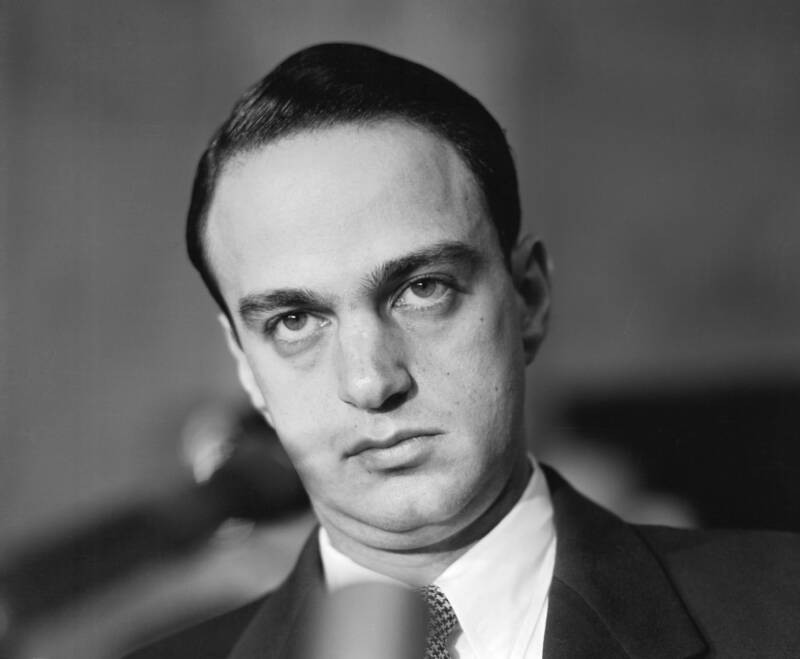
Some historical figures seem to crop up at every major cultural or political turn. Roy Cohn was one of those players who was strangely present at numerous key events of the mid-20th century like a real-life Forrest Gump.Roy Cohns big break came in the 1950s, though his legacy spanned well into the 2010s. He first made a name for himself, albeit a rather shady one, as a prosecutor in the Rosenberg trial.Later, as chief counsel to Senator Joseph McCarthy, he was instrumental in ramping up the fear and bullying linked to the Red Scare. The registered Democrat strategically tied himself closely to the Republican Party moving forward, showcasing his opportunism.Bettmann/Getty ImagesRoy Cohn at the Army-McCarthy hearings in 1954.Cohn was a closeted gay man one who would fall victim to the AIDS epidemic in 1986. Nonetheless, he used his fear-mongering ways and inquisitory methods to purge any suspected homosexual employees from the government.From McCarthyism to mob ties and the tutelage of Donald Trump, Roy Cohn was an unscrupulous bastard by any objective measure. To understand how he so deftly navigated American politics throughout the decades, an in-depth look is imperative.The Early Years Of Roy CohnBorn Roy Marcus Cohn on February 20, 1927, in New York City, the future lawyer was raised on Park Avenue. His father, Albert Cohn, was a judge in the Appellate Division of the State Supreme Court and wielded quite a bit of power.His mother, Dora, doted on her gifted young son, who admittedly showed a strong intellect for his age. By the time he was 20, Cohn had graduated from both Columbia University and Columbia Law School.He was a precocious, brilliant, arrogant young man, one of his peers later recalled, as reported by The New York Times in 1986, but he performed ably and energetically on such cases as the William Remington perjury trial, the Rosenberg spy trial, and the big New York trial of top Communist leaders.Arthur Schatz/The LIFE Images Collection/Getty ImagesRoy Cohn sits in his 1961 Chevrolet Impala convertible while talking on the phone with a client in front of his Madison Avenue office. 1963.Cohn was admitted to the New York bar at 21 and immediately used his familial connections to snag a job as an Assistant U.S. Attorney. He quickly established himself as a sharp prosecutor focused on subversive activities. This would soon cement his legacy.It was during the trial of Julius and Ethel Rosenberg, two American citizens accused of Soviet espionage and selling atomic secrets, that Cohn emerged as a fearsome force to be reckoned with.The Espionage Trial Of Julius And Ethel RosenbergIn March 1951, the Rosenbergs went to trial on federal espionage charges. Cohn was one of the prosecutors on the case.With the Red Scare in full effect, the trial became a political flashpoint. During the Cold War, the hysteria over Communist subversives infiltrating U.S. positions of power was at its peak.Hal Mathewson/NY Daily News Archive/Getty ImagesRoy Cohn is surrounded by autograph seekers in the Astor Ballroom after a dinner held in his honor by the Joint Committee against Communism. July 28, 1954.There was no direct physical evidence that the Rosenbergs were guilty, so the prosecution relied heavily on testimony from alleged co-conspirators to secure a conviction. And it was Roy Cohns direction examination of Ethel Rosenbergs brother, David Greenglass, that secured the couples conviction and subsequent execution.Greenglass had worked as a machinist at the secret Los Alamos Laboratory in New Mexico, which was established by the Manhattan Project to build the first atomic bomb.He testified that Julius Rosenberg had asked him to hand over classified documents and sketches about the weapon that later made it into the hands of the Soviets. Greenglass also incriminated Ethel, claiming that she was the one who typed up the handwritten notes before they were passed on.The U.S.S.R. detonated its first atomic bomb in 1949 supposedly based on information obtained from spies. As such, Greenglass testimony sealed the fates of the Rosenbergs. It was only in 2003 that the story changed.Public DomainDavid Greenglass was sentenced to 15 years in prison. He later claimed that Roy Cohn had pressured him to incriminate his sister as a Soviet spy.In an interview with 60 Minutes, Greenglass admitted that he lied under oath. He never saw his sister type or share any such notes. He also revealed that it was Roy Cohn who convinced him to commit perjury if he wanted to protect his wife and children.The famous trial revealed Cohns nefarious methods for the first time. His tactics were justified by their efficacy, even if they sent people who may not have been guilty to die in the electric chair. Hot off the Rosenberg trial, 26-year-old Roy Cohn was hired as chief counsel for Joseph McCarthy. It was then that the mask really came off.Roy Cohns Role In The McCarthy HearingsAs part of McCarthys Subcommittee on Investigations, Cohn aggressively questioned suspected Communist sympathizers, particularly during the Lavender Scare. This panic stemmed from allegations that Soviet agents were blackmailing closeted U.S. government employees by threatening to reveal their homosexuality if they didnt commit espionage.Cohn and McCarthy supported these claims with little evidence, and their fear-mongering campaign was so successful that President Dwight D. Eisenhower signed an executive order in April 1953 that essentially banned homosexuals from working for the federal government. During this time, Cohn also became friends with G. David Schine, an anti-Communist propagandist who joined McCarthys staff as a consultant.When Schine was drafted into the U.S. Army in 1953, Cohn made every effort to secure him preferential treatment. According to a 1954 report in The New York Times, Cohn even threatened to wreck the Army if they didnt follow his demands.George Skadding/The LIFE Picture Collection/Getty ImagesG. David Schine (left) and Roy Cohn (right) share a laugh as Senator Joseph McCarthy questions U.S. information officer Theodore Kaghan. 1953.It was this belligerence and aggression as well as McCarthys stunning claim that Communists had infiltrated the Defense Department that led to the Army-McCarthy hearings of 1954. What should have been a major accomplishment for Cohn and McCarthy quickly turned against them, and they instead found themselves on the defensive.Both men were accused of improperly pressuring the Army regarding Schine. McCarthy and Cohn, in turn, charged that the Army was holding Schine hostage to quell McCarthys investigation of suspected Communists in the force.One of the more egregious moments came when the Armys special counsel, Joseph N. Welch, credibly accused Cohn of falsifying a photograph depicting Schine with Army Secretary Robert T. Stevens. Then, there was McCarthys bullying of a young prosecutor hired by Welch. Welch couldnt help but respond in defense: Until this moment, Senator, I think I never really gauged your cruelty or your recklessness.Bettmann/Getty ImagesRoy Cohn watches as Senator McCarthy holds up a letter purportedly written by FBI director J. Edgar Hoover warning that a Fort Monmouth employee had a direct connection with an espionage agent.An estimated 20 million Americans were watching this broadcast, and up until that day, most citizens werent familiar with McCarthys personality or tactics. They simply believed he was fighting the dangers of Communism. Cohn motioned for McCarthy to pull back, but he failed to stop McCarthys aggressive questioning. Welch finally interrupted, cutting down McCarthy with his now-famous words: Let us not assassinate this lad further, Senator. Youve done enough. Have you no sense of decency?Public opinion shifted dramatically at this juncture, and the Senate quickly pivoted back. McCarthys colleagues censured him by the end of the year not for destroying lives, but for jeopardizing the reputation of the Senate and faith in the democratic process.Bettmann/Getty ImagesRoy Cohn (right) covers both microphones and whispers to Senator McCarthy while Army Secretary Robert Stevens testifies on the second day of the Army-McCarthy hearings in 1954.Roy Cohn, meanwhile, slipped through the cracks. He left Washington, D.C., and returned to New York City to continue his work as a lawyer. During this next phase in his legal career, he represented everyone from the Catholic Church and George Steinbrenner to the owners of Studio 54, mob bosses, Rupert Murdoch, and perhaps most famously Donald Trump.Becoming The Single Greatest Influence In Donald Trumps LifeThough Cohn was trained as a lawyer, his true skill was as a fixer for anyone worth befriending in the long term. The web of people he counted as clients was remarkable.For instance, he acted as a mentor for political consultant and lobbyist Roger Stone, who in turn became a highly resourceful advisor for Richard Nixon before working to get Donald Trump elected president. Sonia Moskowitz/Getty ImagesRoy Cohn and Donald Trump attend the Trump Tower opening in New York City in October 1983.Trump first met Roy Cohn at a New York City nightclub in 1973. At the time, Trump was in his 20s and battling lawsuits for his alleged violation of Fair Housing Act laws. In one interview, as reported by The Atlantic in 2019, Cohn recalled Trump telling him, Ive spent two days with these establishment law firms, and theyre all telling us, Give up, do this, sign a decree and all of that. Ive followed your career and you seem youre a little bit crazy like I am, and you stand up to the establishment. Can I come see you?Cohns response won Trump over immediately. My view is tell them to go to Hell, said Cohn. And fight the thing in court.Cohn was an excellent charmer of the elite and amassed a wide circle of celebrity friends-turned-clients. For them, his no-holds-barred behavior in the courtroom was the catch they wanted a pit bull on their side. Charles Ruppmann/NY Daily News Archive/Getty ImagesStudio 54 co-owner Steve Rubell (right) and Roy Cohn (left) casually read the Daily News coverage of the nightclubs raid by federal agents in December 1978.Roy would always be for an offensive strategy, said Stone. These were the rules of war. You dont fight on the other guys ground; you define what the debate is going to be about. I think Trump would learn that from Roy. I learned that from Roy.Cohns FBI files, released in 2019, revealed that Donald Trump once reportedly uttered Wheres my Roy Cohn? when he needed legal assistance.The files also showed just how corrupt Cohn really was. From representing mobsters Carmine Galante and Fat Tony Salerno to being disbarred in 1986 for defrauding his clients, he seemingly had no limits. His homosexuality, perhaps, was the only thing he was ashamed of.Bettmann/Getty ImagesDonald Trump, then owner of the New Jersey Generals of the U.S. Football League, with Roy Cohn. October 1984.My cousin Roy Marcus Cohn counsel to Senator Joe McCarthy, consigliere to Mafia bosses, mentor to Donald Trump had almost no principles, David Marcus wrote for Politico in 2019. He smeared Jews even though he was Jewish. He tarred Democrats even though he was a Democrat. He persecuted gay people even though he was gay.In 2008, Roger Stone stated in an interview with the New Yorker, Roy was not gay. He was a man who liked having sex with men. Gays were weak, effeminate. He always seemed to have these young blond boys around He was interested in power and access.Even after Cohn was diagnosed with AIDS, he insisted that he was actually suffering from liver cancer. He died from the disease on August 2, 1986, at age 59. He had been disbarred for unethical conduct just weeks earlier.Roy Cohn left behind a legacy of uninhibited opportunism. His thoughts on Donald Trump, shared in a 1984 interview, are eerily prescient:Donald Trump is probably one of the most important names in America today, Cohn said. What started off as a meteor mounting from New York and going upward is going to touch this country and parts of the world. Donald just wants to be the biggest winner of all.After learning about the controversial life and career of Roy Cohn, read about Donald Trumps mother, Mary Anne MacLeod Trump. Then, go inside the immigrant history of the presidents grandfather, Frederick Trump.The post Americas Fixer: How Roy Cohn Worked With Joseph McCarthy, The Mob, And Donald Trump appeared first on All That's Interesting.
0 Σχόλια
0 Μοιράστηκε
140 Views

 English
 Arabic
 French
 Spanish
 Portuguese
 Deutsch
 Turkish
 Dutch
Dutch
 Italiano
 Russian
 Romaian
 Portuguese (Brazil)