


WWW.THECOLLECTOR.COM
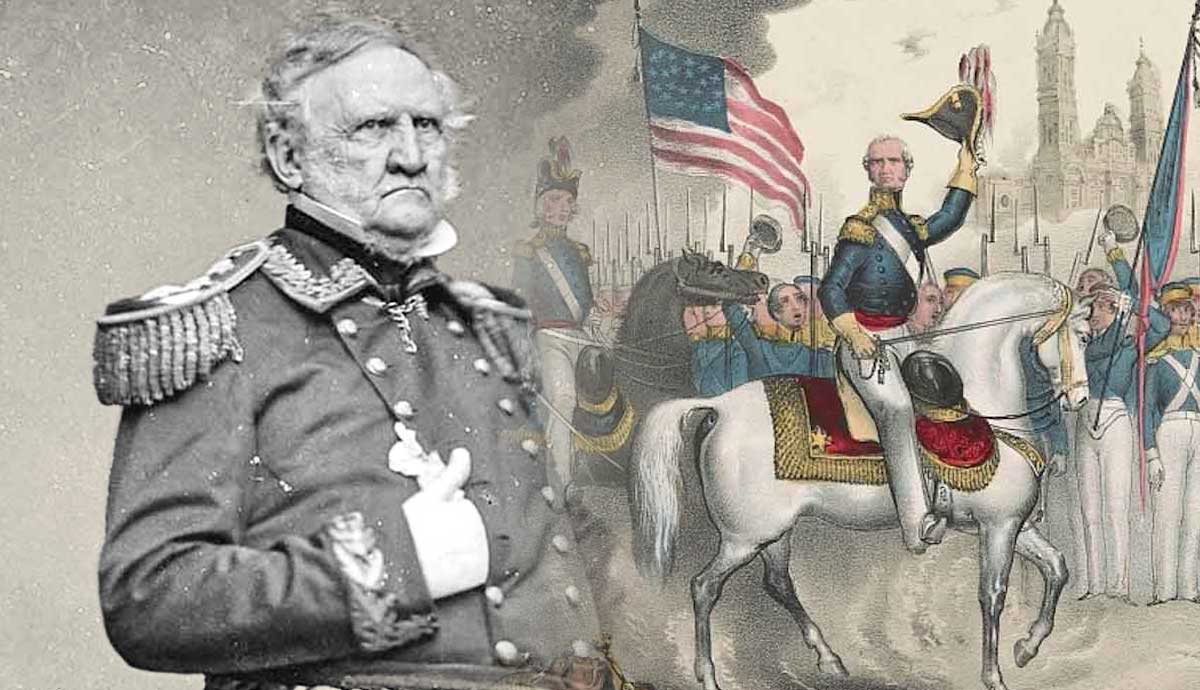
Winfield Scott, the Veteran General Who Captured Mexico City in the Mexican-American War
Born in Virginia in 1786, Winfield Scott trained as a lawyer before enlisting in the US Army in 1808. After achieving national recognition during the War of 1812, Scott served as a reluctant enforcer of Indian Removal during the Jackson and Van Buren administrations. Appointed general-in-chief in 1841, his greatest moment came in 1847 when he captured Mexico City during the Mexican-American War. He was involved in strategic planning during the initial stages of the American Civil War shortly before his retirement in 1861.The Early YearsIllustration of the College of William and Mary, 1887. Source: Wikimedia CommonsWinfield Scott was born on June 13, 1786 near Petersburg, Virginia. His father William Scott was a minor landowner who served as a captain during the American Revolutionary War. Winfield was only six years old when his father died, and his mother assumed responsibility for her four children until her own death in 1803.In 1804, the 18-year-old Scott enrolled at the College of William and Mary in Williamsburg, Virginia, where he studied liberal philosophy and developed an interest in military history. After leaving university in 1807 he was apprenticed to Petersburg lawyer David Robinson. He accompanied Robinson to Richmond, where former Vice President Aaron Burr was on trial for treason after being accused of a conspiracy to carve out his own empire in the western states.Meanwhile, tensions between the United States and Britain over the right of the Royal Navy to search American shipping for deserters led to a brief naval engagement between HMS Leopard and USS Chesapeake on June 22, 1807 that resulted in the death of four American sailors.With war seemingly imminent, the governor of Virginia requested volunteers for the militia. Scott was granted permission to return to Virginia and answer the call. On one occasion, he captured a party of eight British sailors who came ashore to buy provisions, but was soon instructed to release them.While President Thomas Jefferson wanted to avoid war and instead imposed a trade embargo on Britain, he increased the size of the US Army to 6,000 men. With the help of his friend Senator William Branch Giles, Scott secured an interview with the president and was promised a commission as captain. Scott became a captain in the light artillery in May 1808, marking the beginning of a 53-year career in the US Army.War of 1812US Troops at the Battle of Chippewa. Painting by H. Charles McBarron, Jr. Source: US Army Center of Military History via Wikimedia CommonsAfter recruiting a company of 90 men, Scott reported to New Orleans, where he was soon at odds with his commanding officer, the corrupt General James Wilkinson. Scotts denunciations of Wilkinson saw him court-martialed and suspended from his rank for twelve months in January 1810. He decided to return to Virginia but rejoined the army in October 1811 as war with Britain appeared imminent.Shortly after the outbreak of the War of 1812 in June 1812, Scott was promoted to lieutenant colonel. He participated in the invasion of Canada and on October 13, Scotts artillery supported the crossing of the Niagara River at the Battle of Queenston Heights. Although the engagement claimed the life of the British commander Major General Isaac Brook, it was otherwise a calamity for American forces and Scott became a British prisoner.After being released in November, Scott was promoted to colonel in early 1813 and appointed chief of staff to Henry Dearborn, the overall commander of the operations in Canada. Scott had greater success leading the capture of Fort George on Lake Ontario in May 1813, though the campaign ultimately proved unsuccessful when the Americans were defeated at Cryslers Farm in November.In early 1814, President James Madison promoted Scott to brigadier general. Scott led his men to a battlefield victory over the British at Chippewa on July 5, earning him national recognition. Three weeks later, Scotts force was ambushed and badly mauled at the Battle of Lundys Lane on July 25. Scott was wounded and the battle ended inconclusively. He returned to the field in October 1814 to take command of American forces defending Washington and Baltimore.Peacetime CommandsPortrait of President Andrew Jackson by Ralph Eleazer Whiteside Earl. Source: White House Historical AssociationAfter the war ended in early 1815, Scott was involved in demobilizing the army and was named one of four brigadier generals in peacetime. After Napoleon was restored to power in France, Scott obtained permission to travel to Europe, anticipating the renewal of warfare on the continent. By the time Scott crossed the Atlantic, Napoleon had already been defeated at Waterloo. He hurried to Paris, where he made his acquaintance with leading dignitaries of the coalition that had ousted Napoleon.After returning to the United States in May 1816, Scott was appointed to command US forces in the northeastern states. In March 1817 he married Maria Mayo, the daughter of a wealthy engineer from Virginia. Scott soon found himself feuding with future president General Andrew Jackson and his fellow Brigadier General Edmund P. Gaines. While Scott and Jackson reconciled after meeting in Washington in 1823, his rivalry with Gaines persisted as both men sought to succeed Major General Jacob Brown as Commanding General of the United States in 1828. When President John Quincy Adams appointed Alexander Macomb instead, Scott threatened to resign but eventually backed down.In the summer of 1832, President Andrew Jackson ordered Scott to Illinois to take command of US forces fighting the indigenous chief Black Hawk. A few days before Scotts arrival, Black Hawks forces were destroyed at the Battle of Bad Axe on August 3. Scott remained in Illinois to negotiate a peace treaty with the Native Americans.In November 1832, Jackson ordered Scott to South Carolina, whose political leaders were threatening to secede from the Union over high tariffs passed by Congress. Scott spent a couple of months inspecting federal forts in South Carolina and the crisis was diffused by the passage of a compromise tariff bill in February 1833.Indian RemovalMartin Van Buren, eighth president of the United States. Portrait by George Peter Alexander Healy, 1857. Source: National Portrait Gallery, Smithsonian InstitutionIn addition to his normal duties, Scott took a close interest in tactics and training and was nicknamed Old Fuss and Feathers by his subordinates for his insistence on discipline. In 1835, he completed a three-volume book on infantry tactics that remained the Armys standard drill manual until 1855.During the mid-1830s, Scott served as a reluctant enforcer of President Jacksons policy to forcibly remove Native American tribes west of the Mississippi River. After Seminole resistance to the removal led to the Dade massacre of December 1835, Scott took command of US forces in Florida during the Second Seminole War in February 1836. His men struggled in the inhospitable conditions and spent several months campaigning without much success. In May he was ordered to Georgia to deal with a Creek uprising, and his subordinate General Thomas Jesup defeated the enemy on his own initiative.In March 1837, Scotts friend Martin Van Buren succeeded Jackson as president. In January 1838, Van Buren sent Scott to the Canadian border to restrain American patriots who were supporting rebellions in Canada. Scotts status as a hero of the War of 1812 allowed him to speak with authority, and he earned a reputation as a peacemaker by persuading the Americans at the frontier not to risk war with Britain.Cherokee chief John Ross. Lithograph by Charles Bird King, 1843. Source: Library of CongressIn April 1838, Van Buren appointed Scott to supervise the removal of the Cherokee in accordance with a 1835 treaty. Scott was sympathetic to Cherokee arguments against removal owing to their efforts to assimilate with American culture, but insisted on carrying out his orders. Scott planned to gather the Cherokee in a series of camps before conveying them west. While he promised to treat the Cherokee well, the militiamen under his command acted brutally as the Cherokee resisted being uprooted from their homes.In July 1838, Cherokee chief John Ross obtained permission from the government in Washington to organize the westward transportation without the supervision of US troops. Scott was happy to be relieved of his duties, but was determined to accompany the first group of Cherokee who left for Arkansas on October 1.Three weeks later, Scott was recalled to the Canadian frontier as tensions flared up as part of a border dispute between Maine and Canada. Scott once again exhibited his diplomatic skills to persuade the Maine legislature to give him authority to make peace, which he duly negotiated with his British counterpart Sir John Harvey in March 1839.Mexican-American WarZachary Taylor by James Reid Lambdin, 1848. Source: National Portrait Gallery, Smithsonian InstitutionIn 1841, following the death of Alexander Macomb, Scott was promoted to major general and appointed general-in-chief by President John Tyler. Scott had little time for Tyler, who inherited the presidency upon the death of William Henry Harrison. He was also skeptical of Tylers successor James K. Polk, who won the 1844 election promising not only to annex Texaswhich had achieved independence from Mexico in 1836but to expand the frontiers of the United States in both the northwest and the southwest.By the time Polk took office on March 4, 1845, Tyler had already set in motion the annexation of Texas. Polk dispatched Brigadier General Zachary Taylor to command a force of 3,000 men to protect Texas against any armed response from Mexico. A Mexican cavalry incursion across the Rio Grande on April 26, 1846 gave Polk the pretext he needed to declare war on Mexico.Following the outbreak of the Mexican-American War, Scott set to work recruiting and training 20,000 volunteers. Meanwhile, Taylor repulsed the Mexican threat and marched on Monterrey, which he captured in September. Taylors efforts were aligned with Polks original strategy to occupy northern Mexico and force the Mexicans to cede the territory he coveted. He was persuaded to take more aggressive action by Senator Thomas Hart Benton of Missouri, who proposed landing a force at Veracruz to march on Mexico City.With few experienced officers at his disposal, Polk reluctantly appointed Scott to command the operation. After arriving at the Rio Grande in late December 1846 to supervise preparations, Scott and his 12,000 men landed at Veracruz on March 9, 1847. He proceeded to besiege the city, which surrendered three weeks later after an intense artillery bombardment.Illustration of Winfield Scott leading US forces in the capture of Mexico City. Source: Library of CongressScott then marched inland towards the Mexican capital. After receiving news of Scotts landing, GeneralAntonio Lpez de Santa Anna took up a defensive position at Cerro Gordo near the city of Xalapa. Scott ordered his engineers to cut a path through thick vegetation against Santa Annas left flank and launched his attack on April 18. The battle was easily won and Scott captured more than 3,000 Mexican prisoners.Despite Scotts success at Cerro Gordo, he soon found himself in a vulnerable position as half his men were due to return home at the end of their one-year term of service. In early June, he was forced to concentrate his remaining forces and abandon the garrisons on the road to Veracruz. New reinforcements arrived over the following weeks, and by early August, Scott had 14,000 men with him.With Scott marching on Mexico City, Santa Anna consolidated his forces and prepared to make a stand at the Churubusco River. General Gabriel Valencia refused to obey Santa Annas orders, and his force of 5,000 was crushed at the Battle of Contreras in the early hours of August 20. Santa Anna withdrew the bulk of his forces and left a delaying force at Churubusco, which Scott easily overcame later in the day.Scott began his attack on Mexico City in early September. After both sides suffered heavy losses at Molino del Rey on September 8, the Americans overcame Mexican defenses at Chapultepec Castle on September 13. Scotts army controlled the high ground overlooking the city, and on September 14 he rode through the streets of Mexico City in triumph. Scott supervised pacification operations until the war ended with the signing of the Treaty of Guadalupe Hidalgo in February 1848.Presidential CandidateThe Game-cock & The Goose, a pro-Scott cartoon featuring Scott and Franklin Pierce by John Magee, 1852. Source: US Library of CongressScott had joined the Whig Party in the 1830s, though his political affiliations were not widely known at the time. Owing to his diplomatic efforts on the northern frontier, Scott was among the candidates for the Whig nomination for the 1840 presidential election. The Whigs ultimately nominated General William Henry Harrison, who defeated Van Buren but lasted only a month in office until succumbing to illness in April 1841.Scotts name continued to be in the frame for the Whig nomination in the 1844 and 1848 elections but lost out to Henry Clay and Zachary Taylor respectively. Taylor won the general election but died in July 1850. Amidst sectional tensions over the westward expansion of slavery, Taylors successor Millard Fillmore supported the controversial Compromise of 1850.The Compromise of 1850, particularly the Fugitive Slave Act, split the Whigs between Northern and Southern factions. Although Scott had supported the Compromise, he became the preferred candidate among the Northern Whigs for the presidential nomination in 1852. After a closely fought nomination contest, Scott defeated Fillmore on the 53rd ballot to become the Whig candidate in the November 1852 election.The Democrats nominated dark horse candidate Franklin Pierce of New Hampshire, a proslavery Northerner who had served under Scott as a brigadier general during the Mexican War. The split in the Whigs condemned Scott to a heavy defeat at the ballot box. Although Scott won 44 percent of the popular vote, his tally of 42 electoral votes was the lowest ever received by a Whig candidate.American Civil WarPhotograph of Union general-in-chief Winfield Scott. Source: National Park ServiceThe Compromise of 1850 failed to dampen the sectional tensions over slavery. The election of Abraham Lincoln in November 1860 led the southern states to secede from the Union and form the Confederate States of America. As Confederate forces besieged the Union garrison at Fort Sumter in South Carolina, Scott advised Lincoln against attempting to resupply the fortress. The president chose to do so anyway, and on April 12, 1861, the American Civil War began with the Confederate attack on Fort Sumter.As general-in-chief, Scott played an important role in military planning during the early months of the Lincoln administration. Scotts strategy, later known as the Anaconda Plan, involved blockading Southern ports and taking control of the Mississippi to force the Confederacy into submission. Lincoln preferred a more aggressive approach and ordered General Irvin McDowell to march on the Confederate capital of Richmond, Virginia with 30,000 men. McDowell was defeated by the Confederates at the First Battle of Bull Run, crushing Union hopes of a quick victory.The 75-year-old Scott soon fell out of favor, and in November 1861 Lincoln appointed General George B. McClellan as general-in-chief. Scott made a brief visit to Europe before returning to the United States to write his memoirs, which were published in 1864. In retirement, Scott continued to offer occasional advice to Lincoln on the war effort. General Ulysses S. Grants victory at Vicksburg in July 1863 saw Union forces gain control of the Mississippi in accordance with Scotts Anaconda Plan. Scott lived to see the Union victory in 1865 and died on May 29, 1866 just short of his 80th birthday.
0 Комментарии
0 Поделились
186 Просмотры

 English
 Arabic
 French
 Spanish
 Portuguese
 Deutsch
 Turkish
 Dutch
Dutch
 Italiano
 Romaian
 Portuguese (Brazil)
 Greek
Greek