Scientists Just Identified A 60-Foot Octopus With Bone-Crushing Jaws That Ruled The Seas During The Cretaceous
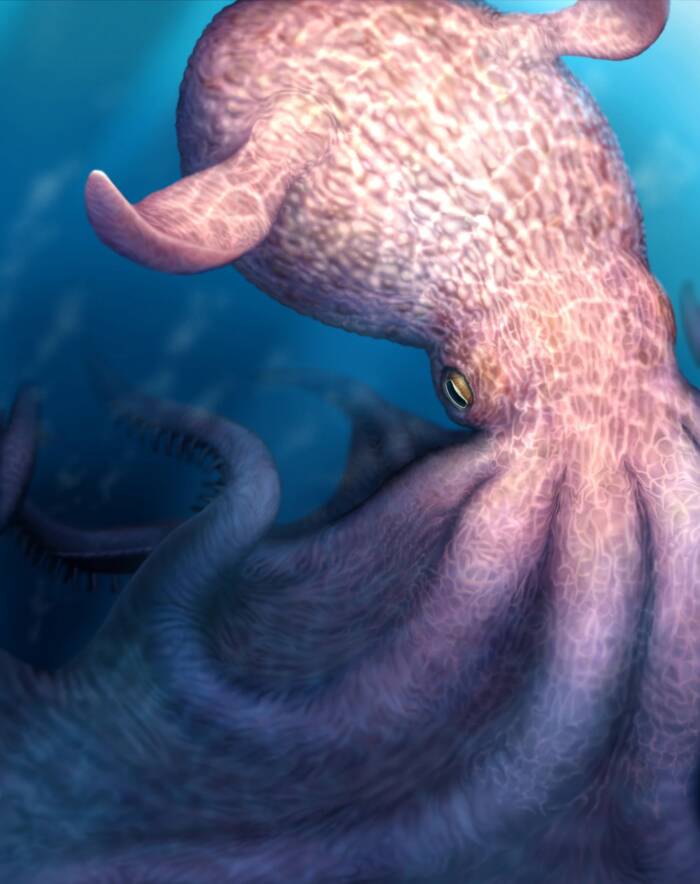
Yohei Utsuki/Department of Earth and Planetary Sciences, Hokkaido UniversityAn illustration of the fearsome apex predator known as Nanaimoteuthis haggarti.Stories have long been told about the Kraken, the fearsome giant sea monster of centuries-old myth that could wrap its tentacles around an entire ship and drown scores of sailors in the process. And while the Kraken may be make-believe, a group of scientists have just made new findings about a prehistoric giant octopus from the Late Cretaceous that could grow to similarly monstrous proportions.The octopus, known as Nanaimoteuthis haggarti, lived between 86 and 72 million years ago. Scientists now believe that it could grow to be 62 feet long bigger than the average city bus and as large as most megalodons. Whats more, researchers also suggest it was an apex predator capable of devouring sharks using jaws that could crush bone.New Analysis Of Fossils Taken From These Giant Prehistoric OctopusesThe new insights about Nanaimoteuthis haggarti, which were detailed in a study published in Science, were made by a group of researchers from Japan and Germany. They set out to study the size of octopuses during the Cretaceous Period (145 million to 66 million years ago), but needed to be creative in their approach. This is because soft-bodied invertebrates like octopuses leave little trace in the fossil record. So, researchers instead looked for these creatures hard beaks, which are more able to become fossilized.Hokkaido UniversityThe lower jaw of an adult N. Haggarti octopus, which suggests that the octopus itself could grow to an impressive size, up to 62 feet in length.Paleontologists started with 15 fossilized beaks from Late Cretaceous deposits in Japan and Vancouver Island in Canada, and also used artificial intelligence to detect fossilized octopus jaws in Japanese sediment samples. With this method, they were able to identify 12 additional jaws, all of which they examined to determine the size of the octopuses themselves.What they found was truly astounding. The researchers identified two species of octopus (previously thought to be vampire squids) known as N. jeletzkyi and N. haggarti. N. jeletzkyi lived roughly 100 and 72 million years ago, and was about the same size as todays giant Pacific octopus (roughly 10 feet to 25 feet long). But N. haggarti, which lived between 86 and 72 million years ago, was even bigger: researchers believe that it could have grown to between 23 to 62 feet, making it one of the largest marine animals of its day.These new insights about the size of octopuses during the Late Cretaceous period are impressive. But scientists are also intrigued by the jaws themselves, which suggest that N. haggarti was an apex predator.How Nanaimoteuthis haggarti Dominated Ocean Life Tens Of Millions Of Years AgoAs part of their study, the researchers also looked at the octopuses jaws. They found that while the jaws of younger octopuses were intact, the jaws of the older octopuses were badly chipped and cracked. According to the study, some of the jaws had lost up to 10 percent of their total length.This suggests that the octopuses were capable of eating hard prey consisting of shells and bones. This prey could have included ammonites and bony fish, as well as even larger marine animals like sharks, plesiosaurs, and mosasaurs.ScienceThe enormous size of Nanaimoteuthis as compared to those of other formidable sea creatures from both the prehistoric era and the present.This extensive wear suggests dynamic crushing of hard skeletons, the researchers wrote. With a calculated total length of [23 to 62 feet], these octopuses may represent the largest invertebrates thus described, rivaling contemporaneous giant marine reptiles. Our findings show that powerful jaws, and the loss of superficial skeletons, convergently transformed cephalopods and marine vertebrates into huge, intelligent predators.Though not everyone agrees with the studys findings it can be difficult to make assumptions based on beaks alone the researchers have painted a fearsome picture of this prehistoric apex predator. Tens of millions of years ago, Nanaimoteuthis haggarti likely stalked the oceans, a sprawling dark shadow capable of wrapping its tentacles around its prey and breaking it down into bite-sized pieces with its powerful jaws.So what happened to these ocean monsters?Scientists remain unsure. Though many varieties of octopus of course exist today, the Nanaimoteuthis has long been extinct. However, more evidence about their rise and fall may be out there, waiting to be discovered in the oceans depths.After reading about this giant octopus that lived tens of millions of years ago, discover the stories of some of Earths most unbelievable prehistoric animals. Then, learn about the Dumbo Octopus, the small but formidable cephalopod of the deep sea.The post Scientists Just Identified A 60-Foot Octopus With Bone-Crushing Jaws That Ruled The Seas During The Cretaceous appeared first on All That's Interesting.




 English
 Arabic
 French
 Spanish
 Portuguese
 Deutsch
 Turkish
 Dutch
Dutch
 Italiano
 Russian
 Romaian
 Greek
Greek