Power Line Construction In Germany Turns Up A 7,000-Year-Old Pit Filled With Beaver Remains
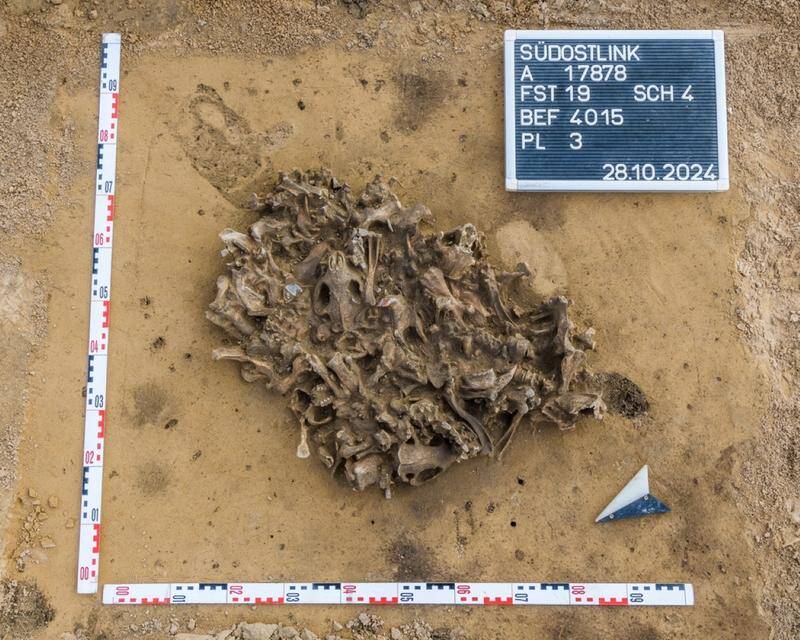
State Office for Heritage Management and Archaeology Saxony-AnhaltThe 7,000-year-old pit filled with beaver remains that was found in Alsleben, Germany.During preventative archaeology ahead of the construction of the SuedOstLink high-voltage electricity transmission line near Alsleben, Germany, archaeologists found a pit full of bones. These remains, easily identifiable by their orange teeth, belonged to beavers and archaeologists determined that theyd been slaughtered a whopping 7,000 years ago.Neolithic people likely killed the beavers for their fur, then disposed of the bones in the pit. But the hunters refuse has now become archaeologists treasure, as this pit is offering an interesting look at Neolithic practices in the region many millennia ago.The 7,000-Year-Old Pit Filled With Beaver Bones That Was Found In AlslebenAccording to the State Office for Heritage Management and Archaeology Saxony-Anhalt, the pit was discovered ahead of the construction of the SuedOstLink power line, which runs roughly 100 miles through Saxony-Anhalt. Its trajectory takes it through a number of ancient settlements where prehistoric peoples once took advantage of the regions especially fertile lands.State Office for Heritage Management and Archaeology Saxony-AnhaltA closer look at the beaver remains in the pit, as well as a Neolithic flint tool that was found alongside them.The beaver pit, documented in 2024 but only fully excavated and analyzed recently, was discovered alongside the Saale River near Alsleben. It was found alongside postholes, storage pits, slotted pits, and burial sites that to date the Neolithic era into the Bronze and Iron Ages. But the beaver pit certainly stands out among these finds.About two-and-a-half feet across and dated to between 4935 and 4787 B.C., the pit was filled with animal bones, which archaeologists were able to quickly identify as beaver bones because of their reddish-brown teeth. The bones are well-preserved, and belong to at least 12 beavers who were between the ages of one and eight years old when they were killed.This Neolithic pit is not only an astounding discovery on its own, its also offering up some new insights on hunting practices in the area some 7,000 years ago.How The Beaver Remains Were Used By Neolithic HuntersBased on the age of the pit, archaeologists believe that the beavers were slaughtered by people belonging to the Stroke-Ornamented Ware Culture, who were so named for their pottery. No pottery was found in the pit alongside the beaver remains, however, though archaeologists did recover a flint tool.Grauesel/Wikimedia CommonsA section of Germanys Saale River, along which the Neolithic pit containing the beaver bones was discovered.Archaeologists believe that the beavers were likely hunted along the Saale River, though the fact that only one such pit has been found suggests a unique event. Neolithic people probably targeted them for their fur, which they could use as clothing. They likely skinned the beavers after they were killed, and dumped their bodies in a heap. Then, once the remains were skeletonized, it seems that the beaver bones were disposed of in the pit.Though little is know about Neolithic clothing, archaeologists do have an idea of how Neolithic people hunted. Depending on the animal, they would have used different methods: spears and arrows would have been used for land animals, while nets and harpoons were used to capture water animals.State Office for Heritage Management and Archaeology Saxony-AnhaltArchaeologists found the remains of at least 12 beavers in the pit that was uncovered at Alsleben.Indeed, though the 7,000-year-old beaver pit is an exciting find and a fascinating time capsule from the Neolithic era many questions about it remain. Why were the beavers hunted in a unique event or are there similar pits nearby? How were the beavers hunted and killed? Which tools did the hunters use? And how did the Stroke-Ornamented Ware Culture use the beaver pelts? What sort of clothing items were they turned into, and how were they made? For now, some of these questions are unanswerable.But still, the beaver pit does offer some insights about Neolithic people, in terms of what they hunted and how they used their prey.The Alsleben find thus not only points to specialized hunting strategies in the early Neolithic period, the State Office for Heritage Management and Archaeology Saxony-Anhalt said, but also allows us to draw conclusions about clothing at that time, which we can imagine to have been quite elaborate.After reading about the 7,000-year-old Neolithic pit filled with beaver bones that was found in Germany, discover the story of the Castoroides, the giant prehistoric beavers that went extinct long ago. Then, look through these fascinating and sometimes surprising images from bestiaries, illustrated animal encyclopedias from the Middle Ages.The post Power Line Construction In Germany Turns Up A 7,000-Year-Old Pit Filled With Beaver Remains appeared first on All That's Interesting.




 English
 Arabic
 French
 Spanish
 Deutsch
 Turkish
 Dutch
Dutch
 Italiano
 Russian
 Romaian
 Portuguese (Brazil)
 Greek
Greek