


WWW.THECOLLECTOR.COM
William I and the Rebirth of the Dutch Monarchy in 1813
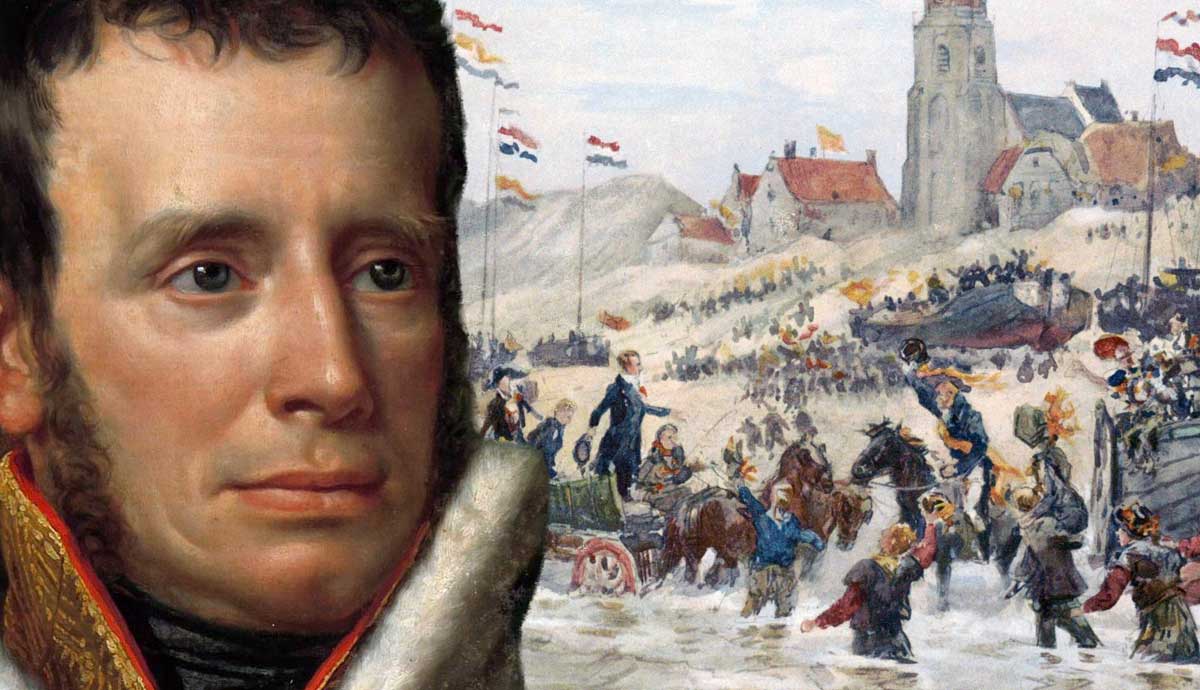
After being overthrown by French revolutionaries in 1795, the House of Orange was out of power in the Netherlands for 18 years. This ended with Prince William Fredericks return to Scheveningen beach in 1813 to take command of a rebellion that would restore the Orange monarchy in the Netherlands.Prince of OrangePrince William Frederick of the Netherlands in exile. Anonymous German painter, 1805-10. Source: RijksmuseumWillem Frederik was born in 1772 in the Hague, son of Stadtholder William V and Princess Wilhelmina of Prussia. In his early years, he received a rigorous education with a strong military focus under the guidance of the mathematician Leonhard Euler and historian Herman Tollius. He attended the military academy in Brunswick from 1788 to 1789 and later studied briefly at the University of Leiden.In 1791, at the urging of his family, he married Princess Wilhelmine of Prussia, his mothers namesake niece. This strengthened ties between the Dutch and Prussian royal families. Historically, the Dutch were aligned with other Protestant countries in continental Europe to hold off the threat posed by its Catholic neighbors.Williams military education enabled him to rise up in the ranks, and after attaining his majority in 1790 he was appointed a general of infantry in the Dutch States Army of which his father was Captain-general. At the same time, he was appointed to the Council of State of the Netherlands.In 1793, Revolutionary France declared war on the Dutch government. William was appointed commander-in-chief of the Dutch mobile army. He proved to be a capable general, winning minor victories at the Siege of Landrecies and the battles of Gosselies and Lambusart. He performed well in a losing cause at the Battle of Fleurus in June 1794, which enabled the French Republicans to occupy the Netherlands. William and his father fled the country for England, starting a long period of exile.The Batavian RepublicMap of the Batavian Republic published by Mortier Covens & Zoon, 1798. Source: Bibliothque nationale de FranceThe advancing French forces had a lot of support. Local Patriot revolutionary committees, who had been in opposition to the House of Orange since the 1780s, coordinated with the French. These committees carried out peaceful takeovers in cities like Amsterdam, seizing municipal power as the old Orangist city councils fled or surrendered. On January 9, 1795, the Batavian Republic was formally proclaimed. The French forced the new state to sign a harsh friendship treaty that forced the Netherlands to cede territory and pay reparations to France.On paper, the new Batavian Republic aimed to create a modern, centralized unitary state with a written constitution and equal rights for all citizens, including religious minorities. However, it suffered from serious political instability and a major loss of revenue. The era was marked by severe internal friction between Unitarians (who favored central power) and Federalists (who favored provincial autonomy), leading to three coups dtat in 1798, 1801, and 1805 supported by various French factions. Its armed forces were kept intentionally weak to ensure that they didnt pose a threat to the French occupiers.By 1805, the Republic was in trouble. Emperor Napoleon I hoped to exert more control over the Netherlandss resources. He initially installed Rutger Jan Schimmelpenninck as Grand Pensionary, an office with nearly dictatorial executive powers. Subsequently, he forced Schimmelpenninck to resign. On June 5, 1806, he abolished the Republic and transformed it into the Kingdom of Holland, installing his brother, Louis Bonaparte, as King. By 1810, Napoleon decided to completely annex the Netherlands into Greater France.William in ExileBattle of Jena, October 14, 1806 by Horace Vernet, 1836. Source: Chteau de Versailles, ParisWhile the Netherlands was wracked with French interference and political instability, William got a front-row seat to the conflict engulfing Europe. In 1799, he joined an Anglo-Russian force that invaded the Netherlands. This operation failed and he was forced to flee his homeland again. As compensation for his dynastys loss of office, Napoleon agreed to make William the prince of Fulda in Germany, which he ruled from 1803 to 1806 as Prince of Nassau-Orange-Fulda.In 1806, after the resumption of hostilities with Napoleon, William joined the Prussians and he became a division commander in Prince Frederick Louiss army. At the Battle of Jena-Auerstedt, he commanded his men valiantly, but to no avail. The Prussians were soundly defeated and he was stripped of his German principality. In spite of this, he did not give up his resistance. When Austria declared war on Napoleon in 1809, he joined the Austrian Army as a Major-General and was badly wounded at the Battle of Wagram.After recovering from his wounds, William stayed in Prussia, hoping to lobby for support for his future return to the Netherlands. Napoleons disastrous Russian campaign of 1812 fatally destabilized the French Empire, and in early 1813 joined Russia in the Sixth Coalition against Napoleon. After Napoleons defeat at Leipzig in October 1813, French rule in the Netherlands collapsed and the Dutch elite faced a crisis. Fearing that they would be occupied by another power, they began to prepare for the return of the House of Orange-Nassau.The Orange RestorationA painting of William Is arrival on Scheveningen Beach, 1912. Rijksmuseum, AmsterdamOn November 21, 1813, Gijsbert Karel van Hogendorp, Frans Adam van der Duyn van Maasdam, and Leopold van Limburg Stirum, three prominent Dutch statesmen, formed a provisional government known as the Driemanschap. In order to preserve Dutch sovereignty and independence, they planned to restore the House of Orange and invited Prince William Frederick to return to take control of his patrimony.William and his family were pleased to be invited back to their country without having to march in with an invading army or spill Dutch blood. The British government, hoping to obtain Dutch support in the war against Napoleon, expedited his return aboard the warship HMS Warrior. Accompanied by his two sons, he arrived on Scheveningen Beach on November 30th. Members of the Driemanschap and thousands of cheering Dutchmen waited for him when his craft landed on the beach.Despite strong sympathies for republicanism within the Netherlands, many Dutch people were tired of being controlled by the French and preferred the robust, independent nationalism of William and his supporters. He was well-liked in the Netherlands, and while he made his way to the Hague, he was given a horse and carriage by locals to help him get there. A few hours later, he arrived in The Hague with his entourage amidst supporters chanting Orange Forever!The Formation of the New GovernmentPortrait of William I, King of the United Kingdom of the Netherlands by Joseph Paelinck, 1819. Source: Wikimedia CommonsOn December 2, 1813, he was proclaimed Sovereign Prince of the United Netherlands in Amsterdam, after rejecting the initial offer of the title of King. The main reason for this was because William did not want to be seen as a king imposed on the Dutch people by foreign powers. The title of Sovereign Prince enabled him to claim the status of a liberator. William insisted that his powers be defined by a wise constitution to protect the rights of the people before he would accept higher status. This allowed him to negotiate a governing document that eventually granted him extensive, nearly absolute executive power while maintaining the appearance of a constitutional ruler.The alliance that defeated Napoleon had a desire to ensure that the Netherlands could act as a formidable barrier against the French. As a result, they unanimously recognized the restoration of the House of Orange in the Netherlands. After Napoleon was exiled to Elba, William obtained recognition as ruler of the northern and southern provinces of the Netherlands (including modern-day Belgium and Luxembourg) in exchange for him giving up his lands in Germany. To rebuild the Dutch economy, he began to oversee a major rehabilitation of the Dutch banking and trade system.After his restoration, William created a new army of 30,000 men within 18 months. With the blessing of the Congress of Vienna, he was crowned King of the United Netherlands in March 1815. When Napoleon returned to France from Elba, William recognized that he intended to target the Low Countries. He ordered his army, commanded by his son Prince William, to join the Allied forces under the Duke of Wellington. The Allied victory against Napoleon at Waterloo ensured that France could no longer threaten Williams kingdom.The Postwar NetherlandsEpisode of the September Days 1830 (on the Grand Place of Brussels) by gide Charles Gustave Wappers, 1835. Source: Wikimedia CommonsPeace in northern Europe ensured that William could focus on rebuilding Dutch state institutions and the economy. He oversaw the construction of a vast network of canals and roads to link the industrialized South with the mercantile North. In 1824, he founded the Netherlands Trading Society, which spearheaded trade with the Dutch East Indies and laid the groundwork for the modern Dutch financial system.More controversially, William sought to impose Dutch culture and the Dutch language all across his kingdom. This alienated the French-speaking southern provinces, which were reluctant to join the united kingdom in the first place. At the same time, tension was increasing within the Dutch metropole because of resentment towards Williams policy of centralization. The bicameral legislature in the Netherlands, known as the States General, lacked real authority to challenge the monarch.In 1830, riots broke out in Brussels because of Francophone resentment towards Dutch rule. When the southern provinces seceded to form the Kingdom of Belgium, William launched an invasion in early 1831. Although Dutch forces gained the upper hand in the ten-day war, the threat of French intervention forced them to withdraw. William refused to recognize Belgian independence until 1839. In October 1840, he agreed to constitutional reforms and abdicated in favor of his son, King William II. Three years later, he died in Berlin at the age of 71.Williams legacy in the Netherlands is mixed. The House of Orange continues to serve as constitutional monarchs in the Netherlands to this day. Some remember him as the man who liberated the provinces from French rule. Others see him as the man who lost Belgium and established an autocratic government that was no better than French occupation.
0 Comentários
0 Compartilhamentos
169 Visualizações

 English
 Arabic
 French
 Spanish
 Deutsch
 Turkish
 Dutch
Dutch
 Italiano
 Russian
 Romaian
 Portuguese (Brazil)
 Greek
Greek