


WWW.THECOLLECTOR.COM
How the Thirty Years War Ravaged Europe and Gave Birth to Modern States
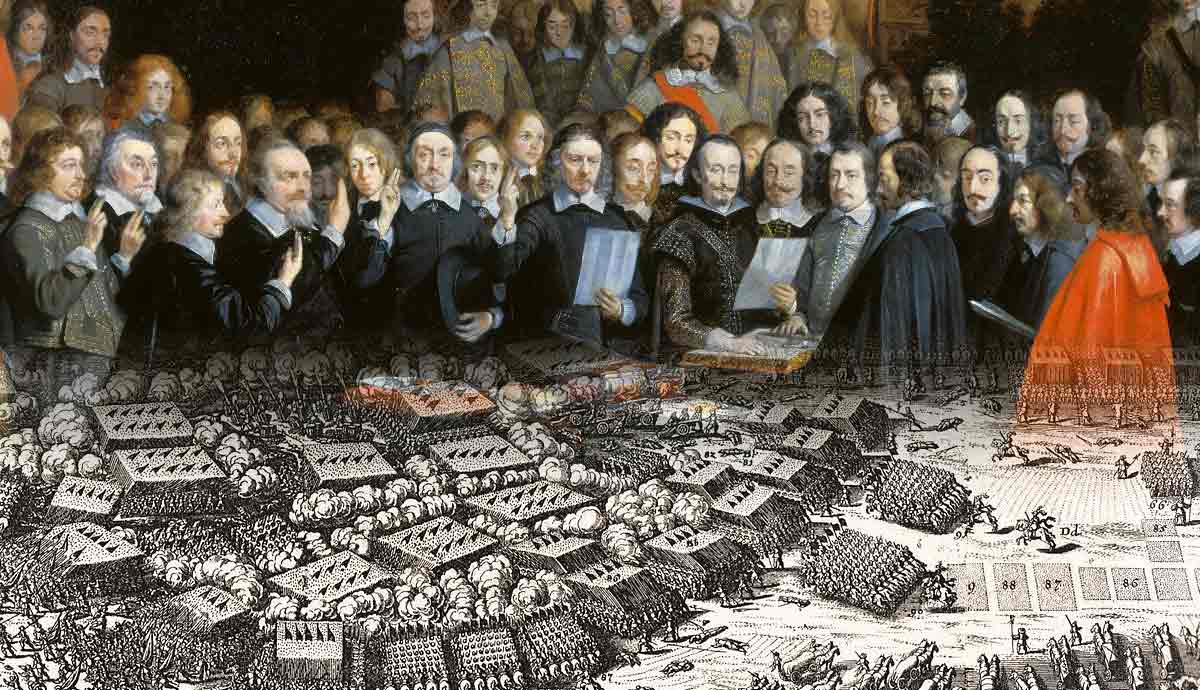
The Thirty Years War (16181648) was one of the most destructive conflicts in European history. What began as a religious struggle in the Holy Roman Empire soon expanded into a continent-wide power struggle involving nearly every major state. Entire regions were depopulated, armies grew to unprecedented size, and the war changed how Europe understood sovereignty and statehood. By the time peace finally arrived in 1648, the war had not only shattered old medieval structures but helped lay the foundations of the modern nation-state.Origins of the Conflict: Religion, Empire, and RebellionThe Defenestration of Prague of 1618, by Matthaus Merian, 1662. Source: Wikimedia CommonsThe Holy Roman Empire in the early seventeenth century was a fragmented and decentralized political entity, composed of hundreds of independent kingdoms, principalities, bishoprics, free cities, and minor lordships. While these territories owed nominal loyalty to the Emperor, real power rested with local rulers, many of whom guarded their autonomy jealously.This loose structure had endured for centuries, but it was placed under immense strain by the religious divisions unleashed by the Reformation. By 1600, the empire was split between Catholic, Lutheran, and Calvinist states. Although the Peace of Augsburg (1555) had attempted to stabilize relations by allowing rulers to choose between Catholicism and Lutheranism, it excluded Calvinists and failed to resolve underlying tensions.Religious identity became closely tied to political authority, with rulers using confessional allegiance to assert independence from imperial control. The Habsburg emperors were staunch Catholics and increasingly sought to reverse Protestant gains and strengthen central authority within the empire.These pressures erupted in Bohemia in 1618. Protestant nobles, alarmed by perceived Habsburg encroachments on their religious and political rights, threw imperial officials out of a castle window in Prague, in the Defenestration of Prague. The initial rebellion was against Habsburg rule rather than a purely religious uprising. Although framed in confessional terms, the conflict centred on resistance to imperial centralization.Early Habsburg victories over Protestant forces reinforced imperial confidence and encouraged escalation of the conflict. A local revolt soon expanded as neighbouring powers intervened in competing visions of authority and sovereignty.Escalation: A Local War Becomes a Continental OneContemporary depiction of Swedish success by Anonymous. Source: Wikimedia CommonsWhat began as a rebellion within the Holy Roman Empire drew in foreign powers whose interests extended far beyond religious solidarity. The first major intervention came from Denmark, where King Christian IV, a Lutheran ruler and imperial prince, entered the war in 1625. His motivations were mixed: supporting the Protestant cause, maintaining Danish influence in northern Germany, and securing control over key Baltic trade routes. His defeat by imperial forces under counts Tilly and Wallenstein demonstrated both the growing strength of the Habsburg war machine and the risks of unilateral intervention.The conflict escalated dramatically with the Swedish intervention in 1630. Under Gustavus Adolphus, Sweden fielded a highly professional army that combined mobility, disciplined infantry, and modern artillery. While Gustavus presented himself as the defender of Protestantism, Swedens aims were strategic as much as religious, seeking dominance around the Baltic and long-term security against imperial power. Swedish successes transformed the wars scale and intensity, drawing more states into the struggle.The final shift came with the entry of France in 1635. Despite being Catholic, France was a traditional rival of the Habsburgs and feared encirclement by Austrian and Spanish Habsburg territories. Cardinal Richelieus decision to back Protestant forces marked a decisive turn toward realpolitik. From this point onward, the Thirty Years War was no longer primarily about faith. Foreign intervention transformed a German religious crisis into a pan-European contest for power, balance, and survival among rival states.The Human Cost: Famine, Disease, and AtrocityThe miseries of war; No. 11, The Hanging, by Jacques Callot, 1632. Source: Wikimedia CommonsThe Thirty Years War inflicted devastation on Central Europe on a scale not seen since the Black Death. In many German regions, population losses ranged from 20 to 40 percent, with some areas suffering even greater decline. This destruction was not primarily the result of battlefield casualties, but of famine, disease, and systematic violence against civilians. Armies in the 17th century relied largely on foraging and requisition, and as the war dragged on, soldiers increasingly lived off the land. Crops were seized or destroyed, livestock slaughtered, and villages stripped bare, leading to repeated cycles of hunger.The sack of Magdeburg in 1631 became the wars most infamous atrocity and a symbol of unchecked brutality. Imperial troops stormed the Protestant city, killing tens of thousands of inhabitants in a single day. News of the massacre spread rapidly across Europe, reinforcing the terror that accompanied advancing armies and convincing many communities that resistance was futile.As agriculture collapsed, famine weakened already vulnerable populations, allowing disease to spread unchecked. Plague outbreaks followed armies and refugees alike, compounding mortality. Entire towns were abandoned, fields left uncultivated, and trade networks shattered. Large-scale population displacement became common as civilians fled violence, often only to encounter hardship elsewhere.Beyond physical destruction, the war shattered social order. Traditional authority structures broke down, banditry flourished, and communities were traumatized by decades of insecurity. More civilians died than soldiers, and the psychological scars endured long after the fighting ended.Military Revolution: Armies, Logistics, and New WarfareBattle of Breitenfeld, 1631. Engraving by Oluf Hanson, c. 1633. Source: Wikimedia CommonsThe Thirty Years War took place during what many historians describe as a military revolution in European warfare. Medieval feudal levies proved inadequate for prolonged conflict, and states increasingly relied on large, professional armies maintained year-round. Forces numbering in the tens of thousands became common, far exceeding anything fielded in earlier centuries. These armies required discipline, regular pay, and command structures that could sustain extended campaigns rather than seasonal fighting.Firepower increased in importance, pioneered by smaller nations such as the Netherlands or Sweden. Unable to rely on large reserves of manpower like France, Spain, or Russia, they relied on broader formations that brought more firepower to bear on targets. A major advocate of this was Gustavus Adolphus who used massed musket salvos, light artillery, and aggressive cavalry charges to defeat numerically superior opponents. Improvements in engineering enhanced fortifications and turned sieges back into costly long drawn affairs.These military developments imposed enormous financial and administrative burdens on states. Maintaining standing armies required reliable taxation systems, war loans, and expanding bureaucracies capable of provisioning troops across vast distances. Mercenaries remained essential, but their employment intensified logistical demands and often contributed to civilian suffering when pay failed to arrive. The scale and duration of the conflict forced rulers to centralize authority and professionalize military administration. In this way, the Thirty Years War transformed how states organized power, resources, and violence.Peace of Westphalia: Sovereignty and the Birth of Modern StatesRatification of the Peace of Mnster between Spain and the Dutch Republic in the town hall of Mnster, 15 May 1648, by Gerard ter Borch. Source: Rijksmuseum AmsterdamAfter three decades of devastation, the Thirty Years War ended through a complex series of negotiations conducted in the Westphalian cities of Mnster and Osnabrck. Rather than a single treaty, the Peace of Westphalia of 1648 consisted of multiple agreements negotiated simultaneously between dozens of belligerents. The prolonged diplomacy reflected the wars transformation from a religious conflict into a struggle involving nearly every major European power.The settlement introduced principles that reshaped European politics. Most significant was the recognition of state sovereignty: rulers gained the right to determine their own internal affairs, including religion, without external interference. The treaties reaffirmed territorial integrity and legal equality among states, weakening the idea of universal imperial authority. While Catholicism, Lutheranism, and Calvinism were all granted legal status within the empire, religious toleration was structured and limited, intended to stabilize political relationships rather than promote freedom of conscience.Westphalia dramatically reduced the power of the Holy Roman Emperor, confirming the autonomy of the empires constituent states. In contrast, France and Sweden emerged strengthened, while the Dutch Republic gained formal recognition of its independence. While historians caution against the popular notion of Westphalia as the birth of the modern world, its significance lies in codifying practices that prioritized states over empires and political interest over religious unity. The peace ended the war by creating a new order in which power was negotiated between sovereign states rather than imposed by faith or imperial ambition.Long-Term Legacy: From Medieval Europe to the Modern AgeSoldiers plundering a farm. Painting by Sebastiaen Vrancx, 1620. Source: Deutsches Historisches MuseumThe Thirty Years War left Central Europe economically and demographically shattered. In many regions, recovery took generations as depopulated towns were resettled and agricultural systems rebuilt from near collapse. Trade routes had been disrupted, land lay uncultivated, and local economies struggled under the long shadow of war-induced poverty.Out of this destruction emerged new and enduring political and administrative structures. States retained the bureaucracies created to fund and sustain war. Systems of taxation, record-keeping, and central administration became enduring features of governance. The conflict accelerated the decline of private armies and feudal military obligations, replacing them with professional, state-controlled forces. Warfare increasingly became the responsibility of governments rather than dynastic households or mercenary entrepreneurs, reinforcing the link between military power and state authority.Diplomatically, the war encouraged a more secular approach to international relations. While religion remained important, political interest came to dominate European statecraft. Alliances were formed and broken based on strategic necessity, a pattern that would define European politics for centuries. This system helped prevent religious wars from engulfing the continent, even as it encouraged frequent limited conflicts between individual states.Culturally, the war left a deep imprint on German memory, reflected in literature, art, and regional identities shaped by loss and trauma. Its horrors also influenced Enlightenment thinkers, who associated unchecked power and religious absolutism with catastrophe. Later European conflicts would unfold within political and military frameworks forged in the aftermath of the Thirty Years War. From devastation emerged the foundations of the modern European nation-state.
0 Commentarios
0 Acciones
160 Views

 English
 Arabic
 French
 Portuguese
 Deutsch
 Turkish
 Dutch
Dutch
 Italiano
 Russian
 Romaian
 Portuguese (Brazil)
 Greek
Greek