Why Britain Risked Everything to Stop Napoleons Empire
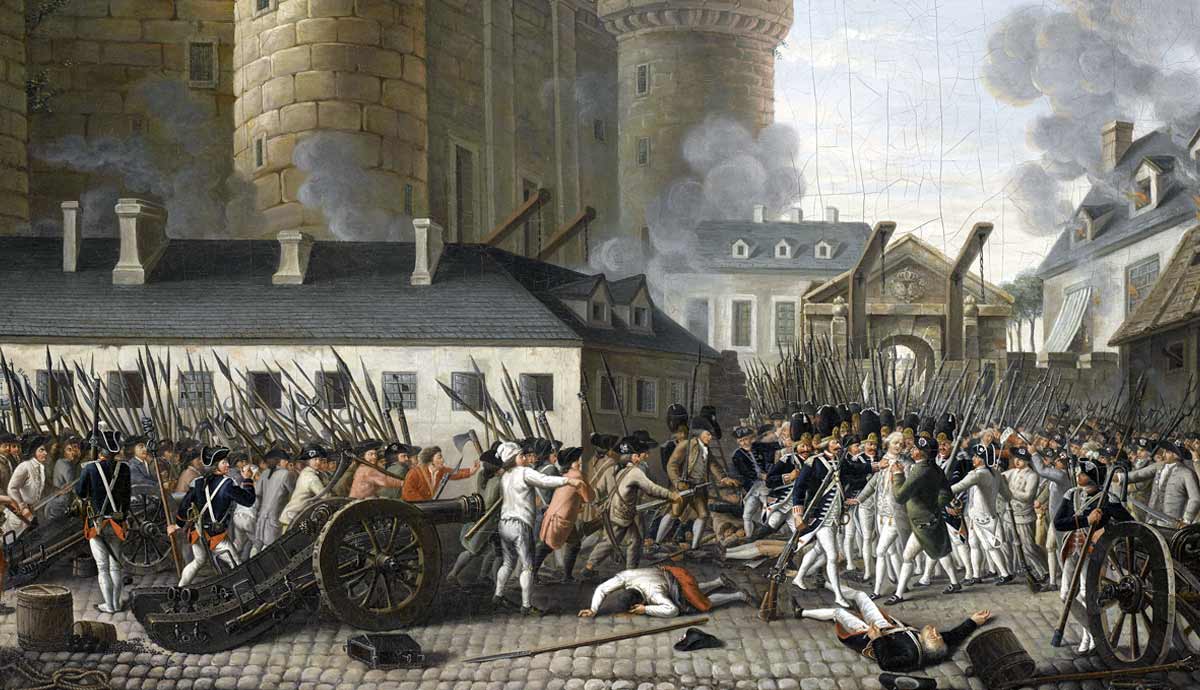
The Storming of the Bastille, 14 July 1789.Few conflicts in history have cost one country as much as the Napoleonic wars cost Britain. The fighting spanned from 1803 to 1815, with a major break for peace from 1802 to 1803. The total cost of the war came to about 1.65 billion, equivalent to 190 billion in todays currency adjusted for inflation. Most of that money was covered by government borrowing. The rest came largely from taxes, including a new income tax introduced in 1799. Yet the real question of why Britain kept paying this price year after year is one that historians still debate today.Tensions Rose Following the Killing of King Louis XVIThe Emperor Napoleon in His Study at the Tuileries, 1812.Britain largely chose to stay out of European affairs after the French Revolution broke out in 1789, but the situation soon spun out of control, compelling London to get involved. Complications began in late 1792 when French troops moved into Belgian territory. This put pressure on Dutch trade routes and on British maritime commerce along the River Scheldt. France soon declared war on both Britain and the Netherlands on 1 February 1793. At the time, the killing of King Louis XVI on 21 January 1793 had already drawn a line between the nations, as it made the new government appear more hostile and illegitimate. On one side stood the conservative royalist United Kingdom and its allies and on the other, the radical Republican France. Hostilities increased further when Napoleon came to power.The Invasion Threat and the Breaking of the Treaty of AmiensDavid Emperor Napoleon Study TuileriesA brief period of peace from 1802 to 1803 ended when Britain declared war on France on 18 May, 1803, bringing the Treaty of Amiens to a close. Britain had refused to evacuate Malta as required by the treaty, a main sticking point. Bonaparte on his part, also violated other provisions by making himself President of the Italian Republic (formerly the Cisalpine Republic) in early 1802 and by failing to fully withdraw French troops from the Batavian Republic (Holland) as stipulated. The threat of a French landing on British shores hung over the country for much of the period between 1793 and 1805. By then Britain had forged major alliances on the continent to keep France busy.The Beginning of Economic WarsPage of the Treaty of Amiens with the eight seals and the eight signatures of the signatories.With no way across the Channel, Napoleon tried a different strategy. On 21 November, 1806, he issued the Berlin Decree, setting up the Continental System which banned all trade with Britain across French-controlled Europe. The territories included French-occupied areas and vassals such as Spain, and later Prussia after its defeat, parts of Northern Germany, and other large areas of Europe. On 17 December, 1807, the Milan Decree extended this to any neutral ship that had stopped at a British port. The plan was to flood British factories with unsold goods and drain gold from the British treasury until the government was forced to ask for peace. The plan did not work. British merchants found ways around the rules. With naval power on their side, they were well-placed to keep smuggling goods into Europe.The Spanish RebellionLieutenant Colonel Arthur Wellesley, aged 26, in the 33rd Regiment, by John Hoppner, 1795. Source: Wikimedia CommonsBecause Portugal refused to stop trading with Britain, the French army marched through Spain and took Lisbon in November 1807. Napoleon even went a step further and removed the Spanish royal family from the throne, putting his brother Joseph on it as King of Spain in 1808. The Spanish people strongly opposed this, and soon, a nationwide uprising followed. Spain quickly became a serious problem for Napoleon. At the Battle of Bailn that occurred in July 1808, the Spanish army trapped and forced the surrender of about 17,000 French troops in what was the first major surrender of a Napoleonic army on a European battlefield. By then, Spain had already asked Britain for help, and in August 1808 Lieutenant-General Arthur Wellesley landed with 15,000 troops at Mondego Bay in Portugal. He and his men fought across Portugal and Spain for nearly six years before finally pushing the French armies back and helping defeat them on French soil.The Removal of Napoleon from the ThroneNapolon Bonaparte Abdicated in Fontainebleau, by Paul Delaroche, 1845. Source: Wikimedia CommonsIn April 1814 Napoleon abdicated the throne and was sent to the island of Elba. He returned to France in March 1815 and raised a new army, but was defeated at the Battle of Waterloo on 18 June 1815 by a British-led coalition under Wellington and the Prussian force under Field Marshal Gebhard Leberecht von Blcher. The battle ended over two decades of near-constant war, after which the winning countries once again restored the French monarchy, placing King Louis XVIII on the throne.




 English
 Arabic
 French
 Spanish
 Deutsch
 Turkish
 Dutch
Dutch
 Italiano
 Russian
 Romaian
 Portuguese (Brazil)
 Greek
Greek