


WWW.THECOLLECTOR.COM
The Mysterious Angels of the Hagia Sophia and Their Rediscovery
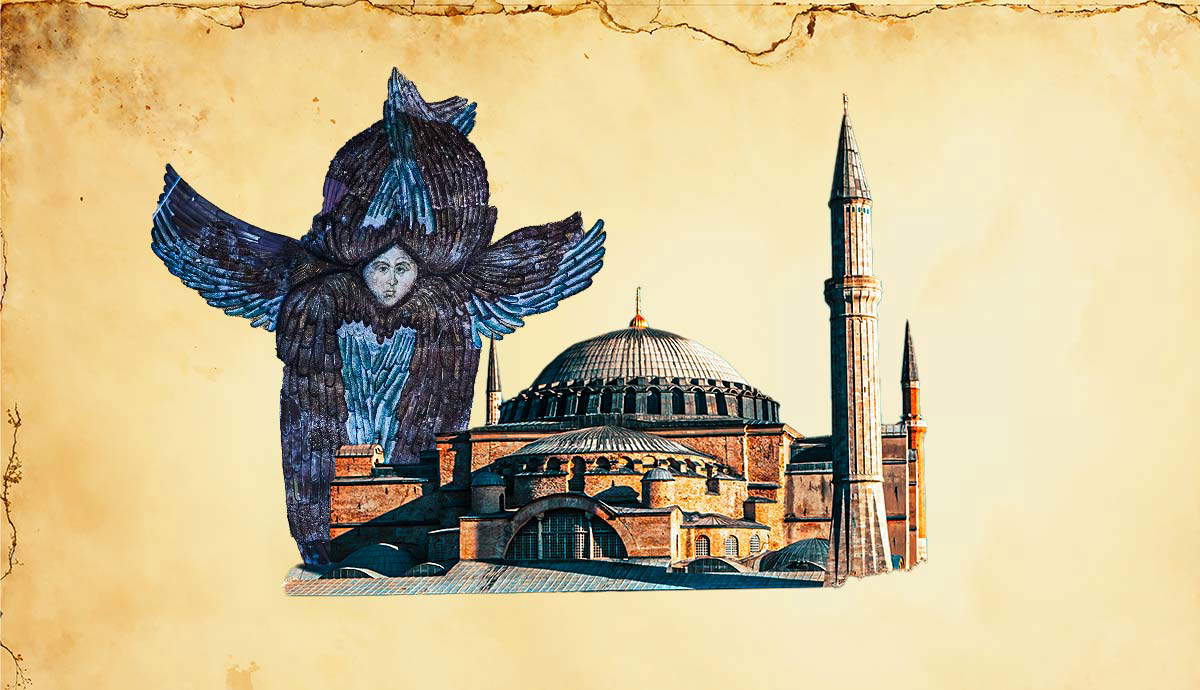
Buried under centuries of plaster remain the seraphim mosaics of the Hagia Sophia. Over 700 years old, these mystifying angels have witnessed the buildings transformation from the glittering heart of Byzantium to a dominating symbol of Ottoman conquest and Islamic power. Embedded within these golden mosaics, the seraphims haunting eyes and massive six wings shine under the central dome, sanctifying the space as an iteration of Gods throne. Despite their erasure under Ottoman rule, the seraphim are once again gazing upon visitors of the Hagia Sophia.The Mythology of the SeraphimMosaic seraphim, Mont Saint-Odile Abbey in Alsace, France. Source Wikimedia CommonsThe seraphim derives from the Hebrew word rf. Meaning to burn, the seraphim are often translated as the burning ones, associated with the divine fire of God. Christianity ranks the seraphim as the highest order within the angelic hierarchy. Their existence is dedicated to their devotion to God, serving as the main and ultimate protectors of his throne.Only two texts in the Judeo-Christian bible detail their unique composition and eerie features, differing from the humanlike depictions of the archangels and saints more common in Christian iconography.In the Book of Isaiah, the Prophet Isaiah recounted seeing, the Lord,high and exalted,seated on a throne [] Above him were seraphim,each with six wings: With two wings they covered their faces, with two they covered their feet,and with two they were flying.And they were calling to one another: Holy, holy, holy is theLordAlmighty;the whole earthis full of his glory (Isaiah 6:1-4).The seraphim are also mentioned by St. John in the Book of Revelation. Also seeing a vision of Heaven, John contends witnessing, In the center, around the throne, were four living creatures, and they were covered with eyes, in front and in back [] Each of the four living creatures had six wings and was covered with eyes all around, even under its wings. Day and night, they never stop saying: Holy, holy, holy is the Lord God Almighty (Revelation 4 5-9).The Hagia Sophia, photo by Raimond Klavins. Source: UnsplashFollowing these biblical descriptions, the seraphim in early Christian art are depicted as massive celestial creatures with human-like faces and bulging eyes surrounded by three massive pairs of wings. Their wings are often outlined in red to represent the divine fire, and the flurry of their wings is in constant motion to praise and worship God.Four seraphim were commonly placed or etched into the highest points of early Christian churches to replicate the scene of Heaven from Revelation, designating the space below as one of the most holy, devout, and protected spaces for worshipers.The Seraphim in Byzantine ArtCeiling of the left chapel in Cathedral (Monreale), Mosaic of Christ Pantocrator. Created during the twelfth century, four seraphim mosaics encircle an image of Christ. Source: Wikimedia CommonsFollowing the final separation of the Western Roman and Byzantine Empire in 395 AD, Byzantine religious art developed its distinctive iconography and mosaic creations. While Western Roman mosaics depicted scenes of everyday life or mythology for floor and wall decoration, Byzantine mosaics became renowned for their gilded recreations of heavenly scenes and creatures on the ceilings and domes of their churches. Instead of using natural stones, Byzantine artisans used glass tesserae painted silver or gold, angling them so that the slightest amount of sunlight would make the tiles glow.Once Orthodox Christianity became institutionalized as the official state religion from the 4th century onwards, Byzantine religious architecture became standardized, domed churches with golden mosaic ceilings inspiring artists throughout from Cairo and Ravenna to Bulgaria and Russia.Once debates on Byzantine iconoclasm concluded in the 9th century, Byzantine artists began adding mosaics of Christ, the Virgin Mary, Old Testament monsters, biblical stories, and the hierarchy of angels. Religious icons and symbols glowed in Byzantine churches; the silver and gold tiles used as backgrounds and outlines emphasized the holiness and divinity of angelic creatures and religious figures.Interior of the Hagia Sophia. On the pendentives under the central dome are the wings and one exposed face of the seraphim. Source: Wikimedia CommonsEvoking their two biblical descriptions, the seraphim were depicted as a floating face with penetrating eyes surrounded by three pairs of wings. Four seraphim were often placed around or under mosaic depictions of Jesus, who was placed in the center of the highest dome or ceiling.Re-creating the scene from the Book of Revelation, these mosaic seraphim signified that the altar space, usually below the central dome, was a mirror of Gods throne, marking it the most sacred, protected, and blessed area of the church.Seraphim mosaics became a common artistic feature of Byzantine design until the fall of their empire in the 15th century. From then onwards, Western European depictions of saints and angels in more humanlike forms became the standardized depictions of heavenly entities.The Seraphim in the Hagia SophiaCentral dome of the Hagia Sophia, surrounded by four seraphim angels. Only the mosaic seraph face on the top left has been revealed under layers of plaster and metal since 2009. Source: Wikimedia CommonsOne of the most famous seraphim mosaics in Byzantine religious iconography is under the central dome within the Hagia Sophia. Completed in 537 AD in Constantinople, the Hagia Sophia remains one of the grandest architectural feats and displays of Byzantine design, its artistic influence witnessed across empires, religions, and continents. Ordered by Emperor Justinian I and designed by Anthemius of Tralles and Isidore of Miletus, the Hagia Sophia served as the largest domed church for almost 1,000 years. Centuries of earthquakes, sieges, and religious debates evolved the golden mosaics over time.Archaeologists contend that the seraphim mosaics were added to the Hagia Sophia during a rebuilding period from 1346-1354, after an earthquake collapsed the churchs eastern arch and part of the central dome. During these repairs, the four seraphim were added to each pendentive under the Christ Pantocrator mosaic in the center of the main dome. Each seraph stood at 20 feet tall, their faces measuring four feet wide, and their wings outlined in different shades of blue and green tile.In total, researchers believe that 16 seraphim and cherub angels may have been added to the Hagia Sophia throughout the Byzantine period, four to the nave pendentives and twelve to the golden vaults in the Southern Gallery. The seraphim were only able to guard the inner sanctum of the Hagia Sophia for just a century until their role was lost under the plaster and dust of the Ottoman Empire.The Seraphim Under Ottoman RuleInterior of Hagia Sophia, photograph taken by Pascal Sebah, 1870. Source: Getty Museum CollectionFollowing the fall of Constantinople and the defeat of the Byzantine Empire by Mehmed II in 1453, most Christian iconography within the Hagia Sophia was concealed. Mehmed II immediately commissioned building projects to convert the Hagia Sophia into a functioning mosque, adding structures like a prayer niche and minarets. However, Mehmed II set a precedent by not eradicating the Byzantine mosaics within the complex. Instead, he placed the Ottoman Empire as the rightful inheritors of the Roman legacy, adopting the Hagia Sophia as proof of the lineage they are now part of. Thus, the mosaics were concealed, covered with curtains, or painted over with whitewash.The glittering saints and angels disappeared, replaced with the etched names of Allah, the Prophet Muhammad, and the first caliphs. In 1609, during Sultan Ahmed Is restoration projects, the seraphim were covered with more white-wash. Additional layers of plaster and metal buried the seraphim faces under painted stars.The seraphim faces remained hidden until 1847, when they were rediscovered during a massive restoration project commissioned by Sultan Abdulmejid I. The Swiss-Italian brothers Gaspard and Giuseppe Fossati led the reconstruction, finding many Byzantine mosaics hidden under paint and plaster. Shocked by their discoveries, the Fossati brothers made sketches of the Christian icons before covering them up again with new plaster and paint. By this point, many historians speculate that the seraphim mosaics on the western pendentives had been destroyed or damaged as the wings were repainted by the Fossati brothers during the restoration project.For the next 160 years, the only modern evidence of the seraphim faces were these sketches. It was not until parts of the seraphim mosaics were discovered in 1989, and one face was fully uncovered in 2009, that the seraphim once again peered down upon the Hagia Sophia.The Seraphim TodayRe-discovered mosaic of a seraph face under the central dome in the Hagia Sophia, May 2022. Source: Wikimedia CommonsFollowing the secular reforms of the new Turkish Republic led by Mustafa Kemal Atatrk after the fall of the Ottoman Empire in 1922, the Hagia Sophia was designated as a state museum and ceased operating as a mosque by 1935. Shortly after, new restoration initiatives began to uncover, identify, and restore the Byzantine mosaics. These projects, involving international organizations like the Byzantine Institute of America, recovered centuries of hidden mosaics, earning the Hagia Sophia the status of a UNESCO World Heritage Site in 1985. In 1989, restoration work began uncovering mosaic tiles under the painted seraphim wings on the pendentives.It was not until scaffolding on the eastern arch was taken down in 2009 that the true extent of the seraphim was uncovered. Noticing mosaic tesserae under layers of loose plaster, further investigation and the removal of seven layers of plaster, paint, and whitewash revealed one of the seraphim faces for the first time in 160 years.In 2020, the Turkish government converted the Hagia Sophia back into a mosque, raising the question of whether the seraphim should once again be covered to adhere to Islamic custom.Regardless of their fate, these mosaics are evidence of Hagia Sophias mosaic-like past, gilded by the art, influence, and faith of multiple empires that changed the course of history under the haunting watch of the seraphim.
0 Yorumlar
0 hisse senetleri
158 Views

 English
 Arabic
 French
 Spanish
 Portuguese
 Deutsch
 Dutch
Dutch
 Italiano
 Russian
 Romaian
 Portuguese (Brazil)
 Greek
Greek