


ALLTHATSINTERESTING.COM
History Is Marked By Powerful Global Empires But Which One Was The Largest?
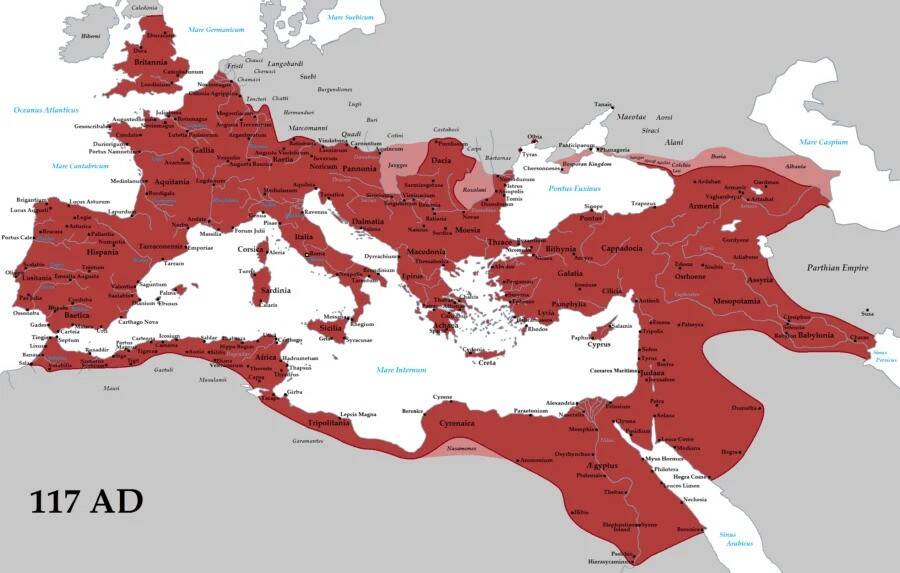
Two thousand years ago, the Roman Empire sprawled across the globe. Home to tens of millions of people, it stretched from the Atlantic Ocean all the way to North Africa and into Asia and Mesopotamia. But the Roman Empire wasnt the largest empire in history not by a long shot. Tataryn/Wikimedia CommonsThe Roman Empire at its peak was large, but it was far from the largest empire in history.Indeed, the Roman Empire wasnt even among the top 10 largest empires of the past. Dozens of other civilizations controlled more land and greater populations. For instance, in the 13th century, Genghis Khan and his descendants conquered historys largest contiguous territory. And in the early 1920s, the British Empire covered more than 25 percent of the land surface on Earth.So, what was the largest empire in history? Depending on how you measure it, there are multiple answers. The Largest Empires In History By Contiguous Land Or Population PercentageWhen it comes to the largest empire in history by contiguous land meaning that the entire empire was connected theres a clear answer: the Mongol Empire, which reigned over much of Asia from 1206 until 1368.Founded by Genghis Khan, the Mongol Empire quickly spread across Eurasia. It ultimately encompassed all of China and Mongolia as well as parts of countries like Korea, Iran, Iraq, Pakistan, Afghanistan, Uzbekistan, Armenia, Romania, Georgia, Ukraine, and Russia. At its peak, it covered more than nine million square miles an area nearly three times the size of the United States.Though the fall of the Mongol Empire began with Genghis death in 1227, it left a deep impression on world history. Genghis had an untold multitude of children with his wives and concubines, and some scientists believe that 1 in every 200 men is descended from the ruler.Zazaa Mongolia/Wikimedia CommonsA giant statue of Genghis Khan in Mongolia. That said, the Mongol Empire was not the largest empire in history in terms of the percentage of the global population.That title, according to some sources, belongs to the Achaemenid Empire, also known as the Persian Empire. It lasted from around 550 B.C.E. until 330 B.C.E. and covered much of the modern-day countries of Iran, Egypt, and Turkey, as well as parts of Afghanistan and Pakistan. At its peak, an estimated 44 percent of the global population was ruled by the Achaemenid Empire. However, the Qing dynasty is also often listed as the largest empire in history by population percentage. Established in 1644, it lasted until 1912 and is thought to have represented roughly 40 percent of the worlds population at its peak. The global population was also much larger during the Qing dynasty, meaning that it technically contained more people than the Achaemenid Empire ever did.However, when it comes to the largest empire in history, there is no confusion. That title belongs to the British Empire.The Largest Empire In History: The British EmpireThe largest empire in history, measured by total size, was the British Empire. Theres a reason for the saying: The sun never sets on the British Empire.During the so-called Age of Discovery, which took place between the 15th and 17th centuries, Britain and other European nations began to increasingly explore and colonize the world. The British Empire arguably began in 1497, when explorer John Cabot arrived in North America after being tasked by King Henry VII to seek out unknown parts of the world. Wellcome CollectionThe cover of a seamens hospital booklet from the 1900s illustrating the reach of the British Empire.From there, the British Empire continued to expand. Over the next several centuries, it came to control land in North America, Oceania, Asia, and Africa, as well as parts of Central and South America. Modern countries like Egypt, India, Iraq, Fiji, and many, many more were all under British rule. In fact, according to the book All the Countries Weve Ever Invaded: And the Few We Never Got Round To by Stuart Laycock, there are just 22 countries in the world that Britain didnt try to invade during its days of power.Indeed, at its peak, the British Empire was by far the largest empire in history. By the 1920s, it controlled more than 13.7 million square miles of land and ruled over more than 400 million people. In other words, the British Empire spread across roughly a quarter of the Earths dry surface and contained about 23 percent of the global population. But, like all empires, the British Empire would not last forever. After World War II, with nationalism spreading across the globe, many countries under British rule pushed to govern themselves. India won its independence in 1947, and many more countries followed. That said, Britain maintains several overseas territories, like Bermuda, and many countries that were once under British rule now belong to the British Commonwealth. The British Empire ceased to exist by the end of the 20th century, with some marking the handoff of Hong Kong to China in 1997 as its official end.Other Civilizations That Grew To Enormous ProportionsWhile the British Empire and the Mongol Empire grew to be the largest empires in history, and the Qing dynasty and the Achaemenid Empire encompassed the greatest percentage of the global population, other civilizations have also had large, influential empires throughout history. The Russian Empire, for example, which lasted from 1721 until the Russian Revolution in 1917, is considered one of the largest empires in history. Stretching from the Black Sea in Europe to the Bering Strait in Asia, it covered almost nine million square miles and was home to roughly 125 million people. Today, Russia is still the largest country in the world. Public DomainA map of the Russian Empire in 1912.Meanwhile, the Spanish Empire, which lasted from 1492 until the 1970s, conquered territory in Africa and the Americas and grew to be five million square miles in size. With less than 20 million people, however, the Spanish Empire was far smaller than its Russian or British counterparts.By contrast, the Roman Empire at its peak only encompassed two million square miles, and its maximum population was somewhere between 45 and 70 million people. Though it looms large in world history in other ways, Rome was far, far smaller than other global powers that came after it. Indeed, when it comes to the question of the largest empire in history, there is a clear answer. Though there are many ways to look at it, the British Empire was ultimately the empire that encompassed the most land on Earth. During the days when the British controlled roughly a quarter of the globe, the Sun truly never set on the British Empire. After reading about the largest empire in history, go inside the many reasons behind the collapse of the Roman Empire. Or, discover the strange story of the Tartarian Empire, the lost empire that was allegedly purposefully erased from history.The post History Is Marked By Powerful Global Empires But Which One Was The Largest? appeared first on All That's Interesting.
0 Reacties
0 aandelen
213 Views

 English
 Arabic
 French
 Spanish
 Portuguese
 Deutsch
 Turkish
 Italiano
 Russian
 Romaian
 Portuguese (Brazil)
 Greek
Greek