Archaeologists Exploring Ancient Greek Ruins In Libya Just Uncovered More Than 100 Game Boards Thatd Been Carved Right Onto The Citys Surfaces
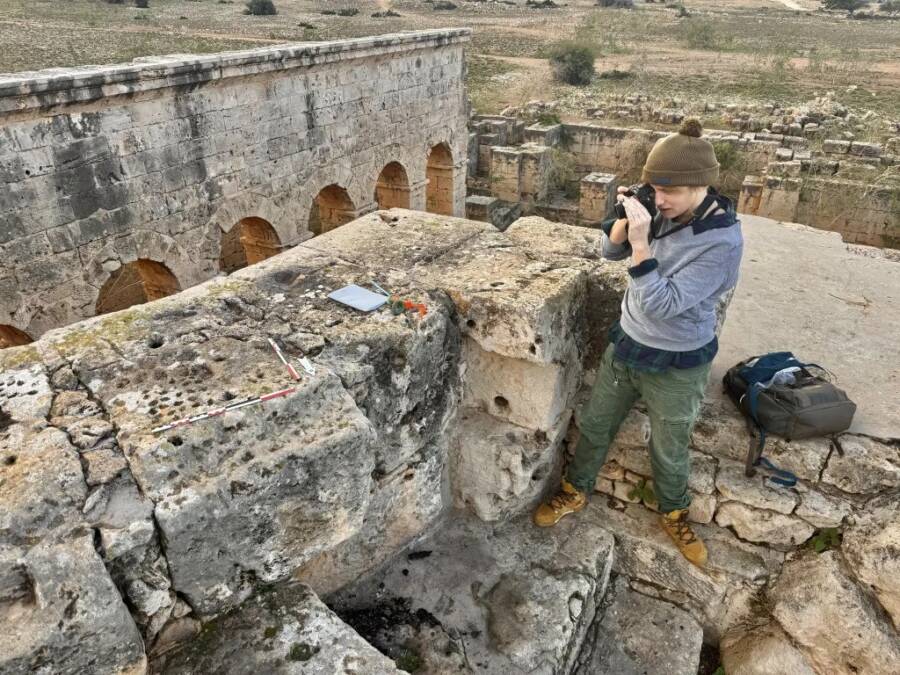
Radosaw TusznioArchaeologist Zofia Kowarska photographing some of the game boards thatd been carved into the ruins of Ptolemais.The ruins of the ancient city of Ptolemais in modern-day Libya have long produced a wealth of exciting archaeological discoveries. In recent years alone, archaeologists have studied the citys acropolis and conducted underwater dives to examine an ancient shipwreck. But one of the citys most curious discoveries, which has just been made public now, is a collection of more than 100 game boards carved directly into the ruins.Likely used in games that were similar to checkers and tic-tac-toe, these boards may have been carved by shepherds who inhabited the region after the fall of Ptolemais in the 7th century C.E. To pass the time, they carved game boards into the stones of old buildings, the remains of which are still visible to this day.The Many Game Boards Found Carved Into The Ancient Greek Ruins Of PtolemaisAccording to Science in Poland, the game boards were discovered by archaeologists from the University of Warsaw, whose excavations resumed in 2023 after a long dormant period due to civil unrest in the area. One of the archaeologists, Zofia Kowarska, began documenting boards likely used for a game known as siza.Zofia KowarskaOne of the dozens of game boards that archaeologists from the University of Warsaw discovered in Ptolemais.There are many different variations of the game, some of which can resemble modern-day checkers or tic-tac-toe. But though Kowarska only expected to find a couple boards, she was surprised to discover dozens of them scattered across the ruins.When I began my research, I thought I would find only a few copies of the boards, but after a few days I had over 100, and this is not the end, as we will continue our research, she said. The boards carved in the ruins suggest that these games were a fairly common form of entertainment. Sometimes we find a dozen, even twenty, or thirty boards side by side in one place.Though the game boards are difficult to date, archaeologists are confident that they were carved into the city ruins long after Ptolemais fell in the 7th century following the Arab conquest. They believe that the game boards were carved by shepherds who played simple games in order to pass the time while keeping an eye on their grazing flocks.Zofia KowarskaA close look at one of the game boards found in Ptolemais which may have been used in a pastime that resembled modern-day checkers or tic-tac-toe.The area of the ancient city is undeveloped, but it is surrounded by vast expanses of land that have always been excellent places for grazing animals, goats, and sheep, Kowarska said. We find boards on the ruins of buildings, which are often located higher than the surrounding terrain, and on the corners of buildings. We believe that people grazing animals would sit in this elevated spot to conveniently observe the terrain and the animals. They spent some time there, while also entertaining themselves with games.But while Ptolemais became a quiet site in the modern-era, a place for shepherds to peacefully play board games while watching their herds, it was a powerful and bustling city in the ancient world.The Rise And Fall Of Ptolemais During AntiquityAs UNESCO reports, Ptolemais was founded in the 7th century B.C.E. as a Greek settlement, and was initially used as a port for the inland city of Barka. It was formally established and named in the Hellenistic period by either Ptolemy I or Ptolemy III, the Macedonian rulers who took over ancient Egypt following the death of Alexander the Great in 323 B.C.E.Ptolemais flourished in the years that followed including during the Roman period and became an important Christian bishopric as Christianity began to spread across the region. Because of its Greek roots, the city had a number of Hellenistic features, including defensive walls, city blocks, large houses, statues, and many public baths. However, Ptolemais fell into ruins after the Arab conquest of the 7th century C.E.Radosaw TusznioZofia Kowarska examining the ruins of Ptolemais for evidence of game boards carved into the stone.Though it had once been a bustling metropolis, it soon became the domain of shepherds and their flocks. The carved boards are a relic of this era and, though the games played with them likely bore a resemblance to modern-day games still played in the region, archaeologists noted that these traditions are quickly becoming a thing of the past.A few inhabitants of present-day Tolmeita [a nearby village in Libya] still know the rules of these games, Kowarska remarked to Science in Poland, but unfortunately, they are disappearing as traditional pastimes are fading away, and other activities, including mobile phone games, take over.After reading about the game boards found amid the ruins of an ancient city in Libya, see how the Berbers of North Africa have preserved their traditional way of life over the centuries. Then, learn about Queen Dido, the legendary founder of the city of Carthage.The post Archaeologists Exploring Ancient Greek Ruins In Libya Just Uncovered More Than 100 Game Boards Thatd Been Carved Right Onto The Citys Surfaces appeared first on All That's Interesting.




 English
 Arabic
 French
 Spanish
 Deutsch
 Turkish
 Dutch
Dutch
 Italiano
 Russian
 Romaian
 Portuguese (Brazil)
 Greek
Greek