


WWW.THECOLLECTOR.COM
How the Fall of Rome Created the Power of the Medieval Papacy
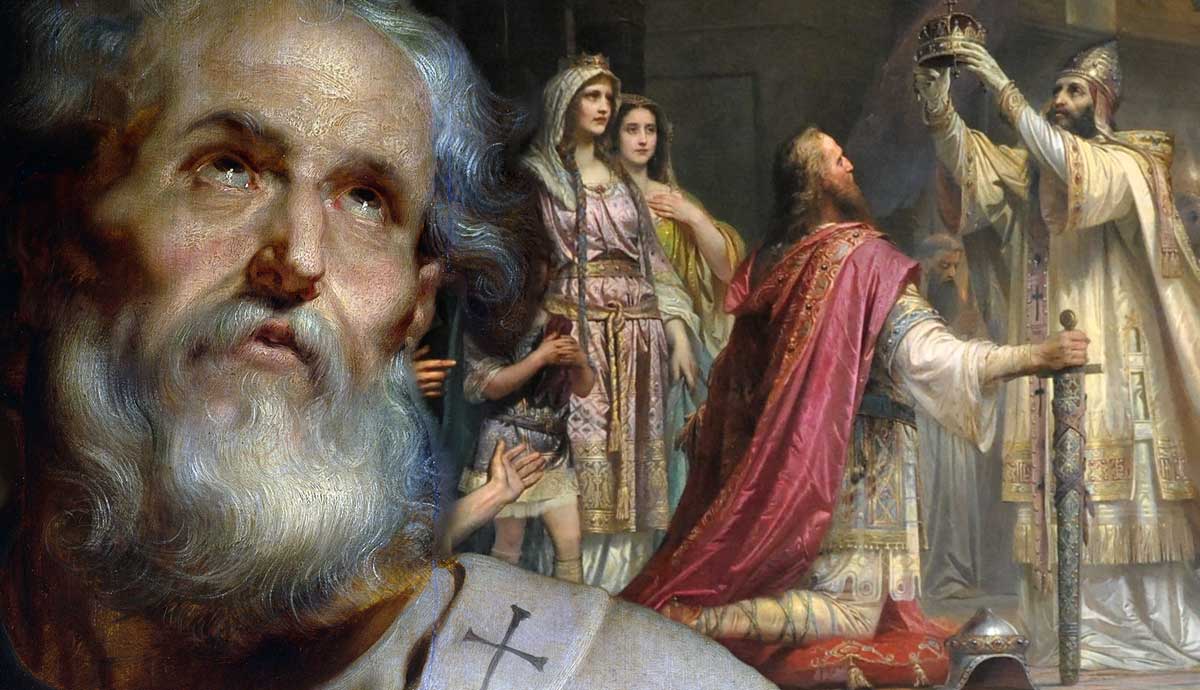
In the Early Middle Ages, after the fall of the Roman Empire left the existing government structures in shambles, the papacy established itself as the preeminent authority in the West. Indeed, in a post-Roman world, where there was no large political structure to ensure stability in Europe, the Roman Church emerged as the only force able to provide some unity. Led by a series of popes functioning as both spiritual and temporal rulers, the papacy came to dominate the intellectual life, political landscape, and culture of the so-called Dark Ages.Setting the Stage: From the Fall of Rome to the Dark AgesDestruction from The Course of Empire series, by Thomas Cole, 1836. Source: New York Historical SocietyIn 476, the German chief Odoacer deposed Romulus Augustulus, ending the succession of Roman emperors inaugurated by Augustus. He then proclaimed himself king. The event is traditionally considered the end of the Roman Empire. By then, the so-called barbarian invasions, or the migration of Germanic peoples into Roman-controlled Europe, had already significantly altered the social and political composition of the empire.In 406, the Vandals, Suebi, Alani, Burgundians, and Alemanni, fleeing from the advance of the Huns, crossed the River Rhine, pouring into Gaul. Some years later, they arrived in Spain. Meanwhile, the Visigoths established themselves in Narbonensis and Aquitania (the territories in Gaul). Though partially successful in regaining control of portions of Gaul, Roman general Constantius was unable to expel the barbarians from the country.In 410, Alaric, at the head of the Visigoths, sacked Rome, pillaging the heart of the Roman Empire for three days. Only the churches were spared, as Alaric had converted to Christian Arianism. In the first half of the 5th century, other Germanic peoples began to establish themselves in the Roman territories. In 435, the Vandals conquered Carthage in North Africa. In 450, Attila and his Huns invaded Italy. Only Pope Leo the Great managed to persuade them not to sack Rome.As several barbarian kingdoms established themselves in the West, the new and old inhabitants coexisted uneasily, marked by differences in costumes, languages, religion, and social institutions. Moreover, throughout the Migration Period, constant warfare exhausted the empires resources and lowered the quality of life, leading to disruptions in trade, agriculture, and urban life. The result was a widespread economic decline and political instability.Filling the Void: The Papacy After the Fall of RomeThe Meeting of Leo the Great and Attila, fresco by Raphael, 1514. Source: Wikimedia Commons/Stanza di Eliodoro, Raphael Rooms, Apostolic Palace, Vatican CityThe collapse of the civil authority in Rome and the Italian peninsula during the Migration Period left a power void. Faced with the disintegration of the Roman Empires government structures, the bishops of Rome and the churchmen (one of the few educated classes left) gradually assumed more and more administrative roles, securing much-needed supplies and organizing the citys defense.During the pontificate of Leo I (440-461), the papal office emerged as the sole authority able to deal with invading tribes. As a result, the prestige of the papacy considerably increased. It was Leo I who persuaded Attilas Huns to spare the city of Rome in 452. According to tradition, the Apostles St. Peter and Paul, along with a host of angels, assisted the pope in his courageous endeavor. Three years later, Leo I intervened once again to save Rome, this time against the Vandals.By placing the leadership in his hands, the pope acted as a de facto political ruler, claiming the political legacy of the Roman emperors and, most importantly, embodying an ideal Romanness in his dealings with the invading barbarians. The result was a papacy that developed a political power that would influence the Western world for centuries to come.By the end of the 6th century, under the pontificate of Gregory the Great (590604), Rome had regained the key role that the city had lost with the disintegration of imperial unity. This time, however, it was no longer the city of emperors, but the seat of the bishop of Rome, who claimed primacy over the so-called Christendom.The Petrine DoctrineSaint Peter, by Peter Paul Rubens, 1610-12. Source: Wikimedia Commons/Museo del Prado, MadridAs Christianity began to spread in the territories of the Roman Empire, the city of Rome was accorded a place of preeminence. Not only was Rome the imperial capital, but it was also believed to be the resting place of both St. Peter and St. Paul. At the time, however, the title of pope was not reserved solely for the bishop of Rome. Indeed, the Christian world had three major centers: Rome, Constantinople, and Antioch.By the pontificate of Leo I the Great, the pope who saw the fall of the Roman Empire, the bishops of Rome had accelerated their claims for primacy. To bolster their role among Christendom, they promoted the so-called Petrine Doctrine, a principle asserting the theological legitimacy of their primacy.The basis for the Petrine Theory was found in the passage of the gospel of Matthew, where Jesus Christ says to Peter: And I tell you, you are Peter [Petros in Greek], and on this rock [petra in Greek] I will build my church. He then adds: I will give you the keys of the kingdom of heaven, and whatever you bind on earth shall be bound in heaven, and whatever you loose on earth shall be loosed in heaven.In the 3rd century, Pope Stephen I was the first to use the Gospel passage to assert his primacy on the matter of the baptism of heretics. During the Migration Period and the Early Middle Ages, the Petrine Doctrine played a crucial role in securing the papacys political and spiritual power. Leo I and Gelasius emphasized their role as heirs of Peter and vicars of Christ, stressing the link between St. Peter and the office of the pope. In 451, the Council of Chalcedon recognized Leo Is claim for primacy, acknowledging that he spoke with the voice of Peter in matters of doctrine.Strategic Alliances: The Popes & the Carolingian DynastyMiniature of Pope Gregory I the Great, from a 12th-century copy of his Dialogues. Source: Wikimedia Commons/British Library, LondonAs the papacy established itself as the center of the Christian church, the popes began to exercise extensive secular power, acting as chief negotiators with the different political actors vying for control over the Italian peninsula.In the mid-6th century, a new player entered the political scene. Between 568 and 572, the Lombards, a German tribe, invaded almost all of northern Italy, left defenseless by the Byzantine Empire. Some central and southern territories also fell under the Lombards control. In the second half of the 8th century, the Lombard king, based in Pavia, eroded the Byzantine presence in the peninsula, greatly alarming the pope, who feared for the security of his territories.While Gregory I managed to improve the Roman Churchs relations with the Lombards, who, in the meantime, had converted to Christianity from Arianism, the situation remained uncertain. To make matters worse, the pope felt that the Byzantine emperor was more interested in protecting Ravenna, the center of the imperial government in Italy, than Rome. Faced with multiple threats, the urgency to orchestrate an independent foreign policy and diplomacy increased.In the 8th century, angered by a new imperial fiscal policy and the Byzantine emperors intervention in religious matters, Pope Gregory III began searching for a new ally and focused his attention on the German rulers in France. In 739, his appeal to Charles Martel, the Frankish mayor of the Palace, failed. In the 750s, however, Stephen III (or II), forced to flee from Rome as the Lombard forces advanced to the city, sought refuge in the Frankish (or Carolingian) Kingdom.The Coronation of Charlemagne, by Friedrich Kaulbach, 1903, via Wikimedia CommonsIn 754, he crowned Pippin the king of the Franks. A key alliance was born, altering the course of medieval history and opening up the Western world to the papacy. After restoring papal authority, Pippin, during a meeting at Quierzy, promised to assist the pope in reclaiming his lands taken by the Lombards. The oral (or written) promise is known as the Donation of Pippin, and came to be considered the basis for the establishment of the Papal States and the papacys claim to temporal power.In 800, the alliance between the Frankish Kingdom and the papacy was reaffirmed when Pope Leo III, on Christmas Day, famously crowned Charlemagne emperor. By this act, the pope established a key legal precedent that would reshape medieval politics and political theory: only the bishop of Rome could bestow the imperial crown. Over the next centuries, the papacy and the empire became the most influential actors in the Western world. Their relationship would be marked by recurring tensions, with each player vying for power.Orthodoxy, Monasticism, & MissionariesThe Latin Fathers of the Church (from left to right: St. Augustine, St. Gregory the Great, St. Hieronymus, and St. Ambrosius), by Pier Francesco Sacchi, 1516. Source: Wikimedia Commons/Louvre Museum, ParisBesides establishing the Roman Church as a leading center in Europe, the rise of the papacy during the transition from Antiquity to the Early Middle Ages also led churchmen to exert significant influence on intellectual life. As a more clearly defined Christian theology emerged, the Latin Fathers of the Churchs commentary on issues like the sacraments, Trinity, and salvation laid the groundwork for the development of Scholasticism, a philosophical system that dominated Western thought throughout the Middle Ages.Working against a backdrop of doctrinal dogmas, the medieval thinkers also provided a Christian way to understand history and society. St. Augustines City of God, for example, became the basis for a new political order, laying the groundwork for addressing church-state relations.In part born out of the need to assimilate previously developed material into a new system, Scholasticism was also a process of learning. Indeed, in the Early Middle Ages, cathedral schools and monasteries became the leading centers of learning in the West, replacing the Academies of Antiquity. Built above one of the highways of migration in the 6th century, the Benedict Abbey of Monte Cassino set the standard for monastic rule in the West.The facade of Monte Cassino Abbey in Lazio, photograph by Monticiano, 2022. Source: Wikimedia CommonsAs the monastic movement grew, the Christian monks contributed to the expansion of the geographical borders of Christianity, extending the influence of the Roman Church to large portions of the (pagan) West. In the 5th century, Ireland became the first territory that had never been part of the Roman Empire to be Christianized. Alongside individual conversion of people from all walks of life, collective conversion also increased the number of Christian believers. This latter type of conversion often had important political implications, as was the case with the Frankish leader Clovis decision to adhere to Christianity.From the 11th century, the papacy, strengthened by the so-called Gregorian Reform, would take further steps to increase its reach with the Crusades. By then, the Roman Church had become one of the most influential players of the medieval period.
0 التعليقات
0 المشاركات
189 مشاهدة

 English
 French
 Spanish
 Portuguese
 Deutsch
 Turkish
 Dutch
Dutch
 Italiano
 Russian
 Romaian
 Portuguese (Brazil)
 Greek
Greek