


ALLTHATSINTERESTING.COM
The Fall Of The Soviet Union In 36 Rarely-Seen Photographs
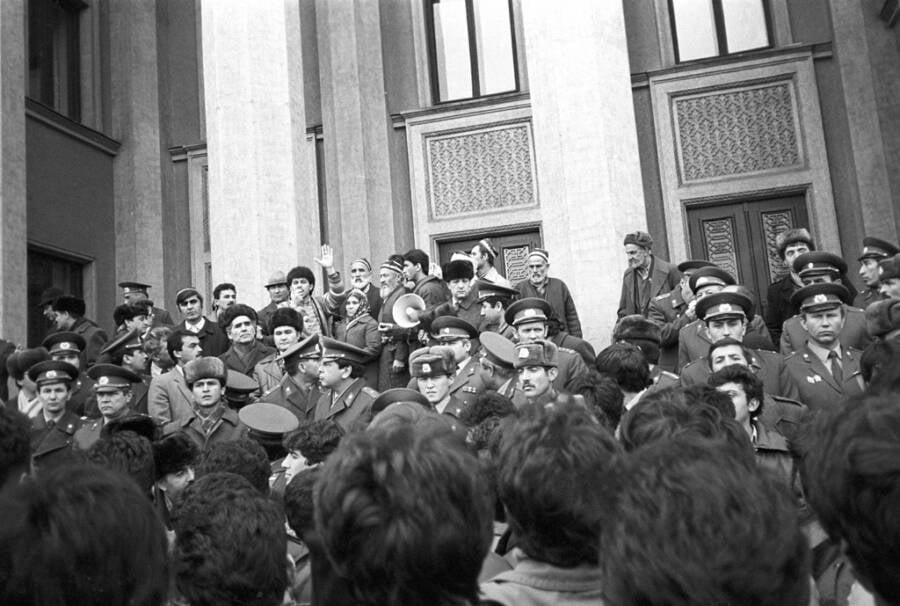
Click here to view slideshowThe fall of the Soviet Union didn't happen overnight. The U.S.S.R. and its Communist Party suffered a slow and prolonged death, undergoing an entire decade of economic collapse, political revolts, and military failures that slowly ate away at one of the most powerful empires in human history.The nation had lasted just 74 years. After the Russian Revolution of 1917, Vladimir Lenin rose to power and helped establish the Union of Soviet Socialist Republics. After Lenin's death in 1924, Joseph Stalin seized control and ruled with an iron fist, eliminating anyone who disagreed with him.As the Cold War began in the 1940s, the Soviet Union pitted itself against the United States in a global struggle for power and nuclear dominance. But by the 1980s, it was clear that something needed to change.Mikhail Gorbachev began leading the U.S.S.R. in 1985 and implemented policies that allowed more freedoms to Soviet citizens, but it was too late to save the country. The economy was falling apart, and people were growing restless. Several territories started declaring independence, and a failed coup attempt in August 1991 was the spark that was needed to bring about the total collapse of the Soviet Union.The Beginning Of The End Of The Soviet UnionRatushenko/RIA Novosti Archive/Wikimedia CommonsThe fall of the U.S.S.R. was preceded by revolts in Soviet republics like Tajikistan. February 1990.In 1985, Mikhail Gorbachev became the General Secretary of the Communist Party of the Soviet Union. And in March 1990, he was named president of the U.S.S.R. He recognized that the authoritarian rule of his predecessors was no longer serving the nation, and he introduced several policies of his own to appease the citizens who had been worn down by Communism for generations.Gorbachev implemented glasnost, or political openness, which put an end to most book bans, weakened the hold of the secret police, and allowed newspapers to criticize the government. Meanwhile, the perestroika reform program restructured the economy. Individuals were able to own businesses for the first time in decades, and workers were permitted to go on strike for higher wages. Gorbachev believed that perestroika would allow for innovation and ultimately revive the crumbling economy, but some of his measures were half-hearted. The state still owned the means of production, so a true market economy wasn't established. This made the policies slow to show any progress, and the U.S.S.R. continued to struggle financially.Food and supplies were so scarce that Soviet citizens had to spend hours lined up outside their local stores, patiently waiting for their turn to scavenge what little was left on the shelves before they were completely stripped bare. The people became restless and territories on the fringe of the empire started making moves to break free.In 1988, Estonia declared sovereignty. And in 1990, Lithuania became the first state to officially leave the U.S.S.R. It was quickly followed by Latvia and Georgia.Yuryi Abramochkin/RIA Novosti Archive/Wikimedia CommonsMikhail Gorbachev speaking at a news conference in 1986.That same year, riots broke out in Dushanbe, the capital of Soviet Tajikistan. The arrival of Armenian refugees in the area heightened the tensions caused by the ongoing reforms, and the Soviet government imposed martial law in an effort to keep things under control. The fall of the Soviet Union had been set in motion.The Coup That Collapsed An EmpireOn August 18, 1991, Communist leaders and KGB agents detained Mikhail Gorbachev at his vacation home in Crimea. They were upset about his new policies and the loss of control in Eastern European countries like Poland, East Germany, Hungary, and Romania. They wanted to reassert the Communist Party's grip on the region, and they knew they had to overthrow Gorbachev to make that happen.One of the coup leaders was Gennady Yanayev, Gorbachev's vice president. Once Gorbachev was placed under house arrest, Yanayev issued a decree naming himself acting president, claiming that Gorbachev was suffering from an illness and unable to carry out his duties.However, Gorbachev was able to send out word to Moscow that Yanayev was lying. So, when tanks rolled into the city to seize control, they were met by hordes of protesters.Ivan Simochkin/Wikimedia CommonsProtesters marching through Moscow on Aug. 19, 1991.Soviet citizens barricaded Moscow's White House, the main government building, and tried to convince troops not to follow their orders. Boris Yeltsin, the president of Russia, delivered a rousing speech from atop a tank in front of the White House."Regardless of the reasons given for [Gorbachev's] removal," Yeltsin said, "we are dealing with a rightist, reactionary, anti-constitutional coup... The peoples of Russia are becoming masters of their destiny."Yeltsin went on to denounce the putschists, or coup leaders, stating, "We are absolutely confident that our countrymen will not permit the sanctioning of the tyranny and lawlessness of the putschists, who have lost all shame and conscience. We address an appeal to servicemen to manifest lofty civic duty and not take part in the reactionary coup. Until these demands are met, we appeal for a universal unlimited strike."Within three days, it was clear that the coup had failed. The total collapse of the Soviet Union was inevitable.Inside The Official Fall Of The Soviet UnionIn the weeks following the failed coup, countries began leaving the U.S.S.R. at a rapid pace. Ukraine, Belarus, Moldova, Azerbaijan, and Kyrgyzstan had declared their independence by the end of August, and by November, just three Soviet states remained: Russia, Kazakhstan, and Uzbekistan. Yuriy Kuydin/RIA Novosti Archive/Wikimedia CommonsThe heads of 11 former Soviet republics meet to formally establish the Commonwealth of Independent States. Dec. 19, 1991.On Dec. 25, 1991, Mikhail Gorbachev resigned his presidency. In a televised speech, the leader declared to the world:"The process of renovating the country and radical changes in the world community turned out to be far more complicated than could be expected. However, what has been done ought to be given its due. This society acquired freedom, liberated itself politically and spiritually, and this is the foremost achievement which we have not yet understood completely, because we have not yet learned to use freedom."Gorbachev ended his address, "Some mistakes could surely have been avoided, many things could have been done better, but I am convinced that sooner or later our common efforts will bear fruit, our nations will live in a prosperous and democratic society. I wish the best to all of you."The fall of the Soviet Union led to the creation of the Commonwealth of Independent States, and the once mighty empire split into 15 separate countries. Just after Gorbachev's resignation speech, the Soviet hammer and sickle flag atop the Kremlin was lowered for the final time, and the Russian tricolor banner was raised in its place.After reading about the fall of the Soviet Union, check out some of the most incredible images from the Soviet-Afghan War. Then, look through these photos of Soviet youth in the 1960s.The post The Fall Of The Soviet Union In 36 Rarely-Seen Photographs appeared first on All That's Interesting.
0 Yorumlar
0 hisse senetleri
188 Views

 English
 Arabic
 French
 Spanish
 Portuguese
 Deutsch
 Dutch
Dutch
 Italiano
 Russian
 Romaian
 Portuguese (Brazil)
 Greek
Greek