


WWW.THECOLLECTOR.COM
The Rule of Saint Benedict That Shaped Medieval Europe
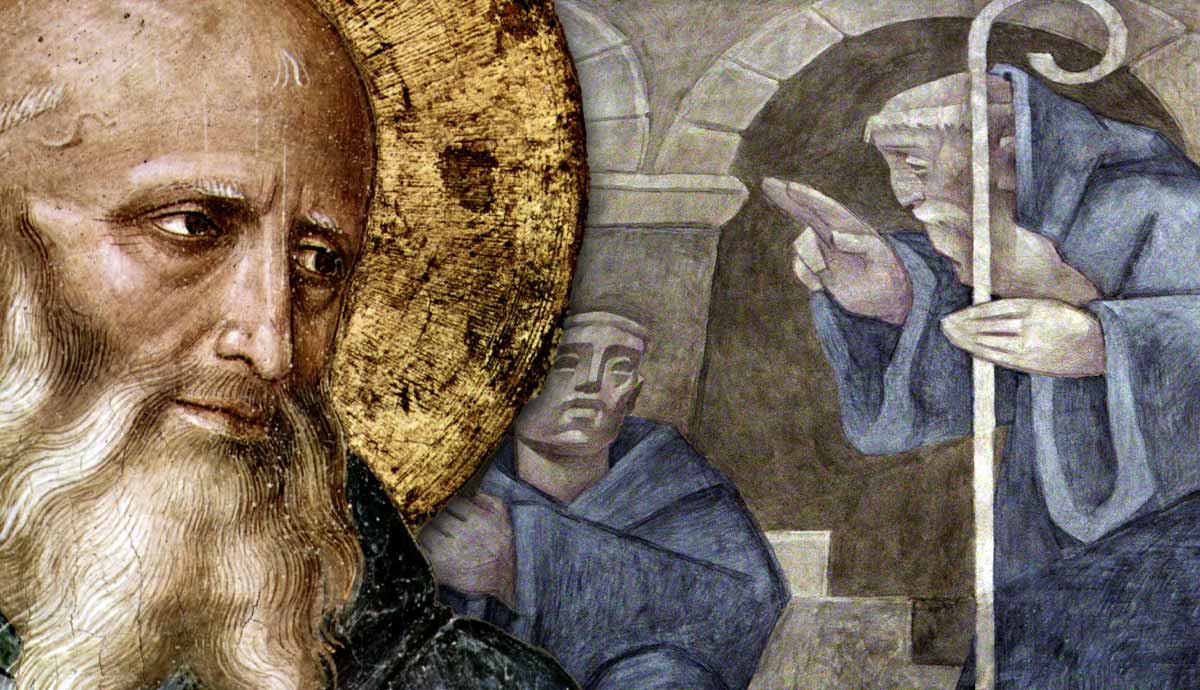
Europe in the Early Middle Ages was a place of change and uncertainty. The order that Rome provided had vanished, and many smaller states jostled for power as they capitalized on new opportunities, creating upheaval in their wake.Into this chaos was born a man who would shape the future of Europe for centuries, a man who promoted community-based ascetic virtues and built the foundation for monastic living, which survives to this day. Saint Benedict was not a military leader or a powerful king. He was a hermit and a monk. And he shaped the future of an entire continent.A World Without RomeRuins of the Roman Forum. Source: Flickr/Wikimedia CommonsThe decline and fall of Rome in the 5th century AD signaled a change in the political and social fabric of Europe. Centralized governance and authority disappeared and were replaced by many proto-feudal societies existing in close proximity. As Rome declined in the 5th century and eventually collapsed, there was a massive shift from urban life to agricultural life. This was due to many factors, such as the disruption of trade networks and the inability of cities to sustain large populations.As a result, Europe suffered a major decline in literary pursuits. Books and libraries were neglected and sometimes intentionally destroyed either by those with little regard for literacy or by those who feared the religious aspects of certain texts. Pagans destroyed Christian works and Christians destroyed pagan works, although the primary cause of the loss of literacy and literary works was the breakdown of the institutions that supported them.This dynamic needed a remedy, and a hermit from Nursia provided it.Benedict the Hermit and Holy ManIllustration of the mountains of Subiaco where Benedict lived as a hermit, from Italy from the Alps to Mount Etna by Karl Stieler et al. Source: University of Illinois Urbana-Champaign/Wikimedia CommonsAccording to the Dialogues, the account of Pope Gregory I, written around 593 AD, Benedict was born into a noble family around 480 AD and was sent to study in Rome. Dissatisfied with what the academic life offered him, Benedict left Rome and traveled eastwards, whereupon he met a monk, Romanus of Subiaco. Romanus had a profound impact on Benedict; so much so that Subiaco gave him his habit, and Benedict spent the next three years living in a cave overlooking a lake.Although he lived the life of a hermit, Romanus visited him frequently, and word of his life spread through the local communities. When the abbot of a local monastery died, the community asked Benedict to take up the position, which he reluctantly agreed to. According to the Dialogues, the monks resented Benedicts stricter rule and put poison in his glass cup. When Benedict made the sign of the cross, the glass shattered, revealing the monks treachery. Benedict calmly resigned his position and went back to his life as a hermit. Although this story is likely an invention or an exaggeration, it speaks to the image of Benedict that was cultivated.Around this time, disciples were drawn to him, and he is said to have founded several small monasteries in or near Subiaco. His fame grew, and patricians and noble families sent their sons to him to become monks under his care. Benedict, with a few disciples, then traveled south and founded the monastery of Monte Cassino, where he instituted his guide for monastic life, known as the Rule.Benedicts RuleSaint Benedict delivering his Rule to monks of his order. Source: Wikimedia CommonsThe life of Saint Benedict is largely characterized by the rules he instituted for monks under his authority. Through this dynamic, he has come to be seen as a wise and benevolent figure; strict, yet fatherly, loving, and calm. Of primary importance in his Regula Benedicti is the sense of community. This life in common, or cenobitic way, was seen as the most reliable way to God, in contrast with the life of a hermit, which Saint Benedict believed was suitable only for those who had mastered community life, although it was not a necessary culmination of the path to godliness.Benedict established a process for those living the monastic life. It began with a years probation wherein a novitiate took part in the monastic community to fully appreciate what the life entailed and whether it really was appropriate for the individual. This ensured that monks were dedicated to the way of life rather than it being a choice based on a passing phase or a whim.The Rule can be defined as having three pillars that form a core value of its practice. These were exemplified in the three vows that monks took upon dedicating themselves to the order. These core vows were those of stability, fidelity to the monastic way of life, and obedience.Detail from a fresco depicting Saint Benedict, from St. Benedicts Abbey, Atchison, Kansas. Source: Flickr/Wikimedia CommonsStability meant a lifelong commitment to the monks community and dedication to the monastery. It meant not looking elsewhere for change or for other sources of pleasure or enlightenment. It represented rootedness, endurance, and loyalty born out of faith in a single community.The dynamics of fidelity to the monastic way of life and obedience meant becoming part of the monastic community and following the laws that governed it. It was a structured life that demanded a schedule of prayer and work (known as Ora et Labora), and of communal life. This schedule was adhered to by the power of the vow.Of course, these werent the only virtues upheld by the Rule. Other aspects included moderation, humility, stewardship, learning, discipline, hospitality, and love, amongst other things. Through all of these tenets, monks were encouraged to follow similar paths, all devoted to God, and in stark contrast to the chaotic and violent world that existed outside the monastery walls. In this, the monastery offered stability and permanence in an uncertain time.Monasteries and Their Role in Rebuilding SocietyThe reconstructed monastery (or more precisely, abbey) of Monte Cassino, founded by Saint Benedict. It was destroyed in WWII and rebuilt. Source: Wikimedia CommonsThe decline and fall of Rome had a huge effect on the socio-political structure of Europe. Urban life decreased, as did central authority and the academic arts. Monasteries, such as Monte Cassino, founded by Saint Benedict, adhered to the Rule and helped preserve much of what was lost. They played a crucial role in guiding Europe through the chaos of a tumultuous era and into an era of greater stability and certainty.In an era heavily reliant on agriculture, monasteries made significant contributions to society. These institutions came to own vast tracts of land and became extremely productive farms in their own right. Monks dedicated much of their lives to their communities, and as such, monasteries were an invaluable aspect of medieval life.Monks worked the fields, pioneering new techniques in agriculture, such as crop rotation. They drained swamps, cleared forests, initiated selective breeding for healthier herds, and improved soil with better irrigation techniques. Through these practices, monks played a major part in providing food for communities and offering a source of comfort during uncertain times.Monks under the guidance of Saint Benedict established a long tradition of preserving literary works. Source: Wikimedia CommonsThe preservation of knowledge was another hallmark of monastic life. Monasteries were centers of learning, and as the Rule highlighted learning through study and literacy, monks spent large parts of their lives hunched over desks copying books and other important manuscripts. Before the invention of the printing press, this was the primary method for replicating the written word. Monastic labor proved invaluable for preserving the ancient knowledge that would have been lost otherwise.This extended not just to texts compatible with Christian doctrine, but to many of the old pagan texts as well, including ancient poetry, plays, and epics. Plato, Virgil, Aristotle, and Ovid all had their works preserved by monks for future generations.This dedication to academic pursuits extended to the education of others, and monasteries took up the mantle of schools, providing an environment of learning for noble and common children alike. Apart from training the future clergy, monasteries were schools for other pursuits as well. Grammar and arithmetic were taught, along with music and astronomy. In an era when education was a privilege rather than a necessity for the common folk, monasteries emerged as centers of academia. As academic institutions, they had a huge influence on education in the Middle Ages, resulting in the establishment of major universities such as Oxford and Bologna.Statue of Saint Benedict. Source: Wikimedia CommonsMonasteries also served as guesthouses, and during a time when there was little in the way of accommodations for visitors and pilgrims, this was an important aspect. Monks and nuns took great pride in being hospitable and providing respite to weary travelers. Hospitality also extended towards the poor, and monasteries proved to be shelters of kindness and humanity.Similar in nature, convents had the same effect, operating as centers of prayer, charity, and learning. According to the traditional stories, the female branch of the order was founded by Saint Benedicts sister, Saint Scholastica.It is unsurprising that monasteries and convents were popular with people from all walks of life. As the Christian faith spread throughout Europe, thousands of such establishments were built, and Saint Benedicts Rule found common ground all over the continent.Detail from Crucifixion with Saints depicting Saint Benedict by Fra Angelico (ca. 13951455). Source: Museum of San Marco/Wikimedia CommonsThrough his works, Saint Benedict provided a foundation for the rebuilding of Europe in a chaotic time. His Rule resulted in the preservation of knowledge, the progression of agricultural techniques, the rebuilding of social order, and a devotion to God, which left a lasting legacy on the continent. It is reasonable to assume that without this one humble man, living a hermits life in a cave above Subiaco, Europe would have turned out very differently, and would have been a lot poorer for it.
0 التعليقات
0 المشاركات
240 مشاهدة

 English
 French
 Spanish
 Portuguese
 Deutsch
 Turkish
 Dutch
Dutch
 Italiano
 Russian
 Romaian
 Portuguese (Brazil)
 Greek
Greek