


WWW.THECOLLECTOR.COM
How Railroads Turned America into a Superpower
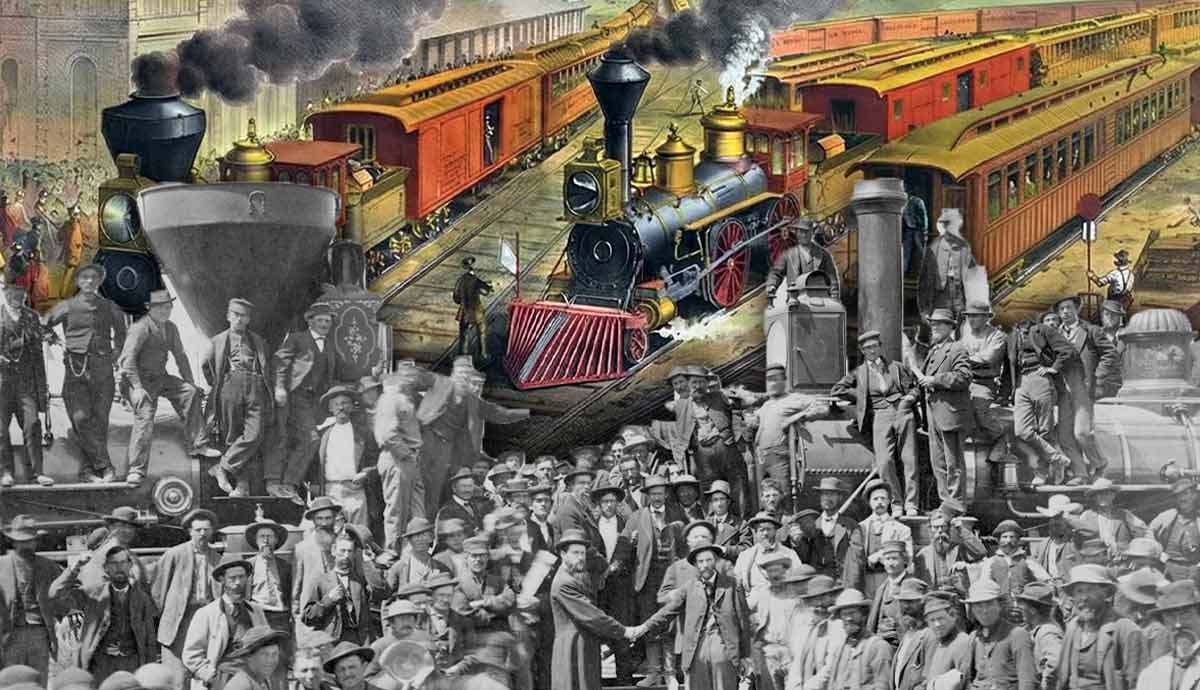
1800s American railroad express trains. Source: Library of Congress; with 1869 Meeting of Union Pacific and Central Pacific Railroads. Source: WikimediaBefore the War Between the States, railroads existed as regional entities. The more industrialized Northeast contained the bulk of the 3,000 miles of track. But construction never halted. By 1850, railroads moved into the Midwest, opening new markets. These markets were supported by about 9,000 miles of track.After 1850, railroads became the primary mode of transportation, surpassing canals. Financed by private investment, states, and local governments, construction added 2,100 miles annually. As North and South edged towards war in 1860, the U.S. now contained about 30,000 miles of railroads.The North, with its hefty industrial edge, kept laying track. This pace slowed, yet by 1865, it had built an estimated additional 35,000 to 40,000 miles. The post-Civil War era witnessed a construction frenzy that built an extensive national interlinking networkNational Unity and Economics1918 American Rail Network. Source: University of Southern FloridaWith the final rail spike driven in 1869, Americas transformation into a superpower started. The U.S. contained 45,000 miles of track in 1870. In the haze of construction, that number quadrupled to 254,000 miles by 1916. Added benefits soon appeared as steel rails crossed the nation.Railroads introduced standardized time zones, replacing more than 140 scattered time zones. Scheduling became critical as travel times decreased. In 1883, U.S. railroads established time zones (Eastern, Central, Mountain, and Pacific). The schedules were communicated to newspapers, telegraphs, and radio. With standardization now completed, businesses could coordinate on a national scale, making commerce easier. Seeing the benefits, Congress made time zones official in 1918.Further benefits soon appeared. Travel times fell dramatically. Ocean voyages and wagon journeys fell from months to seven days. Although more expensive, settlers went West by rail rather than older methods like the Oregon Trail.The Danger Signal-Train at Night. Source: St. Francis Cabrini ShrineThe railroads growth became Americas most significant economic driver. This one industry spurred steel, coal, and manufacturing sectors. By 1890, the railroads employed 750,000 workers and built up a market capitalization of $10 billion.Rail lines expanded westward, stitching America into a giant network. This created new industrial hubs while strengthening older cities. Cities considered west took on new life. Chicago became a railroad terminus between eastern and western lines. Chicago also became Americas second biggest city by 1900, earning the nickname Hog Butcher of the World. Cleveland lay on Lake Eries shores and possessed strong rail connections. Oil refining in Cleveland became a central industry. Further west, cities like St. Louis formed into meeting points. Thousands of German and Irish emigrants flocked here for employment, including in train manufacturing. From this substantial employment byproduct was the creation of millions of jobs. This included construction, operations, and steelworkers, among others.The Unknown Part of a SuperpowerThe New York Stock Exchange Call Room, 1800s. Source: New York Mercantile Exchange MuseumA lesser-known fact is how railroads made the United States into a financial superpower. Railroads are a costly endeavor, requiring substantial capital. As demand and rail construction grew exponentially, railroad investors developed new financial tools. These tools would push Wall Street from a quiet merchant exchange into a true international exchange.The railroads land acquisition, operations, and construction required the use of the new financial tools. Banks like JP Morgan created corporate bonds and stock offers, blueprints for later markets. These innovations meant that railroad securities represented the bulk of public investment on the New York Stock Exchange (NYSE) from the 1860s to the 1880s.Europeans also invested in American railroads, tying American finance to international markets. This additional foreign capital proved a boon, enabling the construction of massive foundation. Modern corporations arose from all this, helping Americas future rise.Besides financial innovations, railroads set up faster communication. They integrated telegraphs along their routes. Telegraphs meant instant communication for trading, train dispatch, and scheduling. Such speed meant quick updates and integrated regional markets.Mobilization and PoliticsWashington DC Railyard 1917. Source: American RailsRailroads continually demonstrated their utility during conflicts. Troops, weapons, and supplies could be transported across the country swiftly. Events like the 1898 Spanish-American War demonstrated that the U.S. government could mobilize quickly. In the Great War, railroads connected ports, enabling unprecedented amounts of supplies for faster transportation to Europe.Finally, railroads established federal control in the American West. Government authority moved in with the rails too, reducing the Old Wests notorious violence, integrating markets, and incorporating new states.Theres no doubt the railroads made America into a superpower. Their pioneering impact on the economy, technology, and politics created a solid base. America grew into a super power afer 1900. The Great War and Second World War confirmed this status.
0 Commentarii
0 Distribuiri
45 Views

 English
 Arabic
 French
 Spanish
 Portuguese
 Deutsch
 Turkish
 Dutch
Dutch
 Italiano
 Russian
 Portuguese (Brazil)
 Greek
Greek