


ALLTHATSINTERESTING.COM
The Perplexing History Of The Eleusinian Mysteries, The Ancient Greek Rites That Remain Unknown To This Day
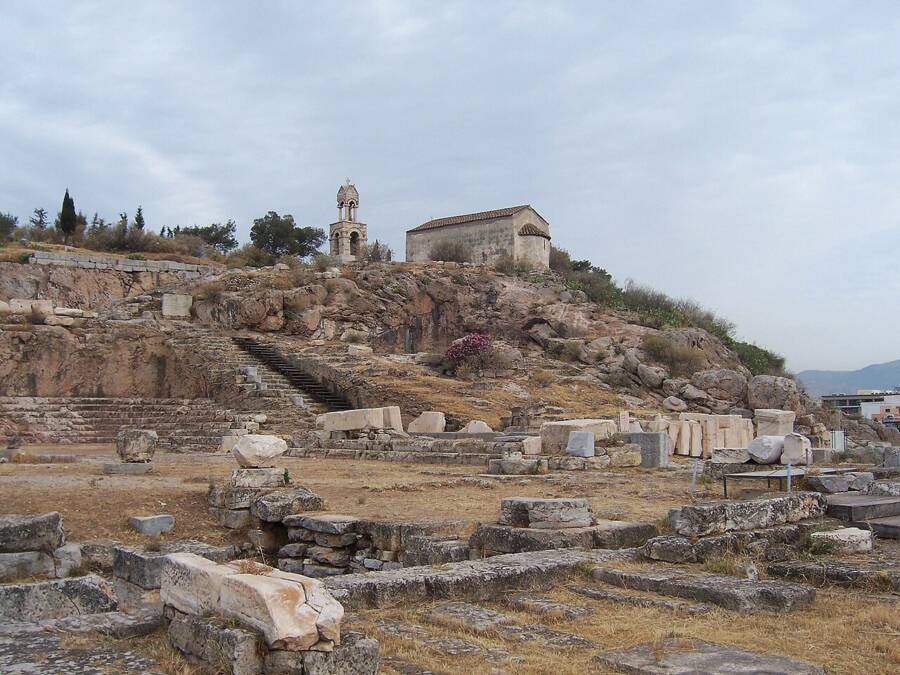
Carole Raddato/Wikimedia CommonsThe ancient city of Eleusis, where the Eleusinian Mysteries took place for over a thousand years.Ancient Greece was a land of gods, myths, altars, and temples that inspire books, films, and modern culture to this day. But its most intriguing ritual is the one we know the least about: the Eleusinian Mysteries, a shadowy ceremony that was held every year.This nine-day ritual, which began in Athens and ended in the ancient city of Eleusis, drew thousands of worshippers each autumn. Its participants fasted, offered sacrifices, walked in a 14-mile procession, and drank a mysterious brew known as kykeon, which may have had hallucinogenic effects.But the actual heart of the ritual, the final climax that took place in the sanctuary of the Telesterion, was such a secret that anyone who revealed what happened inside could be put to death. As such, researchers have long speculated about the full story of the Eleusinian Mysteries but many of its truths have been lost to the ages.This is everything we know about the Eleusinian Mysteries, from how they began to who participated to what may have happened during the secret ceremony.How Demeter And Persephone Inspired The Eleusinian MysteriesThe story of the Eleusinian Mysteries begins with Demeter, the Greek goddess of agriculture and the harvest. In myth, she was a nurturing deity who oversaw the fertility of crops and, thus, the survival of humanity. At first, under her care, Earth enjoyed perpetual seasons of spring and summer. But this changed when Demeters daughter, Persephone, was kidnapped by Hades, the Greek god of the Underworld. Distraught, Demeter wandered for nine days as crops withered and died and people began to go hungry. She ended her journey in Eleusis, near the mouth of the Underworld, and was able to convince Zeus to force Hades to return Persephone. Public DomainA 17th-century painting showing the abduction of Persephone by Hades.Before he did, however, Hades tricked Persephone into eating pomegranate seeds. This meant that she would only be allowed to spend part of the year with her mother before returning to the Underworld for several months. Each year, while Persephone was with Hades, Demeter would grieve and neglect her duties, leading to the barrenness of winter. When Persephone returned, so did Demeters joy, thus spawning the fertile seasons of spring and summer.It was this myth of life and death, loss and return, and the cycle of creation and rebirth that ultimately inspired the ritual known as the Eleusinian Mysteries.The Nine-Day Ritual Of Fasting, Sacrifice, And PsychedelicsThere is much that remains unknown about the Eleusinian Mysteries. But we do know when the ritual took place, how it progressed, and who was involved.Each spring, the Lesser Mysteries were held at a stream outside of Athens. These purification rites were followed by the main ceremony in the month of Boedromion, which fell sometime in September or October. Anyone could take part men, women, children, and even slaves but there were two barriers to entry: Participants had to understand Greek, and they could not be guilty of murder. Given the openness of the ceremony, the Eleusinian Mysteries drew thousands of people every year. Famous Greeks like Socrates and Plato are believed to have participated, as well as powerful Romans like the emperors Augustus and Hadrian.The initiates started their journey in Athens, where they spent five days making sacrifices, taking ritual baths, and fasting. On the fifth day, they began their 14-mile journey from Athens to Eleusis, which took them along an important road known as the Sacred Way, the same route that Demeter had purportedly walked while searching for Persephone. The worshippers were led by priestesses, who carried chests full of mysterious sacred objects. Carole Raddato/Wikimedia CommonsThe ruins of the Telesterion, the sprawling sanctuary where the climax of the Eleusinian Mysteries took place. Once they arrived in Eleusis, the participants would have passed by the Plutoneion, a cavern thought to be the entrance to the Underworld from which Persephone emerged each spring. Then, they drank a beverage known as kykeon. The drink was made of barley and mint, but it may have also contained ergot, a fungus known to have hallucinogenic properties. Indeed, traces of ergot have been found in ceremonial vases, and a recent study found that ancient people would have known how to remove the toxicity from the fungus to make it safe to drink.From there, the Eleusinian Mysteries participants would have filed into the Telesterion, a massive sanctuary that could have easily held thousands of people. At the center of the hall was a smaller building known as the Anaktoron, which was built over an ancient site. Only the Eleusinian high priests, or hierophants, were allowed to enter. But from this point, the historical record goes silent. No one was allowed to reveal what happened at the Telesterion. If they did, they would be executed. Just three words offer a clue about what happened during the Eleusinian Mysteries: dromena, deiknumena, legomena, or Things done, things shown, things said. Its unknown what was done, shown, or said in the Telesterion, but its been suggested that it could have been something truly horrific, such as rape or murder, a nod to the story of Persephone and Hades. Whatever happened, participants purportedly left the Eleusinian Mysteries with a new fearlessness in the face of death. The End Of The Eleusinian MysteriesThough the Eleusinian Mysteries were practiced for more than a thousand years, beginning as early as 1500 B.C.E., they came to an end in the fourth century C.E. With the rise of Christianity came a new disdain for pagan rituals, and Roman emperor Theodosius I closed the sanctuary at Eleusis in 392. A few years later, Christians led by Alaric, King of the Goths, looted and destroyed what was left of the Mysteries at Eleusis. Public DomainA votive plaque from the fourth century B.C.E. showing elements from the Eleusinian Mysteries.Today, Eleusis is in ruins. But traces remain of the secret rituals that once took place there. Broken columns stand in at the site of the Telesterion, and visitors can still pass by the Plutoneion. The Eleusinian Mysteries themselves ended long ago, but if they taught their participants anything, it was that death is just another stage of life not something to be feared, but part of a larger and greater cycle. As Cicero wrote in De Legibus in the first century C.E., For among the many excellent and indeed divine institutions which your Athens has brought forth and contributed to human life, none, in my opinion, is better than those mysteries [I]n very truth we have learned from them the beginnings of life, and have gained the power not only to live happily, but also to die with a better hope.After reading about the murky history of the Eleusinian Mysteries, go inside these harrowing stories of death gods from around the world. Or, learn about Ganymede, the handsome Greek youth who was abducted by Zeus to be the cupbearer to the gods and perhaps Zeus lover. The post The Perplexing History Of The Eleusinian Mysteries, The Ancient Greek Rites That Remain Unknown To This Day appeared first on All That's Interesting.
0 Комментарии
0 Поделились
29 Просмотры

 English
 Arabic
 French
 Spanish
 Portuguese
 Deutsch
 Turkish
 Dutch
Dutch
 Italiano
 Romaian
 Portuguese (Brazil)
 Greek
Greek