


WWW.THECOLLECTOR.COM
Spains Failed Quest to Rule the World Ends in Asia
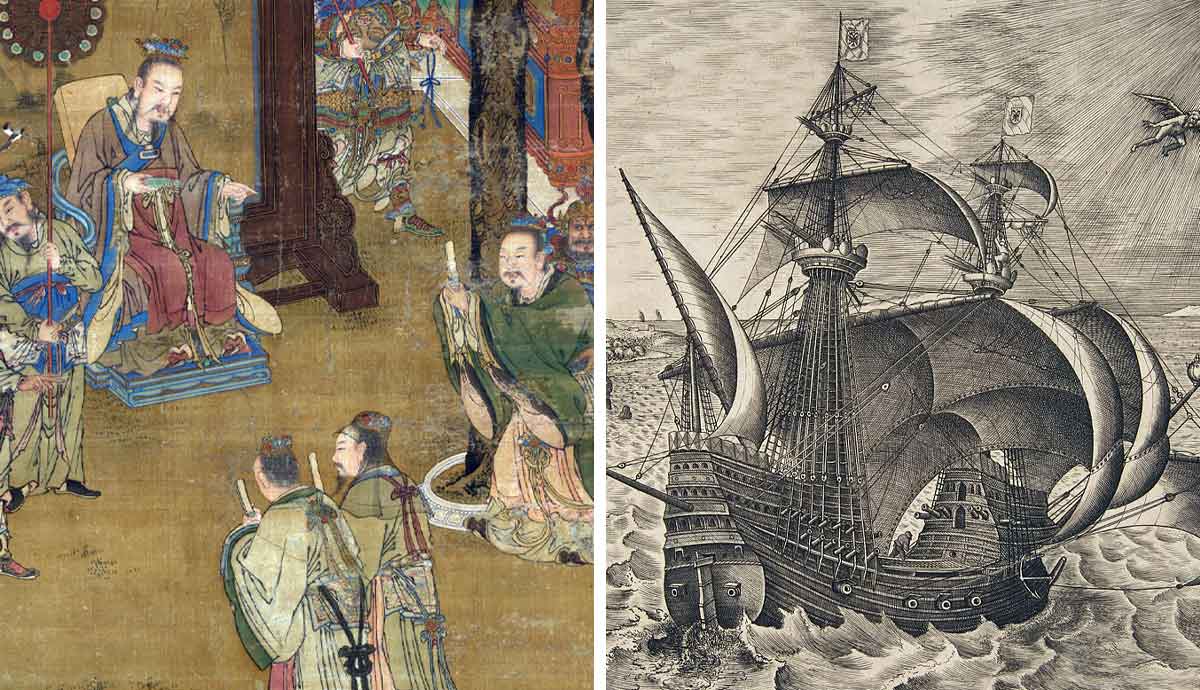
By the late 16th Century, the Spanish Empire stretched from the Mediterranean to the Canaries, across the Atlantic to the Americas, past the Pacific all the way to the Philippines. Ever searching for new lands to conquer, the governor of Manila laid out plans to invade Ming China using Spanish Troops, Japanese Mercenaries, and Filipinos. King Philip II considered his designs.Non Sufficit Orbis: The World is Not EnoughMedal of Philip II with the inscription Philip II of Spain and King of the New World The World is Not Enough, 1583. Source: Royal Collection TrustWhen Christopher Columbus sailed to the Caribbean and began the brutal process of its colonization, he had gone west searching for Asia and new routes to the spice trade. Ferdinand Magellans expedition uncovered those routes just 30 years later, and infamous conquistador Hernan Cortes, high off his conquests in the Americas, suggested an invasion of China as early as 1526.The Spanish established their first outpost in the Philippines in 1565 using Tlaxcalan soldiers from Mexico, and settled in Manila because of its proximity to trade routes in the South China Sea. The Portuguese had expanded their own colonial empire from Brazil to Africa and across the Indian Ocean to Indonesia, with trading posts in Macau and Nagasaki in the far east. At the turn of the 16th century, the Papacy had granted halves of the globe to Spain and Portugal to christianize in the Treaties of Tordesillas and Zaragoza, and by 1580 both kingdoms were united under King Philip II of Spain.As Philip II consolidated his global empire, he adopted the motto: non sufficit orbis, Latin for The world is not enough. With a chain of colonies stretching across six continents, the newly christened Iberian Union turned its gaze to a scheme beyond their initial goal of free access to Asian markets. Plans for an invasion of China were laid out as conversion campaigns advanced in Japan and the colonization of the Philippines accelerated.The Iberian mode of warfare was well established by this point, and their use of pike and shot was feared and copied throughout Europe as the tercios dominated on the battlefield. On campaign abroad, small bands of conquistadors exploited local rivalries and used their advanced military tactics and equipment alongside forces provided by allies on the ground. This had proven effective in projecting power abroad against larger peoples, and the plan for Asia was more of the same.Nanban, the Southern BarbariansArrival of the Europeans, Edo period. Source: Metropolitan Museum of Art, New YorkIberian power in East Asia was marginal at best in this period, but their ambitions were unlimited. Spanish Manila struggled to project power across the Philippines, facing resistance and subversion from various indigenous groups across the islands.Portuguese expeditions had tried to take Chinese land for trading ports by force, but after a string of naval defeats by Ming Chinas forces, were able to rent Macau in 1554 in exchange for silver. The Portuguese had been moderately successful in preparing an invasion of Japan by christianizing locals from their trading post in Nagasaki. Japan often referred to Europeans as nanban, or southern barbarians.However, some local lords converted to Catholicism, giving Philip II ambitions to expand into Japan and China. He aimed to continue their program of pitting kingdoms against each other by assembling Japanese converts into a combined army of Spanish, Portuguese, and Filipino soldiers. Daimyo Konishi Yukunaga even promised to provide 6,000 men in support of an invasion of China.Despite being at the very edges of the Iberian empires, hopes for the domination of East Asia moved beyond controlling the spice trade into the conquest of Japan and China and converting their entire world to Catholicism, putting pressure on the Ottomans and the Muslim world from both East and West.Yet China, which calls itself zhongguo or middle kingdom, had a massive population of roughly 145-160 million people at the time. With over a quarter of the worlds population, an advanced civilization with thousands of years of traditions, the power of Ming China was formidable, even to a Spanish Empire ravenous for new lands. Early plans for the conquest called for 4,000 troops, with later designs demanding 12,000 Spanish and Portuguese soldiers, with 6,000 Japanese mercenaries and 6,000 Filipinos.The Weight of the Dragon ThroneRemonstrating with the Emperor. Painting by court artist Liu Jun, late 15th century. Source: Metropolitan Museum of Art, New YorkMatters came to a head in 1586, when every official in Manila approved an invasion proposal, which stated that China was Superior to us in everything except salvation of the faith (Kamen, p. 225), though in the previous decade an official believed it could be taken with as few as 60 men. China had advanced military technology, and while the Ming Dynasty was declining it still had three to five million soldiers on its books, including 800,000 combat-ready soldiers.The Iberians would have also not had the same military advantages it exploited to win highly contested wars in the New World. Advanced metallurgy in China meant that Ming armies had steel armaments, cavalry, firearms, and most importantly, cannon. At the very limits of their supply lines, Philip IIs army had to rely on firearms imported from Japan. Even if an invasion made inroads, keeping an army fed, reinforced, and supplied would have been extremely difficult. All this would have been done in the face of a numerically superior peer, or at very best, near-peer enemy.In its earlier clashes with the Portuguese, China had shown its ability to defeat European powers at sea. This happened even though Philip IIs strength was his naval power, and China had scuttled most of its fleets a century earlier as part of an inward-looking policy after Zheng Hes expeditions under the Yongle Emperor.An invasion would have put conquistadors and their foreign levies up against Chinas enormous army. Though the conquistadors had achieved asymmetrical victories in the New World, they were limited in their ability to challenge rival powers in Europe.The Armada Crumbles in the WestThe Destruction of the Armada, Phillip James de Loutherbourg, c. 1800. Source: The British MuseumAs the Spanish and Portuguese had raced to colonize the world, wars continued to rage back home in Europe. The continent was engulfed in the Eighty Years War and the Ottoman-Habsburg Wars, pitting Philip IIs forces against England, France, the Netherlands, and the Ottoman Empire, all while attempting to pacify regions under their domain across the Americas, Africa, and Asia.In a push to oust the Protestant Queen Elizabeth I, the Great Armada was formed in 1588 to invade the British Isles and end English support for the Dutch in their efforts to seek independence from Spain. In the same year, Philip II commissioned an official council to plan for the invasion of China. The year 1588 represented the height of Iberian ambitions to conquer the world.Although the Armada was a formidable force of 137 ships and 55,000 men, the fleet was outmaneuvered by more nimble English ships and thrown into chaos by fire ships at the Battle of Gravelines off the French coast. The remnants of the Armada suffered further losses from stormy weather off the coasts of Scotland and Ireland as they limped back home to Spain.This defeat was a major setback in Philips plans for world conquest and sent shockwaves across his empire. It also coincided with several major crises in Asia. In 1587 Japans great unifier Toyotomi Hideyoshi banished all Catholic missions from the country and occupied Nagasaki. In the Philippines, Tagalog nobles launched a massive uprising, seeking aid from Japanese pirates and the Ottoman-backed Sultanate of Brunei to oust the Spanish. Dubbed the Tando Conspiracy, it was uncovered and thwarted, but Spanish control was not as absolute as they believed. With their presumed Japanese and Filipino support evaporating, and massive losses in Europe, the quest for China was abandoned.Dust Settles in the EastView of Earth from Space, Zelch Csaba. 2025. Source: PexelsLater Spanish expeditions to Cambodia and against the Siamese Kingdom of Ayutthaya did not bring further conquests. Yet as Iberian ambitions to rule Asia dwindled, Toyotomi Hideyoshi advanced the plans of his predecessor Oda Nobunaga to expand Japanese rule across the region.After the expulsion of Catholic missionaries, he sent threatening envoys to the Spanish in Manila and tried to assemble forces to sail south. At the same time, he envisioned One Asia under Japan and went to war with the Ming Dynasty by invading their vassal Joseon Dynasty in Korea. The resulting Imjin War led to Toyotomis defeat, and his plans for the Philippines never materialized, stifling Japanese expansionism for more than two centuries. Toyotomi was succeeded by the Tokugawa shogunate who, after the Christian-led Shimabura Rebellions, began its period of closure to the world, known as sakoku.Despite its considerable weight, the Ming Dynasty was fortunate that the Iberians had not attempted to exploit local rivalries. Over the following decades, the Ming emperors faced encroachment from the Manchus in the northeast as well as internal rebellion, and by 1644 Beijing had fallen to peasant rebels. The Manchu bannermen of the Qing Dynasty soon breached the Great Wall and gained the mandate of heaven. The Qing emperors held off western incursions for 200 years until the Opium Wars and their infamous Century of Humiliation.Armed Three-master with Daedalus and Icarus in the Sky from The Sailing Vessel, Frans Huys, c. 1561-1565. Source: Metropolitan Museum of Art, New YorkSpanish and Portuguese influence in the region waned as Dutch and English traders entered the stage, with the Dutch being the only Europeans to meaningfully access Japanese markets until Commodore Matthew Perry forced open the ports in 1854. The Dutch invasions hit Macau but were repelled in 1622. They moved on Indonesia, Malaysia, and Taiwan, and severely reduced Spain and Portugals power in the region especially after Portugal rebelled against Spanish rule, dissolving the Iberian Union in 1640. The Thirty Years War and parallel Eighty Years War came to a close in 1648, having devastated central Europe and weakened Spains position as the dominant imperial power of the time.By the 1700s, Spain and Portugal were struggling to retain their colonial empires and had largely become second-rate powers on the global stage. The Philippines remained one of Spains last colonial holdings until it was taken by the USA in 1898.The threats to invade England and China place 1588 as the high watermark of Iberian colonization. Though Philip II and his successors remained in a position of influence, their vision of undisputed rule over the globe was broken. The world had proven too much for the man it was not enough for.Further ReadingKamen, H. (2003). Empire: How Spain Became a World Power, 1492-1763. Great Britain: Penguin Books.
0 Comentários
0 Compartilhamentos
42 Visualizações

 English
 Arabic
 French
 Spanish
 Portuguese
 Deutsch
 Turkish
 Dutch
Dutch
 Italiano
 Russian
 Romaian
 Greek
Greek