


WWW.THECOLLECTOR.COM
The Fearless Gallowglasses Who Ruled Irish Battlefields for 400 Years
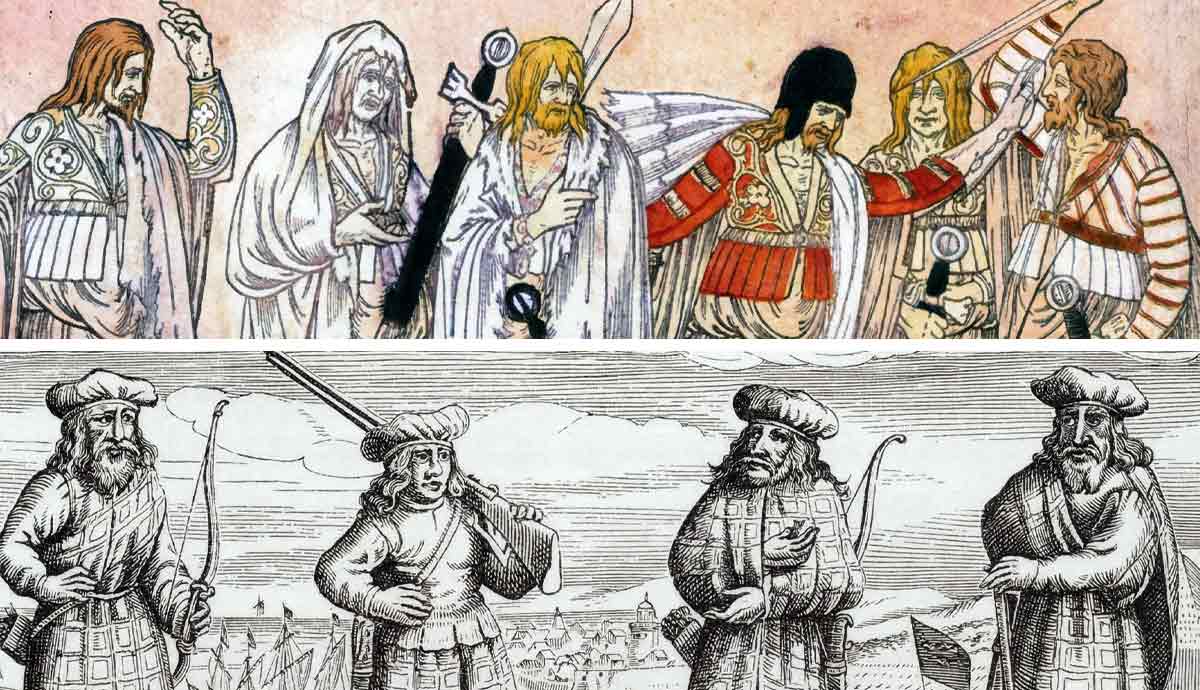
The gallowglass were elite Norse-Gaelic mercenary warriors who served in Ireland from the 13th to the early 17th century. Descended from Norse settlers in the Western Isles and Argyll, they became Irelands most reliable heavy infantry, fighting for Gaelic and Anglo-Irish lords alike. Armed with massive axes and clad in chainmail, they acted as shock troops, bodyguards, and household soldiers during centuries of conflict. Their role declined with the rise of gunpowder warfare, but their names, clans, and reputation left an enduring mark on Irish history and cultural memory.Origins and Rise of the GallowglassLeiv Eirikson discovering America by Christian Krohg, 1893. Source: National Museum of Art, Architecture and Design, OsloThe original gallowglass came from the western coast of Scotland, particularly the Western Isles and Argyll. These areas had seen heavy Norse settlement from the 10th century onwards. Intermarriage between the Norse settlers and the local Gaels had resulted in a distinct difference from the native Irish though they had adopted the Irish language and shared many customs. The term gallowglass comes from the Irish gallglach. Gall means foreign and glach has several meanings from hero to volunteer. Literally translated it means foreign warrior, a reflection of their origins.These Gall Gaeil (foreign Gaels) were steeped in Norse heritage and even their homelands in the Western Isles were known to the Irish as the Innse Gall or Isles of the Foreigners. Life in the Hebrides and Argyll was often harsh, dominated by subsistence farming and clan warfare. Service as a mercenary appealed to ambitious young men seeking wealth and prestige. Irish kings began hiring these foreign Gaels as soldiers from the 12th century onwards.As foreigners they were popular as bodyguards and enforcers since they had no stake in local rivalries and were loyal only to their paymasters. Every Irish lord of note kept a retinue with some clans entering into generational service with Irish lordships. In time many gallowglass settled in Ireland and recruited from the Irish but they were still referred to as Scots by the rest of the population. Despite contemporary chroniclers decrying their love of money, they showed unrestrained courage on the battlefield and fought loyally for their employers.Appearance and TypesIrish Gallowglass and Kern by Albrecht Durer, 1521. Source: Wikimedia CommonsGallowglasses were physically imposing warriors, noted in contemporary accounts for their exceptional height and strength. Much like the grenadiers of later centuries, they formed an elite heavy infantry whose presence alone could intimidate opponents. Their armor distinguished them immediately from the typically lightly equipped Irish kern. A gallowglass usually wore a long chainmail hauberk, an iron helmet, and sometimes gauntlets, equipment that changed little from the 13th to the 16th century. To many English observers, their appearance evoked memories of Viking raiders, with some chroniclers remarking that they looked like figures from an earlier age.Their weaponry reinforced this impression. The signature gallowglass weapon was the large two-handed axe, capable of cleaving shields and causing catastrophic injuries. Its sheer size had a powerful psychological effect in close combat. Spears were also used, and by the 15th and 16th centuries, some warriors adopted the two-handed claymore, though this weapon became more strongly associated with other Scottish mercenary groups. Many gallowglasses carried short swords or dirks as secondary weapons, while their personal attendants, sometimes referred to as knaves by the English, were equipped with javelins, bows, and spears.Two broad categories of gallowglass existed. Some entered hereditary service with a single Irish lordship, forming a permanent household guard whose families often became integrated into local society over generations. Only powerful Gaelic dynasties could afford such retainers. The majority, however, were freelance warriors hired seasonally, typically for three months at a time. They moved from lordship to lordship seeking employment in local wars and raids, often fighting against rival gallowglass companies. For many freelancers, the ultimate ambition was to earn a place in a permanent retinue.Organization, Hiring, and Household ServiceAnonymous woodcut of Irish warriors, 1575. Source: Ashmolean Museum, OxfordGallowglass were organized in corrughadh or battles (battalion). These usually consisted of 80 spars or more. Each spar was made up of one gallowglass and their attendants. Typically a gallowglass would have two boys in service, much like a knight had squires. In exchange they would be trained in the ways of war. In battle they would fight as skirmishers in support of their lord. A constable would lead each battle and in cases where a lord was fortunate enough to have several in his service, they would appoint a marshal over all their troops.Payment for gallowglasses was traditionally made in kind rather than in coin. Contemporary records from the 16th century note that a gallowglasss quarterly wage consisted of one cow as pay and two more for his sustenance. This system imposed a heavy burden on local populations, as lords were obliged not only to feed and provision the soldiers but also to billet them in the homes of tenants. The requirement to house these armed retainers, who were not always disciplined off the battlefield, was a frequent cause of resentment in the countryside.Gallowglasses could also enter service through political alliances. It was not uncommon for companies to be included in marriage dowries. One notable example occurred in 1569 when Turlough Luineach ONeill, lord of Tr Eoghain (Tyrone), married the widowed Agnes Campbell, daughter of the Earl of Argyll. Her dowry is recorded as including at least 1,200 gallowglasses, demonstrating the considerable military power such alliances could bring to Irish chiefs.The Gallowglasses in Irish Warfare (13th16th Centuries)The Image of Irelande by John Derrick, 1581. Source: Wikimedia CommonsIreland in the medieval and early modern periods was a landscape of continual conflict. Gaelic lords fought one another for dominance, battled the Anglo-Norman earls, and resisted the expanding authority of the English Crown. This climate of near-constant warfare created steady demand for professional soldiers, and the gallowglass thrived within it. Their initial value lay in countering Norman men-at-arms, whose armor, longbows, and cavalry tactics disrupted traditional Irish warfare. By the sixteenth century, during the Tudor reconquest, gallowglasses had become the only reliable heavy infantry available to Gaelic lords.Within the Gaelic military system, gallowglasses occupied a distinctive middle tier between the mounted nobles and the lightly equipped kern. Irish cavalry, though noble and prestigious, fought without stirrups and were unsuited to the shock tactics of English cavalry. Kern, meanwhile, formed the bulk of Irish armies as mobile skirmishers, excellent at ambush, raiding, and harassment but not built to endure prolonged close combat. The gallowglass provided what both groups lacked: disciplined, armored infantry capable of meeting Norman or Tudor troops face-to-face.Most Irish warfare consisted of raids, ambushes, and punitive expeditions. During cattle raids, kern swept ahead in loose formations while gallowglasses served as the solid reserve, ready to confront any rescuing force. In set-piece battles, they formed the main body of the Gaelic host, advancing in dense formations that relied on shock, weight, and ferocity. Their reputation for steadfastness was legendary: numerous contemporary accounts describe gallowglasses who fought to the last, refusing to flee even when their employer and his household cavalry had already abandoned the field.Decline During the Tudor ConquestIrish and Scottish soldiers in the Thirty Years War, 1631. Source: Wikimedia CommonsThe 16th century saw the end of the Gaelic order in Ireland and with it, the gallowglass. As warfare intensified, Irish lords hired increasing numbers of mercenaries, from seasonal Scottish redshanks to professional bonnachts, who mirrored the gallowglass system of billeting. Yet by the 1500s the traditional equipment and tactics of the gallowglass were becoming obsolete. The growing use of firearms and disciplined pike formations in Irish warfare exposed their limitations. Their shock charges, once devastating, struggled to break the deep English pike squares employed by Tudor commanders. Individually a gallowglass remained a formidable fighter, but in close-order combat the cohesion and drill of English infantry usually proved superior. Adaptation became essential.From the mid 1500s on, the gallowglass frequently came off the worst in pitched battles. Hugh ONeill and other Gaelic lords used Irish continental veterans and Spanish soldiers as instructors to modernize their gallowglass and kern infantry. Generally the kern became musketeers while the gallowglass became pikemen. Some continued to use their distinctive weaponry similar to the doppelsoldners amongst the Landsknechts. Continental fashions had slowly started to influence their helmets and armor.The catastrophic defeat at the Battle of Kinsale in 1601 was effectively the last major engagement in which gallowglasses fought in their traditional role. The subsequent collapse of Gaelic lordship removed the economic systems that sustained them. Some families survived as landowners under English rule; others turned to banditry or sought service abroad. Irish mercenaries with distinctive equipment appear in scattered accounts of the Thirty Years War, but as a distinct military caste the gallowglass had vanished by the early seventeenth century.Legacy and Cultural MemoryGallowglass stone carvings at Roscommon Friary. Source: Heritage IrelandOver the centuries, the gallowglass became woven into the fabric of Irish society. Those who served permanently under a single lordship often evolved into hereditary military families, gaining land and authority in their own right. Clans such as the MacDonnells, MacSweeneys, and MacSheehys trace their roots to these warrior lineages, and their names remain common today in regions where gallowglass septs once held power. Their descendants became part of the social landscape long after their battlefield role vanished.Though they were praised for their courage and skill, there is always a sense of dread in the writings about the gallowglass. They gave no quarter and in victory would run amok. Their brutality was typical for warfare of the time but they seem to be equally reviled by Irish and English writers. Such was their reputation that crown administrators were quick to deport any masterless swordsman during the Plantations for fear of renewed rebellion.Their striking appearance and martial identity also entered wider cultural memory. Shakespeare alluded to gallowglasses in Macbeth, grouping them with other exotic fighters of the Gaelic world. Edmund Spenser, drawing on English fears of Irish wildness, used the image of a gallowglass to describe a monstrous giant in The Faerie Queene. Chroniclers noted the shock of English courtiers when Shane ONeill appeared in London accompanied by his mailed gallowglass bodyguards, whose imposing stature and foreignness unsettled the Elizabethan court. To English settlers in Dublin, they embodied the dangers of a world beyond their experience. To the Gaelic Irish, by contrast, the gallowglass stood for continuity and strength, a mark of the Gaelic order that had endured in Ireland and the Scottish Highlands.
0 Comments
0 Shares
28 Views

 Arabic
 French
 Spanish
 Portuguese
 Deutsch
 Turkish
 Dutch
Dutch
 Italiano
 Russian
 Romaian
 Portuguese (Brazil)
 Greek
Greek